

Theor Chem Acc (2015) 134:115
1 3
The quality of the approximation deteriorates when signifi cant strains are present in the structure (like those in
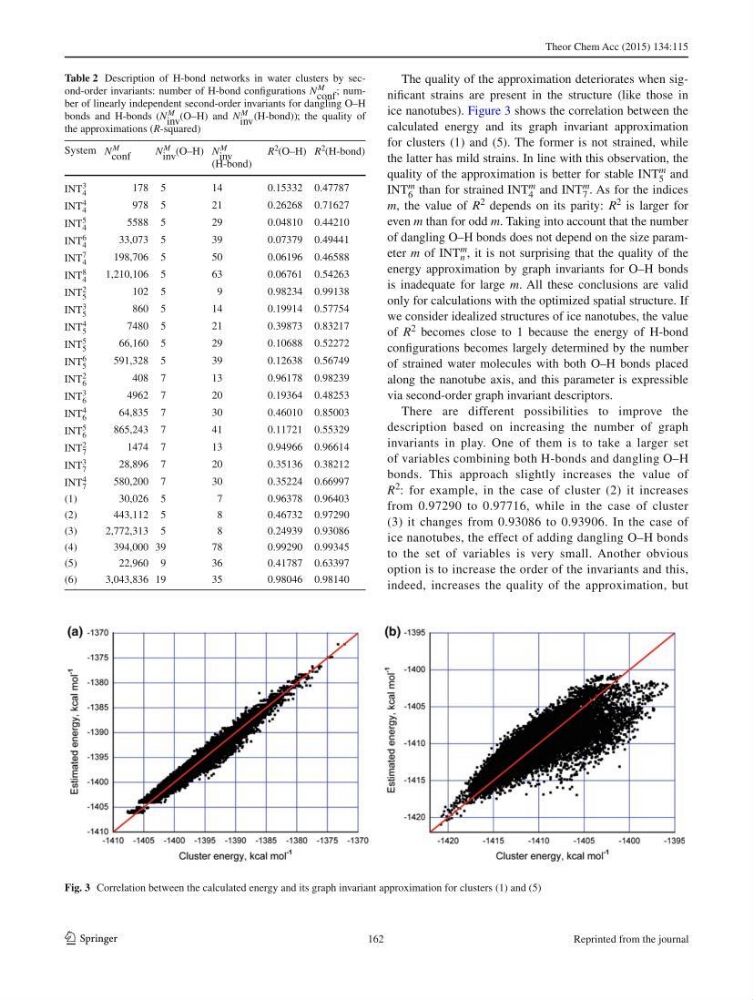
ice nanotubes). Figure 3 shows the correlation between the
calculated energy and its graph invariant approximation
for clusters (1) and (5). The former is not strained, while
the latter has mild strains. In line with this observation, the
quality of the approximation is better for stable INT m
5 and
INT m
6 than for strained INT m
4 and INT m
7 . As for the indices
m , the value of R 2 depends on its parity: R 2 is larger for
even m than for odd m . Taking into account that the number
of dangling O–H bonds does not depend on the size parameter m of INT m
n , it is not surprising that the quality of the
energy approximation by graph invariants for O–H bonds
is inadequate for large m . All these conclusions are valid
only for calculations with the optimized spatial structure. If
we consider idealized structures of ice nanotubes, the value
of R 2 becomes close to 1 because the energy of H-bond
confi gurations becomes largely determined by the number
of strained water molecules with both O–H bonds placed
along the nanotube axis, and this parameter is expressible
via second-order graph invariant descriptors.
There are different possibilities to improve the
description based on increasing the number of graph
invariants in play. One of them is to take a larger set
of variables combining both H-bonds and dangling O–H
bonds. This approach slightly increases the value of
R 2 : for example, in the case of cluster (2) it increases
from 0.97290 to 0.97716, while in the case of cluster
(3) it changes from 0.93086 to 0.93906. In the case of
ice nanotubes, the effect of adding dangling O–H bonds
to the set of variables is very small. Another obvious
option is to increase the order of the invariants and this,
indeed, increases the quality of the approximation, but
Table 2 Description of H-bond networks in water clusters by second-order invariants: number of H-bond confi gurations N M
conf ; number of linearly independent second-order invariants for dangling O–H
bonds and H-bonds (N M
inv (O–H) and N M
inv (H-bond)) ; the quality of
the approximations ( R -squared)
System N M
conf
N M
inv (O–H) N M
inv
(H-bond)
R 2 (O–H) R 2 (H-bond)
INT 3
4
178 5
14
0.15332 0.47787
INT 4
4
978 5
21
0.26268 0.71627
INT 5
4
5588 5
29
0.04810 0.44210
INT 6
4
33,073 5
39
0.07379 0.49441
INT 7
4
198,706 5
50
0.06196 0.46588
INT 8
4
1,210,106 5
63
0.06761 0.54263
INT 2
5
102 5
9
0.98234 0.99138
INT 3
5
860 5
14
0.19914 0.57754
INT 4
5
7480 5
21
0.39873 0.83217
INT 5
5
66,160 5
29
0.10688 0.52272
INT 6
5
591,328 5
39
0.12638 0.56749
INT 2
6
408 7
13
0.96178 0.98239
INT 3
6
4962 7
20
0.19364 0.48253
INT 4
6
64,835 7
30
0.46010 0.85003
INT 5
6
865,243 7
41
0.11721 0.55329
INT 2
7
1474 7
13
0.94966 0.96614
INT 3
7
28,896 7
20
0.35136 0.38212
INT 4
7
580,200 7
30
0.35224 0.66997
(1)
30,026 5
7
0.96378 0.96403
(2)
443,112 5
8
0.46732 0.97290
(3)
2,772,313 5
8
0.24939 0.93086
(4)
394,000 39
78
0.99290 0.99345
(5)
22,960 9
36
0.41787 0.63397
(6)
3,043,836 19
35
0.98046 0.98140
Fig. 3 Correlation between the calculated energy and its graph invariant approximation for clusters (1) and (5)
162
Reprinted from the journal
1 3
The quality of the approximation deteriorates when signifi cant strains are present in the structure (like those in
ice nanotubes). Figure 3 shows the correlation between the
calculated energy and its graph invariant approximation
for clusters (1) and (5). The former is not strained, while
the latter has mild strains. In line with this observation, the
quality of the approximation is better for stable INT m
5 and
INT m
6 than for strained INT m
4 and INT m
7 . As for the indices
m , the value of R 2 depends on its parity: R 2 is larger for
even m than for odd m . Taking into account that the number
of dangling O–H bonds does not depend on the size parameter m of INT m
n , it is not surprising that the quality of the
energy approximation by graph invariants for O–H bonds
is inadequate for large m . All these conclusions are valid
only for calculations with the optimized spatial structure. If
we consider idealized structures of ice nanotubes, the value
of R 2 becomes close to 1 because the energy of H-bond
confi gurations becomes largely determined by the number
of strained water molecules with both O–H bonds placed
along the nanotube axis, and this parameter is expressible
via second-order graph invariant descriptors.
There are different possibilities to improve the
description based on increasing the number of graph
invariants in play. One of them is to take a larger set
of variables combining both H-bonds and dangling O–H
bonds. This approach slightly increases the value of
R 2 : for example, in the case of cluster (2) it increases
from 0.97290 to 0.97716, while in the case of cluster
(3) it changes from 0.93086 to 0.93906. In the case of
ice nanotubes, the effect of adding dangling O–H bonds
to the set of variables is very small. Another obvious
option is to increase the order of the invariants and this,
indeed, increases the quality of the approximation, but
Table 2 Description of H-bond networks in water clusters by second-order invariants: number of H-bond confi gurations N M
conf ; number of linearly independent second-order invariants for dangling O–H
bonds and H-bonds (N M
inv (O–H) and N M
inv (H-bond)) ; the quality of
the approximations ( R -squared)
System N M
conf
N M
inv (O–H) N M
inv
(H-bond)
R 2 (O–H) R 2 (H-bond)
INT 3
4
178 5
14
0.15332 0.47787
INT 4
4
978 5
21
0.26268 0.71627
INT 5
4
5588 5
29
0.04810 0.44210
INT 6
4
33,073 5
39
0.07379 0.49441
INT 7
4
198,706 5
50
0.06196 0.46588
INT 8
4
1,210,106 5
63
0.06761 0.54263
INT 2
5
102 5
9
0.98234 0.99138
INT 3
5
860 5
14
0.19914 0.57754
INT 4
5
7480 5
21
0.39873 0.83217
INT 5
5
66,160 5
29
0.10688 0.52272
INT 6
5
591,328 5
39
0.12638 0.56749
INT 2
6
408 7
13
0.96178 0.98239
INT 3
6
4962 7
20
0.19364 0.48253
INT 4
6
64,835 7
30
0.46010 0.85003
INT 5
6
865,243 7
41
0.11721 0.55329
INT 2
7
1474 7
13
0.94966 0.96614
INT 3
7
28,896 7
20
0.35136 0.38212
INT 4
7
580,200 7
30
0.35224 0.66997
(1)
30,026 5
7
0.96378 0.96403
(2)
443,112 5
8
0.46732 0.97290
(3)
2,772,313 5
8
0.24939 0.93086
(4)
394,000 39
78
0.99290 0.99345
(5)
22,960 9
36
0.41787 0.63397
(6)
3,043,836 19
35
0.98046 0.98140
Fig. 3 Correlation between the calculated energy and its graph invariant approximation for clusters (1) and (5)
162
Reprinted from the journal