

Theor Chem Acc (2015) 134:115
1 3
3 Results and discussion
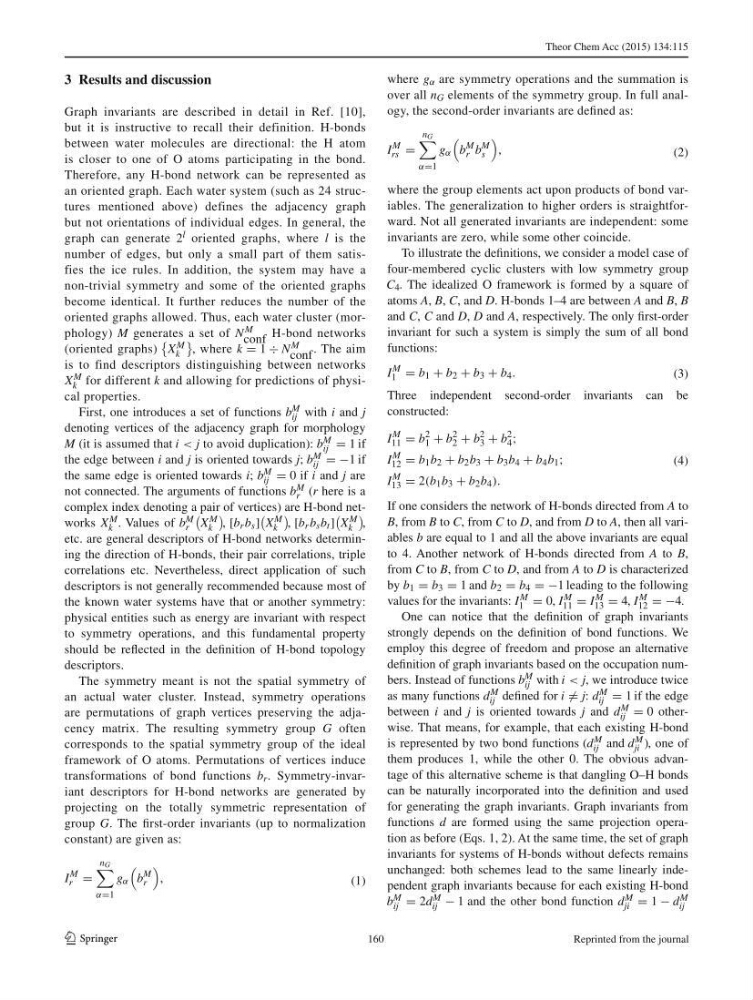
Graph invariants are described in detail in Ref. [ 10 ],
but it is instructive to recall their definition. H-bonds
between water molecules are directional: the H atom
is closer to one of O atoms participating in the bond.
Therefore, any H-bond network can be represented as
an oriented graph. Each water system (such as 24 structures mentioned above) defines the adjacency graph
but not orientations of individual edges. In general, the
graph can generate 2 l oriented graphs, where l is the
number of edges, but only a small part of them satisfies the ice rules. In addition, the system may have a
non-trivial symmetry and some of the oriented graphs
become identical. It further reduces the number of the
oriented graphs allowed. Thus, each water cluster (morphology) M generates a set of N M
conf H-bond networks
(oriented graphs)
X M
k
, where k = 1 ÷ N M
conf . The aim
is to find descriptors distinguishing between networks
X M
k for different k and allowing for predictions of physical properties.
First, one introduces a set of functions b M
ij with i and j
denoting vertices of the adjacency graph for morphology
M (it is assumed that i < j to avoid duplication): b M
ij = 1 if
the edge between i and j is oriented towards j ; b M
ij = −1 if
the same edge is oriented towards i ; b M
ij = 0 if i and j are
not connected. The arguments of functions b M
r ( r here is a
complex index denoting a pair of vertices) are H-bond networks X M
k . Values of b M
r
X M
k
, [b r b s ]
X M
k
, [b r b s b t ]
X M
k
,
etc. are general descriptors of H-bond networks determining the direction of H-bonds, their pair correlations, triple
correlations etc. Nevertheless, direct application of such
descriptors is not generally recommended because most of
the known water systems have that or another symmetry:
physical entities such as energy are invariant with respect
to symmetry operations, and this fundamental property
should be refl ected in the defi nition of H-bond topology
descriptors.
The symmetry meant is not the spatial symmetry of
an actual water cluster. Instead, symmetry operations
are permutations of graph vertices preserving the adjacency matrix. The resulting symmetry group G often
corresponds to the spatial symmetry group of the ideal
framework of O atoms. Permutations of vertices induce
transformations of bond functions b r . Symmetry-invariant descriptors for H-bond networks are generated by
projecting on the totally symmetric representation of
group G . The fi rst-order invariants (up to normalization
constant) are given as:
(1)
I
M
r =
n G
α=1
g α
b
M
r
,
where g α are symmetry operations and the summation is
over all n G elements of the symmetry group. In full analogy, the second-order invariants are defi ned as:
where the group elements act upon products of bond variables. The generalization to higher orders is straightforward. Not all generated invariants are independent: some
invariants are zero, while some other coincide.
To illustrate the defi nitions, we consider a model case of
four-membered cyclic clusters with low symmetry group
C 4 . The idealized O framework is formed by a square of
atoms A , B , C , and D . H-bonds 1–4 are between A and B , B
and C , C and D , D and A , respectively. The only fi rst-order
invariant for such a system is simply the sum of all bond
functions:
Three independent second-order invariants can be
constructed:
If one considers the network of H-bonds directed from A to
B , from B to C , from C to D , and from D to A , then all variables b are equal to 1 and all the above invariants are equal
to 4. Another network of H-bonds directed from A to B ,
from C to B , from C to D , and from A to D is characterized
by b 1 = b 3 = 1 and b 2 = b 4 = −1 leading to the following
values for the invariants: I M
1 = 0 , I M
11 = I M
13 = 4 , I M
12 = −4 .
One can notice that the defi nition of graph invariants
strongly depends on the defi nition of bond functions. We
employ this degree of freedom and propose an alternative
defi nition of graph invariants based on the occupation numbers. Instead of functions b M
ij with i < j , we introduce twice
as many functions d M
ij defi ned for i = j : d M
ij = 1 if the edge
between i and j is oriented towards j and d M
ij = 0 otherwise. That means, for example, that each existing H-bond
is represented by two bond functions (d M
ij and d M
ji ) , one of
them produces 1, while the other 0. The obvious advantage of this alternative scheme is that dangling O–H bonds
can be naturally incorporated into the defi nition and used
for generating the graph invariants. Graph invariants from
functions d are formed using the same projection operation as before (Eqs. 1 , 2 ). At the same time, the set of graph
invariants for systems of H-bonds without defects remains
unchanged: both schemes lead to the same linearly independent graph invariants because for each existing H-bond
b M
ij = 2d M
ij − 1 and the other bond function d M
ji = 1 − d M
ij
(2)
I
M
rs =
n G
α=1
g α
b
M
r b
M
s
,
(3)
I
M
1 = b 1 + b 2 + b 3 + b 4 .
(4)
I
M
11 = b
2
1 + b
2
2 + b
2
3 + b
2
4 ;
I
M
12 = b 1 b 2 + b 2 b 3 + b 3 b 4 + b 4 b 1 ;
I
M
13 = 2(b 1 b 3 + b 2 b 4 ).
160
Reprinted from the journal
1 3
3 Results and discussion
Graph invariants are described in detail in Ref. [ 10 ],
but it is instructive to recall their definition. H-bonds
between water molecules are directional: the H atom
is closer to one of O atoms participating in the bond.
Therefore, any H-bond network can be represented as
an oriented graph. Each water system (such as 24 structures mentioned above) defines the adjacency graph
but not orientations of individual edges. In general, the
graph can generate 2 l oriented graphs, where l is the
number of edges, but only a small part of them satisfies the ice rules. In addition, the system may have a
non-trivial symmetry and some of the oriented graphs
become identical. It further reduces the number of the
oriented graphs allowed. Thus, each water cluster (morphology) M generates a set of N M
conf H-bond networks
(oriented graphs)
X M
k
, where k = 1 ÷ N M
conf . The aim
is to find descriptors distinguishing between networks
X M
k for different k and allowing for predictions of physical properties.
First, one introduces a set of functions b M
ij with i and j
denoting vertices of the adjacency graph for morphology
M (it is assumed that i < j to avoid duplication): b M
ij = 1 if
the edge between i and j is oriented towards j ; b M
ij = −1 if
the same edge is oriented towards i ; b M
ij = 0 if i and j are
not connected. The arguments of functions b M
r ( r here is a
complex index denoting a pair of vertices) are H-bond networks X M
k . Values of b M
r
X M
k
, [b r b s ]
X M
k
, [b r b s b t ]
X M
k
,
etc. are general descriptors of H-bond networks determining the direction of H-bonds, their pair correlations, triple
correlations etc. Nevertheless, direct application of such
descriptors is not generally recommended because most of
the known water systems have that or another symmetry:
physical entities such as energy are invariant with respect
to symmetry operations, and this fundamental property
should be refl ected in the defi nition of H-bond topology
descriptors.
The symmetry meant is not the spatial symmetry of
an actual water cluster. Instead, symmetry operations
are permutations of graph vertices preserving the adjacency matrix. The resulting symmetry group G often
corresponds to the spatial symmetry group of the ideal
framework of O atoms. Permutations of vertices induce
transformations of bond functions b r . Symmetry-invariant descriptors for H-bond networks are generated by
projecting on the totally symmetric representation of
group G . The fi rst-order invariants (up to normalization
constant) are given as:
(1)
I
M
r =
n G
α=1
g α
b
M
r
,
where g α are symmetry operations and the summation is
over all n G elements of the symmetry group. In full analogy, the second-order invariants are defi ned as:
where the group elements act upon products of bond variables. The generalization to higher orders is straightforward. Not all generated invariants are independent: some
invariants are zero, while some other coincide.
To illustrate the defi nitions, we consider a model case of
four-membered cyclic clusters with low symmetry group
C 4 . The idealized O framework is formed by a square of
atoms A , B , C , and D . H-bonds 1–4 are between A and B , B
and C , C and D , D and A , respectively. The only fi rst-order
invariant for such a system is simply the sum of all bond
functions:
Three independent second-order invariants can be
constructed:
If one considers the network of H-bonds directed from A to
B , from B to C , from C to D , and from D to A , then all variables b are equal to 1 and all the above invariants are equal
to 4. Another network of H-bonds directed from A to B ,
from C to B , from C to D , and from A to D is characterized
by b 1 = b 3 = 1 and b 2 = b 4 = −1 leading to the following
values for the invariants: I M
1 = 0 , I M
11 = I M
13 = 4 , I M
12 = −4 .
One can notice that the defi nition of graph invariants
strongly depends on the defi nition of bond functions. We
employ this degree of freedom and propose an alternative
defi nition of graph invariants based on the occupation numbers. Instead of functions b M
ij with i < j , we introduce twice
as many functions d M
ij defi ned for i = j : d M
ij = 1 if the edge
between i and j is oriented towards j and d M
ij = 0 otherwise. That means, for example, that each existing H-bond
is represented by two bond functions (d M
ij and d M
ji ) , one of
them produces 1, while the other 0. The obvious advantage of this alternative scheme is that dangling O–H bonds
can be naturally incorporated into the defi nition and used
for generating the graph invariants. Graph invariants from
functions d are formed using the same projection operation as before (Eqs. 1 , 2 ). At the same time, the set of graph
invariants for systems of H-bonds without defects remains
unchanged: both schemes lead to the same linearly independent graph invariants because for each existing H-bond
b M
ij = 2d M
ij − 1 and the other bond function d M
ji = 1 − d M
ij
(2)
I
M
rs =
n G
α=1
g α
b
M
r b
M
s
,
(3)
I
M
1 = b 1 + b 2 + b 3 + b 4 .
(4)
I
M
11 = b
2
1 + b
2
2 + b
2
3 + b
2
4 ;
I
M
12 = b 1 b 2 + b 2 b 3 + b 3 b 4 + b 4 b 1 ;
I
M
13 = 2(b 1 b 3 + b 2 b 4 ).
160
Reprinted from the journal