

Theor Chem Acc (2015) 134:115
1 3
structures considered in the paper are fi nite fragments of
experimentally known ice nanotubes (see Fig. 1 ), which
can be viewed as stacks of n -membered rings (or rolled
square-net sheets) with n being from 4 to 7. The fragments
are denoted as INT m
n where m is the number of n -membered layers. We studied structures with suffi cient but
not exceedingly large number of H-bond confi gurations,
namely INT m
4 with m = 3 ÷ 8 , INT m
5 with m = 2 ÷ 6 ,
INT m
6 with m = 2 ÷ 5 , and INT m
7 with m = 2 ÷ 4 [ 17 ]. The
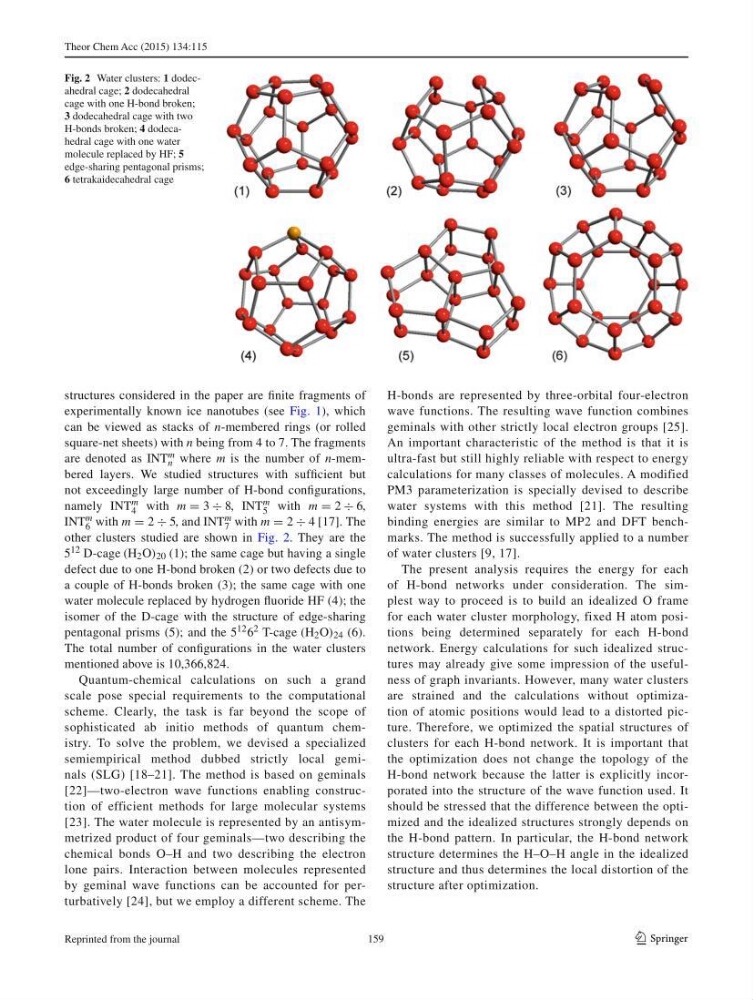
other clusters studied are shown in Fig. 2 . They are the
5 12 D-cage (H 2 O) 20 (1); the same cage but having a single
defect due to one H-bond broken (2) or two defects due to
a couple of H-bonds broken (3); the same cage with one
water molecule replaced by hydrogen fl uoride HF (4); the
isomer of the D-cage with the structure of edge-sharing
pentagonal prisms (5); and the 5 12 6 2 T-cage (H 2 O) 24 (6).
The total number of confi gurations in the water clusters
mentioned above is 10,366,824.
Quantum-chemical calculations on such a grand
scale pose special requirements to the computational
scheme. Clearly, the task is far beyond the scope of
sophisticated ab initio methods of quantum chemistry. To solve the problem, we devised a specialized
semiempirical method dubbed strictly local geminals (SLG) [ 18 – 21 ]. The method is based on geminals
[ 22 ]—two-electron wave functions enabling construction of efficient methods for large molecular systems
[ 23 ]. The water molecule is represented by an antisymmetrized product of four geminals—two describing the
chemical bonds O–H and two describing the electron
lone pairs. Interaction between molecules represented
by geminal wave functions can be accounted for perturbatively [ 24 ], but we employ a different scheme. The
H-bonds are represented by three-orbital four-electron
wave functions. The resulting wave function combines
geminals with other strictly local electron groups [ 25 ].
An important characteristic of the method is that it is
ultra-fast but still highly reliable with respect to energy
calculations for many classes of molecules. A modified
PM3 parameterization is specially devised to describe
water systems with this method [ 21 ]. The resulting
binding energies are similar to MP2 and DFT benchmarks. The method is successfully applied to a number
of water clusters [ 9 , 17 ].
The present analysis requires the energy for each
of H-bond networks under consideration. The simplest way to proceed is to build an idealized O frame
for each water cluster morphology, fixed H atom positions being determined separately for each H-bond
network. Energy calculations for such idealized structures may already give some impression of the usefulness of graph invariants. However, many water clusters
are strained and the calculations without optimization of atomic positions would lead to a distorted picture. Therefore, we optimized the spatial structures of
clusters for each H-bond network. It is important that
the optimization does not change the topology of the
H-bond network because the latter is explicitly incorporated into the structure of the wave function used. It
should be stressed that the difference between the optimized and the idealized structures strongly depends on
the H-bond pattern. In particular, the H-bond network
structure determines the H–O–H angle in the idealized
structure and thus determines the local distortion of the
structure after optimization.
Fig. 2 Water clusters: 1 dodecahedral cage; 2 dodecahedral
cage with one H-bond broken;
3 dodecahedral cage with two
H-bonds broken; 4 dodecahedral cage with one water
molecule replaced by HF; 5
edge-sharing pentagonal prisms;
6 tetrakaidecahedral cage
159
Reprinted from the journal
1 3
structures considered in the paper are fi nite fragments of
experimentally known ice nanotubes (see Fig. 1 ), which
can be viewed as stacks of n -membered rings (or rolled
square-net sheets) with n being from 4 to 7. The fragments
are denoted as INT m
n where m is the number of n -membered layers. We studied structures with suffi cient but
not exceedingly large number of H-bond confi gurations,
namely INT m
4 with m = 3 ÷ 8 , INT m
5 with m = 2 ÷ 6 ,
INT m
6 with m = 2 ÷ 5 , and INT m
7 with m = 2 ÷ 4 [ 17 ]. The
other clusters studied are shown in Fig. 2 . They are the
5 12 D-cage (H 2 O) 20 (1); the same cage but having a single
defect due to one H-bond broken (2) or two defects due to
a couple of H-bonds broken (3); the same cage with one
water molecule replaced by hydrogen fl uoride HF (4); the
isomer of the D-cage with the structure of edge-sharing
pentagonal prisms (5); and the 5 12 6 2 T-cage (H 2 O) 24 (6).
The total number of confi gurations in the water clusters
mentioned above is 10,366,824.
Quantum-chemical calculations on such a grand
scale pose special requirements to the computational
scheme. Clearly, the task is far beyond the scope of
sophisticated ab initio methods of quantum chemistry. To solve the problem, we devised a specialized
semiempirical method dubbed strictly local geminals (SLG) [ 18 – 21 ]. The method is based on geminals
[ 22 ]—two-electron wave functions enabling construction of efficient methods for large molecular systems
[ 23 ]. The water molecule is represented by an antisymmetrized product of four geminals—two describing the
chemical bonds O–H and two describing the electron
lone pairs. Interaction between molecules represented
by geminal wave functions can be accounted for perturbatively [ 24 ], but we employ a different scheme. The
H-bonds are represented by three-orbital four-electron
wave functions. The resulting wave function combines
geminals with other strictly local electron groups [ 25 ].
An important characteristic of the method is that it is
ultra-fast but still highly reliable with respect to energy
calculations for many classes of molecules. A modified
PM3 parameterization is specially devised to describe
water systems with this method [ 21 ]. The resulting
binding energies are similar to MP2 and DFT benchmarks. The method is successfully applied to a number
of water clusters [ 9 , 17 ].
The present analysis requires the energy for each
of H-bond networks under consideration. The simplest way to proceed is to build an idealized O frame
for each water cluster morphology, fixed H atom positions being determined separately for each H-bond
network. Energy calculations for such idealized structures may already give some impression of the usefulness of graph invariants. However, many water clusters
are strained and the calculations without optimization of atomic positions would lead to a distorted picture. Therefore, we optimized the spatial structures of
clusters for each H-bond network. It is important that
the optimization does not change the topology of the
H-bond network because the latter is explicitly incorporated into the structure of the wave function used. It
should be stressed that the difference between the optimized and the idealized structures strongly depends on
the H-bond pattern. In particular, the H-bond network
structure determines the H–O–H angle in the idealized
structure and thus determines the local distortion of the
structure after optimization.
Fig. 2 Water clusters: 1 dodecahedral cage; 2 dodecahedral
cage with one H-bond broken;
3 dodecahedral cage with two
H-bonds broken; 4 dodecahedral cage with one water
molecule replaced by HF; 5
edge-sharing pentagonal prisms;
6 tetrakaidecahedral cage
159
Reprinted from the journal