

Theor Chem Acc (2015) 134:115
1 3
insuffi cient. Any reasonable prediction of properties of
such systems would require a thorough analysis of H-bond
confi gurations because a signifi cant part of them can be
thermally populated.
Construction of a predictive model correlating the
energy and other properties with the H-bond network structure is a long-standing problem. A number of approaches
have been put forward, mostly for water clusters. A most
straightforward approach is based on classifi cation of all
H-bonds in a cluster according to their local environment
with subsequent counting the numbers of bonds of different types. The required classifi cation can rely upon notions
of weak and strong H-bonds (which are often associated
with cis and trans H-bonds)—now so easily quantifi ed by
DFT [ 3 ]—or it can take into account the fi rst neighbours
of H-bonds leading to two types of trans-bonds and three
types of cis-bonds [ 6 ]. Similar ideas underline the so-called
Strong–Weak-Effective-Bond model for polyhedral water
clusters which is based on estimating the effective pair
interactions between nearest neighbours [ 7 ]. An alternative
model, especially suited to water cages, classifi es bonds
according to the state of oxygen atoms (having a dangling
O–H bond or a lone pair) [ 8 ], but it leads to the same fi ve
types of H-bonds. Our own calculations of all H-bond isomers of dodecahedral water cluster (H 2 O) 20 indicate that
there exists a correlation between the cluster energy and
the number of trans or cis H-bonds or the number of pairs
of dangling O–H bonds in vicinal positions, but it is not
strong enough to build a predictive model [ 9 ].
A viable alternative to this approach is given by a general set of entities called graph invariants [ 10 ]. Those are
automatically generated descriptors of the H-bond structure
taking into account the symmetry of the system. The energy
and other properties can be approximated as linear combinations of graph invariants. This approach seems very
promising because it employs only the adjacency matrix,
does not rely on special physical insight, and encompasses
a hierarchy of approximations. Incidentally, other common descriptors of H-bond networks (such as numbers of
H-bonds of different types, see above) emerge as particular
cases of graph invariants. Moreover, the concept is highly
useful for generation or enumeration of symmetry-distinct
H-bond networks reducing N 2 scaling of these procedures
to N log N , where N is the total number of confi gurations.
The method has originally been developed for fi nite
clusters, but its generalization to periodic systems [ 11 ] has
been no less successful. Graph invariant descriptors provide a simple algorithm to extrapolate from a handful of
expensive quantum-mechanical calculations to a larger set
of H-bond confi gurations. Similarly, they can be used to
extrapolate from calculations for smaller unit cells to statistical mechanical simulations employing larger unit cells.
The method is routinely applied in studies of H-bond topology and proton-ordering transitions for different phases of
ice [ 12 – 16 ]. At the same time, its applicability is not thoroughly tested in different aspects. First, only second-order
invariants are used in all numerical applications. Second,
only water systems without signifi cant strains and any
defects are studied. Third, all the applications correspond to
a very small number of actually calculated H-bond isomers
with the only exception provided by the 30,026 isomers of
the dodecahedral water cluster (H 2 O) 20 , where the graph
invariant approximation is compared with the exhaustive
force fi eld OSS2 calculations [ 10 ].
In the present paper, graph invariants are benchmarked
against results of quantum-chemical calculations. Exhaustive calculations of all H-bond networks for water clusters
of 24 different morphologies provide reference values of
the energy. A series of tests attempting to approximate the
energy by a linear combination of graph invariant descriptors reveals limits for applicability of the method.
2 Computational details
Benchmarking requires calculations for a number of water
clusters, each providing a set of H-bond networks, large
enough to be studied with graph invariants. To be representative, the set of water clusters should include clusters of different size, symmetry and strains. Most of the
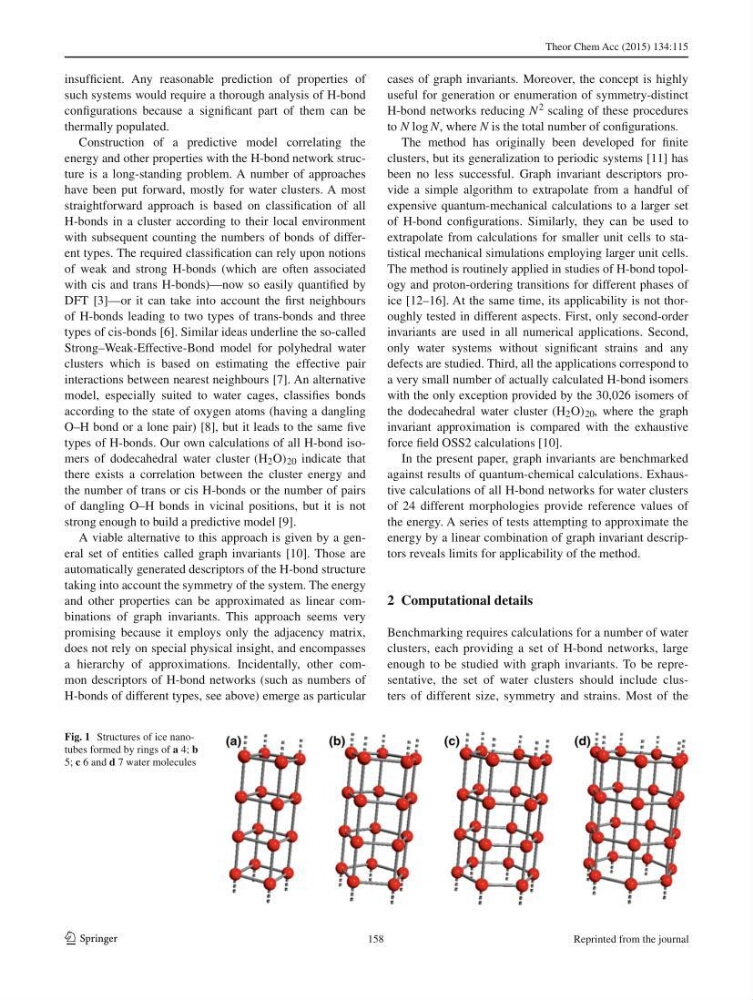
Fig. 1 Structures of ice nanotubes formed by rings of a 4; b
5; c 6 and d 7 water molecules
158
Reprinted from the journal
1 3
insuffi cient. Any reasonable prediction of properties of
such systems would require a thorough analysis of H-bond
confi gurations because a signifi cant part of them can be
thermally populated.
Construction of a predictive model correlating the
energy and other properties with the H-bond network structure is a long-standing problem. A number of approaches
have been put forward, mostly for water clusters. A most
straightforward approach is based on classifi cation of all
H-bonds in a cluster according to their local environment
with subsequent counting the numbers of bonds of different types. The required classifi cation can rely upon notions
of weak and strong H-bonds (which are often associated
with cis and trans H-bonds)—now so easily quantifi ed by
DFT [ 3 ]—or it can take into account the fi rst neighbours
of H-bonds leading to two types of trans-bonds and three
types of cis-bonds [ 6 ]. Similar ideas underline the so-called
Strong–Weak-Effective-Bond model for polyhedral water
clusters which is based on estimating the effective pair
interactions between nearest neighbours [ 7 ]. An alternative
model, especially suited to water cages, classifi es bonds
according to the state of oxygen atoms (having a dangling
O–H bond or a lone pair) [ 8 ], but it leads to the same fi ve
types of H-bonds. Our own calculations of all H-bond isomers of dodecahedral water cluster (H 2 O) 20 indicate that
there exists a correlation between the cluster energy and
the number of trans or cis H-bonds or the number of pairs
of dangling O–H bonds in vicinal positions, but it is not
strong enough to build a predictive model [ 9 ].
A viable alternative to this approach is given by a general set of entities called graph invariants [ 10 ]. Those are
automatically generated descriptors of the H-bond structure
taking into account the symmetry of the system. The energy
and other properties can be approximated as linear combinations of graph invariants. This approach seems very
promising because it employs only the adjacency matrix,
does not rely on special physical insight, and encompasses
a hierarchy of approximations. Incidentally, other common descriptors of H-bond networks (such as numbers of
H-bonds of different types, see above) emerge as particular
cases of graph invariants. Moreover, the concept is highly
useful for generation or enumeration of symmetry-distinct
H-bond networks reducing N 2 scaling of these procedures
to N log N , where N is the total number of confi gurations.
The method has originally been developed for fi nite
clusters, but its generalization to periodic systems [ 11 ] has
been no less successful. Graph invariant descriptors provide a simple algorithm to extrapolate from a handful of
expensive quantum-mechanical calculations to a larger set
of H-bond confi gurations. Similarly, they can be used to
extrapolate from calculations for smaller unit cells to statistical mechanical simulations employing larger unit cells.
The method is routinely applied in studies of H-bond topology and proton-ordering transitions for different phases of
ice [ 12 – 16 ]. At the same time, its applicability is not thoroughly tested in different aspects. First, only second-order
invariants are used in all numerical applications. Second,
only water systems without signifi cant strains and any
defects are studied. Third, all the applications correspond to
a very small number of actually calculated H-bond isomers
with the only exception provided by the 30,026 isomers of
the dodecahedral water cluster (H 2 O) 20 , where the graph
invariant approximation is compared with the exhaustive
force fi eld OSS2 calculations [ 10 ].
In the present paper, graph invariants are benchmarked
against results of quantum-chemical calculations. Exhaustive calculations of all H-bond networks for water clusters
of 24 different morphologies provide reference values of
the energy. A series of tests attempting to approximate the
energy by a linear combination of graph invariant descriptors reveals limits for applicability of the method.
2 Computational details
Benchmarking requires calculations for a number of water
clusters, each providing a set of H-bond networks, large
enough to be studied with graph invariants. To be representative, the set of water clusters should include clusters of different size, symmetry and strains. Most of the
Fig. 1 Structures of ice nanotubes formed by rings of a 4; b
5; c 6 and d 7 water molecules
158
Reprinted from the journal