

Theor Chem Acc (2015) 134:132
1 3
dihedral angle (see Fig. 3 for the atom numbering). Various
system separations were applied in order to study the effect
of QM subsystem size on the quality of the results.
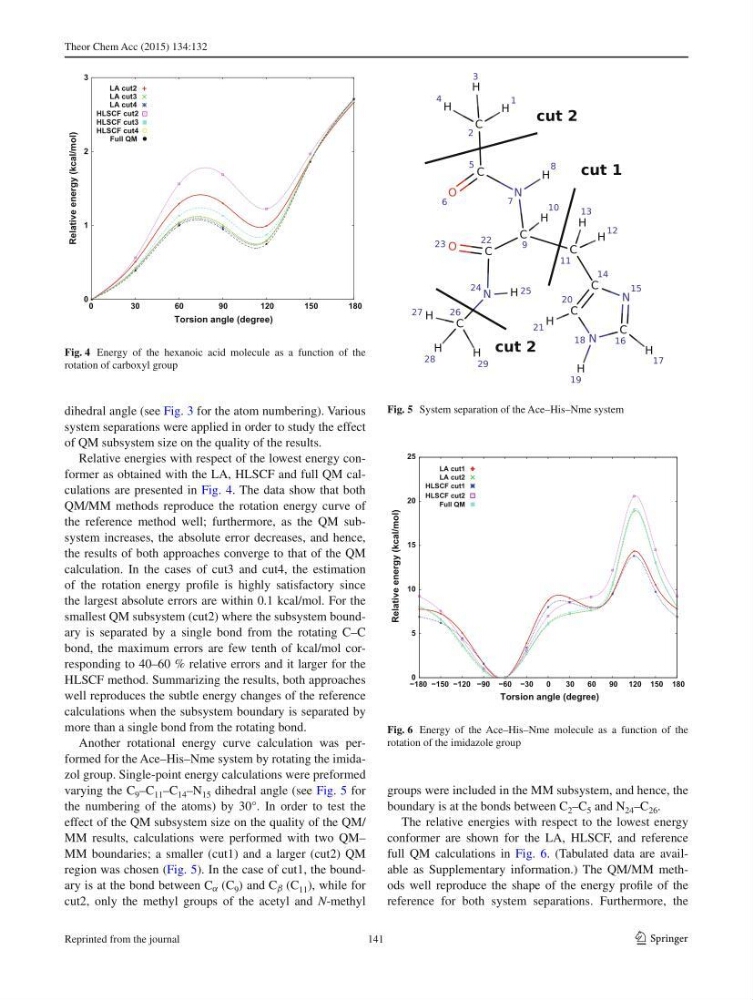
Relative energies with respect of the lowest energy conformer as obtained with the LA, HLSCF and full QM calculations are presented in Fig. 4 . The data show that both
QM/MM methods reproduce the rotation energy curve of
the reference method well; furthermore, as the QM subsystem increases, the absolute error decreases, and hence,
the results of both approaches converge to that of the QM
calculation. In the cases of cut3 and cut4, the estimation
of the rotation energy profi le is highly satisfactory since
the largest absolute errors are within 0.1 kcal/mol. For the
smallest QM subsystem (cut2) where the subsystem boundary is separated by a single bond from the rotating C–C
bond, the maximum errors are few tenth of kcal/mol corresponding to 40–60 % relative errors and it larger for the
HLSCF method. Summarizing the results, both approaches
well reproduces the subtle energy changes of the reference
calculations when the subsystem boundary is separated by
more than a single bond from the rotating bond.
Another rotational energy curve calculation was performed for the Ace–His–Nme system by rotating the imidazol group. Single-point energy calculations were preformed
varying the C 9 –C 11 –C 14 –N 15 dihedral angle (see Fig. 5 for
the numbering of the atoms) by 30°. In order to test the
effect of the QM subsystem size on the quality of the QM/
MM results, calculations were performed with two QM–
MM boundaries; a smaller (cut1) and a larger (cut2) QM
region was chosen (Fig. 5 ). In the case of cut1, the boundary is at the bond between C α (C 9 ) and C β (C 11 ), while for
cut2, only the methyl groups of the acetyl and N -methyl
groups were included in the MM subsystem, and hence, the
boundary is at the bonds between C 2 –C 5 and N 24 –C 26 .
The relative energies with respect to the lowest energy
conformer are shown for the LA, HLSCF, and reference
full QM calculations in Fig. 6 . (Tabulated data are available as Supplementary information.) The QM/MM methods well reproduce the shape of the energy profi le of the
reference for both system separations. Furthermore, the
0
1
2
3
0
30
60
90
120
150
180
Relative energy (kcal/mol)
Torsion angle (degree)
LA cut2
LA cut3
LA cut4
HLSCF cut2
HLSCF cut3
HLSCF cut4
Full QM
Fig. 4 Energy of the hexanoic acid molecule as a function of the
rotation of carboxyl group
Fig. 5 System separation of the Ace–His–Nme system
0
5
10
15
20
25
−180 −150 −120 −90 −60 −30
0
30
60
90 120 150 180
Relative energy (kcal/mol)
Torsion angle (degree)
LA cut1
LA cut2
HLSCF cut1
HLSCF cut2
Full QM
Fig. 6 Energy of the Ace–His–Nme molecule as a function of the
rotation of the imidazole group
141
Reprinted from the journal
1 3
dihedral angle (see Fig. 3 for the atom numbering). Various
system separations were applied in order to study the effect
of QM subsystem size on the quality of the results.
Relative energies with respect of the lowest energy conformer as obtained with the LA, HLSCF and full QM calculations are presented in Fig. 4 . The data show that both
QM/MM methods reproduce the rotation energy curve of
the reference method well; furthermore, as the QM subsystem increases, the absolute error decreases, and hence,
the results of both approaches converge to that of the QM
calculation. In the cases of cut3 and cut4, the estimation
of the rotation energy profi le is highly satisfactory since
the largest absolute errors are within 0.1 kcal/mol. For the
smallest QM subsystem (cut2) where the subsystem boundary is separated by a single bond from the rotating C–C
bond, the maximum errors are few tenth of kcal/mol corresponding to 40–60 % relative errors and it larger for the
HLSCF method. Summarizing the results, both approaches
well reproduces the subtle energy changes of the reference
calculations when the subsystem boundary is separated by
more than a single bond from the rotating bond.
Another rotational energy curve calculation was performed for the Ace–His–Nme system by rotating the imidazol group. Single-point energy calculations were preformed
varying the C 9 –C 11 –C 14 –N 15 dihedral angle (see Fig. 5 for
the numbering of the atoms) by 30°. In order to test the
effect of the QM subsystem size on the quality of the QM/
MM results, calculations were performed with two QM–
MM boundaries; a smaller (cut1) and a larger (cut2) QM
region was chosen (Fig. 5 ). In the case of cut1, the boundary is at the bond between C α (C 9 ) and C β (C 11 ), while for
cut2, only the methyl groups of the acetyl and N -methyl
groups were included in the MM subsystem, and hence, the
boundary is at the bonds between C 2 –C 5 and N 24 –C 26 .
The relative energies with respect to the lowest energy
conformer are shown for the LA, HLSCF, and reference
full QM calculations in Fig. 6 . (Tabulated data are available as Supplementary information.) The QM/MM methods well reproduce the shape of the energy profi le of the
reference for both system separations. Furthermore, the
0
1
2
3
0
30
60
90
120
150
180
Relative energy (kcal/mol)
Torsion angle (degree)
LA cut2
LA cut3
LA cut4
HLSCF cut2
HLSCF cut3
HLSCF cut4
Full QM
Fig. 4 Energy of the hexanoic acid molecule as a function of the
rotation of carboxyl group
Fig. 5 System separation of the Ace–His–Nme system
0
5
10
15
20
25
−180 −150 −120 −90 −60 −30
0
30
60
90 120 150 180
Relative energy (kcal/mol)
Torsion angle (degree)
LA cut1
LA cut2
HLSCF cut1
HLSCF cut2
Full QM
Fig. 6 Energy of the Ace–His–Nme molecule as a function of the
rotation of the imidazole group
141
Reprinted from the journal