

Theor Chem Acc (2015) 134:132
1 3
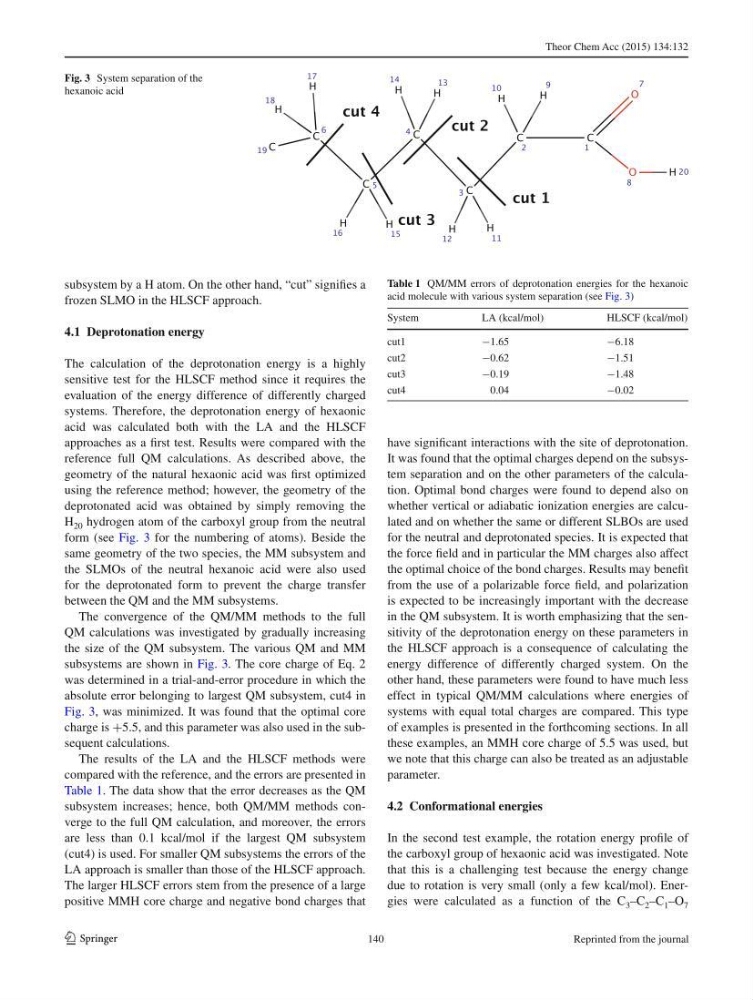
subsystem by a H atom. On the other hand, “cut” signifi es a
frozen SLMO in the HLSCF approach.
4.1 Deprotonation energy
The calculation of the deprotonation energy is a highly
sensitive test for the HLSCF method since it requires the
evaluation of the energy difference of differently charged
systems. Therefore, the deprotonation energy of hexaonic
acid was calculated both with the LA and the HLSCF
approaches as a fi rst test. Results were compared with the
reference full QM calculations. As described above, the
geometry of the natural hexaonic acid was fi rst optimized
using the reference method; however, the geometry of the
deprotonated acid was obtained by simply removing the
H 20 hydrogen atom of the carboxyl group from the neutral
form (see Fig. 3 for the numbering of atoms). Beside the
same geometry of the two species, the MM subsystem and
the SLMOs of the neutral hexanoic acid were also used
for the deprotonated form to prevent the charge transfer
between the QM and the MM subsystems.
The convergence of the QM/MM methods to the full
QM calculations was investigated by gradually increasing
the size of the QM subsystem. The various QM and MM
subsystems are shown in Fig. 3 . The core charge of Eq. 2
was determined in a trial-and-error procedure in which the
absolute error belonging to largest QM subsystem, cut4 in
Fig. 3 , was minimized. It was found that the optimal core
charge is +5.5, and this parameter was also used in the subsequent calculations.
The results of the LA and the HLSCF methods were
compared with the reference, and the errors are presented in
Table 1 . The data show that the error decreases as the QM
subsystem increases; hence, both QM/MM methods converge to the full QM calculation, and moreover, the errors
are less than 0.1 kcal/mol if the largest QM subsystem
(cut4) is used. For smaller QM subsystems the errors of the
LA approach is smaller than those of the HLSCF approach.
The larger HLSCF errors stem from the presence of a large
positive MMH core charge and negative bond charges that
have signifi cant interactions with the site of deprotonation.
It was found that the optimal charges depend on the subsystem separation and on the other parameters of the calculation. Optimal bond charges were found to depend also on
whether vertical or adiabatic ionization energies are calculated and on whether the same or different SLBOs are used
for the neutral and deprotonated species. It is expected that
the force fi eld and in particular the MM charges also affect
the optimal choice of the bond charges. Results may benefi t
from the use of a polarizable force fi eld, and polarization
is expected to be increasingly important with the decrease
in the QM subsystem. It is worth emphasizing that the sensitivity of the deprotonation energy on these parameters in
the HLSCF approach is a consequence of calculating the
energy difference of differently charged system. On the
other hand, these parameters were found to have much less
effect in typical QM/MM calculations where energies of
systems with equal total charges are compared. This type
of examples is presented in the forthcoming sections. In all
these examples, an MMH core charge of 5.5 was used, but
we note that this charge can also be treated as an adjustable
parameter.
4.2 Conformational energies
In the second test example, the rotation energy profi le of
the carboxyl group of hexaonic acid was investigated. Note
that this is a challenging test because the energy change
due to rotation is very small (only a few kcal/mol). Energies were calculated as a function of the C 3 –C 2 –C 1 –O 7
Fig. 3 System separation of the
hexanoic acid
Table 1 QM/MM errors of deprotonation energies for the hexanoic
acid molecule with various system separation (see Fig. 3 )
System
LA (kcal/mol)
HLSCF (kcal/mol)
cut1
−1.65
−6.18
cut2
−0.62
−1.51
cut3
−0.19
−1.48
cut4
0.04
−0.02
140
Reprinted from the journal
1 3
subsystem by a H atom. On the other hand, “cut” signifi es a
frozen SLMO in the HLSCF approach.
4.1 Deprotonation energy
The calculation of the deprotonation energy is a highly
sensitive test for the HLSCF method since it requires the
evaluation of the energy difference of differently charged
systems. Therefore, the deprotonation energy of hexaonic
acid was calculated both with the LA and the HLSCF
approaches as a fi rst test. Results were compared with the
reference full QM calculations. As described above, the
geometry of the natural hexaonic acid was fi rst optimized
using the reference method; however, the geometry of the
deprotonated acid was obtained by simply removing the
H 20 hydrogen atom of the carboxyl group from the neutral
form (see Fig. 3 for the numbering of atoms). Beside the
same geometry of the two species, the MM subsystem and
the SLMOs of the neutral hexanoic acid were also used
for the deprotonated form to prevent the charge transfer
between the QM and the MM subsystems.
The convergence of the QM/MM methods to the full
QM calculations was investigated by gradually increasing
the size of the QM subsystem. The various QM and MM
subsystems are shown in Fig. 3 . The core charge of Eq. 2
was determined in a trial-and-error procedure in which the
absolute error belonging to largest QM subsystem, cut4 in
Fig. 3 , was minimized. It was found that the optimal core
charge is +5.5, and this parameter was also used in the subsequent calculations.
The results of the LA and the HLSCF methods were
compared with the reference, and the errors are presented in
Table 1 . The data show that the error decreases as the QM
subsystem increases; hence, both QM/MM methods converge to the full QM calculation, and moreover, the errors
are less than 0.1 kcal/mol if the largest QM subsystem
(cut4) is used. For smaller QM subsystems the errors of the
LA approach is smaller than those of the HLSCF approach.
The larger HLSCF errors stem from the presence of a large
positive MMH core charge and negative bond charges that
have signifi cant interactions with the site of deprotonation.
It was found that the optimal charges depend on the subsystem separation and on the other parameters of the calculation. Optimal bond charges were found to depend also on
whether vertical or adiabatic ionization energies are calculated and on whether the same or different SLBOs are used
for the neutral and deprotonated species. It is expected that
the force fi eld and in particular the MM charges also affect
the optimal choice of the bond charges. Results may benefi t
from the use of a polarizable force fi eld, and polarization
is expected to be increasingly important with the decrease
in the QM subsystem. It is worth emphasizing that the sensitivity of the deprotonation energy on these parameters in
the HLSCF approach is a consequence of calculating the
energy difference of differently charged system. On the
other hand, these parameters were found to have much less
effect in typical QM/MM calculations where energies of
systems with equal total charges are compared. This type
of examples is presented in the forthcoming sections. In all
these examples, an MMH core charge of 5.5 was used, but
we note that this charge can also be treated as an adjustable
parameter.
4.2 Conformational energies
In the second test example, the rotation energy profi le of
the carboxyl group of hexaonic acid was investigated. Note
that this is a challenging test because the energy change
due to rotation is very small (only a few kcal/mol). Energies were calculated as a function of the C 3 –C 2 –C 1 –O 7
Fig. 3 System separation of the
hexanoic acid
Table 1 QM/MM errors of deprotonation energies for the hexanoic
acid molecule with various system separation (see Fig. 3 )
System
LA (kcal/mol)
HLSCF (kcal/mol)
cut1
−1.65
−6.18
cut2
−0.62
−1.51
cut3
−0.19
−1.48
cut4
0.04
−0.02
140
Reprinted from the journal