

Theor Chem Acc (2015) 134:116
1 3
ω B97XD functional that practically copy the CAM-B3LYP
spectra. One observes that the simulated UV–Vis spectra
very well agree with the experimental recording. Except for
a small range around the wavelength 200 nm, this statement
is equally valid for the gas-phase and the PCM simulations.
Yet, in the range toward the wavelength of about 200 nm
the improving effect of PCM is visible. Generally, the simulated UV–Vis spectrum possesses all the features of the
measured one in the CH 3 CN solution, although the maxima
are slightly shifted toward shorter wavelengths. The latter
effect is somewhat stronger for the LC- ω PBE values.
Improving effect of the PCM is much more evident in
the simulated ECD spectra. In particular, the positive sign
wave in the 200–250 nm range failed to be well simulated
in the mere gas-phase model. Indeed, also in experiment,
the effect of the different environment in ECD spectrum
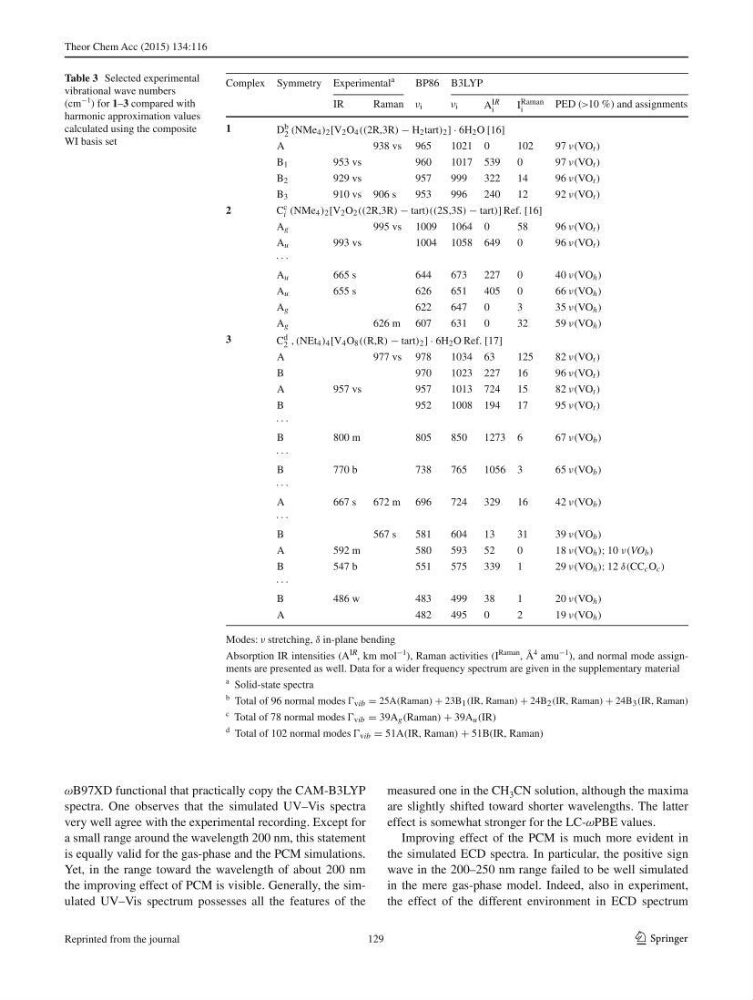
Table 3 Selected experimental
vibrational wave numbers
(cm
−1 ) for 1 – 3 compared with
harmonic approximation values
calculated using the composite
WI basis set
Modes: ν stretching, δ in-plane bending
Absorption IR intensities ( A
IR
, km mol
−1 ), Raman activities (I
Raman , Å
4 amu
−1 ), and normal mode assignments are presented as well. Data for a wider frequency spectrum are given in the supplementary material
a Solid-state spectra
b Total of 96 normal modes vib = 25A(Raman) + 23B 1 (IR, Raman) + 24B 2 (IR, Raman) + 24B 3 (IR, Raman)
c Total of 78 normal modes vib = 39A g (Raman) + 39A u (IR)
d Total of 102 normal modes vib = 51A(IR, Raman) + 51B(IR, Raman)
Complex Symmetry Experimental
a
BP86 B3LYP
IR
Raman ν i
ν i
A
IR
i
I Raman
i
PED ( > 10 %) and assignments
1
D b
2 (NMe 4 ) 2 [V 2 O 4 ((2R,3R) − H 2 tart) 2 ] · 6H 2 O [ 16 ]
A
938 vs 965
1021 0
102
97 ν(VO t )
B 1
953 vs
960
1017 539
0
97 ν(VO t )
B 2
929 vs
957
999
322
14
96 ν(VO t )
B 3
910 vs 906 s
953
996
240
12
92 ν(VO t )
2
C
c
i (NMe 4 ) 2 [V 2 O 2 ((2R,3R) − tart)((2S,3S) − tart)] Ref. [ 16 ]
A g
995 vs 1009 1064 0
58
96 ν(VO t )
A u
993 vs
1004 1058 649
0
96 ν(VO t )
· · ·
A u
665 s
644
673
227
0
40 ν(VO h )
A u
655 s
626
651
405
0
66 ν(VO h )
A g
622
647
0
3
35 ν(VO h )
A g
626 m 607
631
0
32
59 ν(VO h )
3
C
d
2 , (NEt 4 ) 4 [V 4 O 8 ((R,R) − tart) 2 ] · 6H 2 O Ref. [ 17 ]
A
977 vs 978
1034 63
125
82 ν(VO t )
B
970
1023 227
16
96 ν(VO t )
A
957 vs
957
1013 724
15
82 ν(VO t )
B
952
1008 194
17
95 ν(VO t )
· · ·
B
800 m
805
850
1273 6
67 ν(VO b )
· · ·
B
770 b
738
765
1056 3
65 ν(VO b )
· · ·
A
667 s
672 m 696
724
329
16
42 ν(VO b )
· · ·
B
567 s
581
604
13
31
39 ν(VO b )
A
592 m
580
593
52
0
18 ν(VO h ); 10 ν(VO b )
B
547 b
551
575
339
1
29 ν(VO h ); 12 δ(CC c O c )
· · ·
B
486 w
483
499
38
1
20 ν(VO h )
A
482
495
0
2
19 ν(VO h )
129
Reprinted from the journal
1 3
ω B97XD functional that practically copy the CAM-B3LYP
spectra. One observes that the simulated UV–Vis spectra
very well agree with the experimental recording. Except for
a small range around the wavelength 200 nm, this statement
is equally valid for the gas-phase and the PCM simulations.
Yet, in the range toward the wavelength of about 200 nm
the improving effect of PCM is visible. Generally, the simulated UV–Vis spectrum possesses all the features of the
measured one in the CH 3 CN solution, although the maxima
are slightly shifted toward shorter wavelengths. The latter
effect is somewhat stronger for the LC- ω PBE values.
Improving effect of the PCM is much more evident in
the simulated ECD spectra. In particular, the positive sign
wave in the 200–250 nm range failed to be well simulated
in the mere gas-phase model. Indeed, also in experiment,
the effect of the different environment in ECD spectrum
Table 3 Selected experimental
vibrational wave numbers
(cm
−1 ) for 1 – 3 compared with
harmonic approximation values
calculated using the composite
WI basis set
Modes: ν stretching, δ in-plane bending
Absorption IR intensities ( A
IR
, km mol
−1 ), Raman activities (I
Raman , Å
4 amu
−1 ), and normal mode assignments are presented as well. Data for a wider frequency spectrum are given in the supplementary material
a Solid-state spectra
b Total of 96 normal modes vib = 25A(Raman) + 23B 1 (IR, Raman) + 24B 2 (IR, Raman) + 24B 3 (IR, Raman)
c Total of 78 normal modes vib = 39A g (Raman) + 39A u (IR)
d Total of 102 normal modes vib = 51A(IR, Raman) + 51B(IR, Raman)
Complex Symmetry Experimental
a
BP86 B3LYP
IR
Raman ν i
ν i
A
IR
i
I Raman
i
PED ( > 10 %) and assignments
1
D b
2 (NMe 4 ) 2 [V 2 O 4 ((2R,3R) − H 2 tart) 2 ] · 6H 2 O [ 16 ]
A
938 vs 965
1021 0
102
97 ν(VO t )
B 1
953 vs
960
1017 539
0
97 ν(VO t )
B 2
929 vs
957
999
322
14
96 ν(VO t )
B 3
910 vs 906 s
953
996
240
12
92 ν(VO t )
2
C
c
i (NMe 4 ) 2 [V 2 O 2 ((2R,3R) − tart)((2S,3S) − tart)] Ref. [ 16 ]
A g
995 vs 1009 1064 0
58
96 ν(VO t )
A u
993 vs
1004 1058 649
0
96 ν(VO t )
· · ·
A u
665 s
644
673
227
0
40 ν(VO h )
A u
655 s
626
651
405
0
66 ν(VO h )
A g
622
647
0
3
35 ν(VO h )
A g
626 m 607
631
0
32
59 ν(VO h )
3
C
d
2 , (NEt 4 ) 4 [V 4 O 8 ((R,R) − tart) 2 ] · 6H 2 O Ref. [ 17 ]
A
977 vs 978
1034 63
125
82 ν(VO t )
B
970
1023 227
16
96 ν(VO t )
A
957 vs
957
1013 724
15
82 ν(VO t )
B
952
1008 194
17
95 ν(VO t )
· · ·
B
800 m
805
850
1273 6
67 ν(VO b )
· · ·
B
770 b
738
765
1056 3
65 ν(VO b )
· · ·
A
667 s
672 m 696
724
329
16
42 ν(VO b )
· · ·
B
567 s
581
604
13
31
39 ν(VO b )
A
592 m
580
593
52
0
18 ν(VO h ); 10 ν(VO b )
B
547 b
551
575
339
1
29 ν(VO h ); 12 δ(CC c O c )
· · ·
B
486 w
483
499
38
1
20 ν(VO h )
A
482
495
0
2
19 ν(VO h )
129
Reprinted from the journal