

Theor Chem Acc (2015) 134:123
1 3
Z being the nuclear charge and α the fi ne-structure constant. The gauge invariance is here clearly demonstrated,
and it is interesting to note that the accuracy is actually
higher in the Coulomb gauge, the reason being that in the
Feynman gauge there are large cancellations between different contributions, making the result less accurate.
Very recently these calculations have been extended to
helium-like systems by Holmberg et al. [ 5 ]. Complete twophoton calculations have been performed in the Coulomb
as well as the Feynman gauge, again demonstrating the
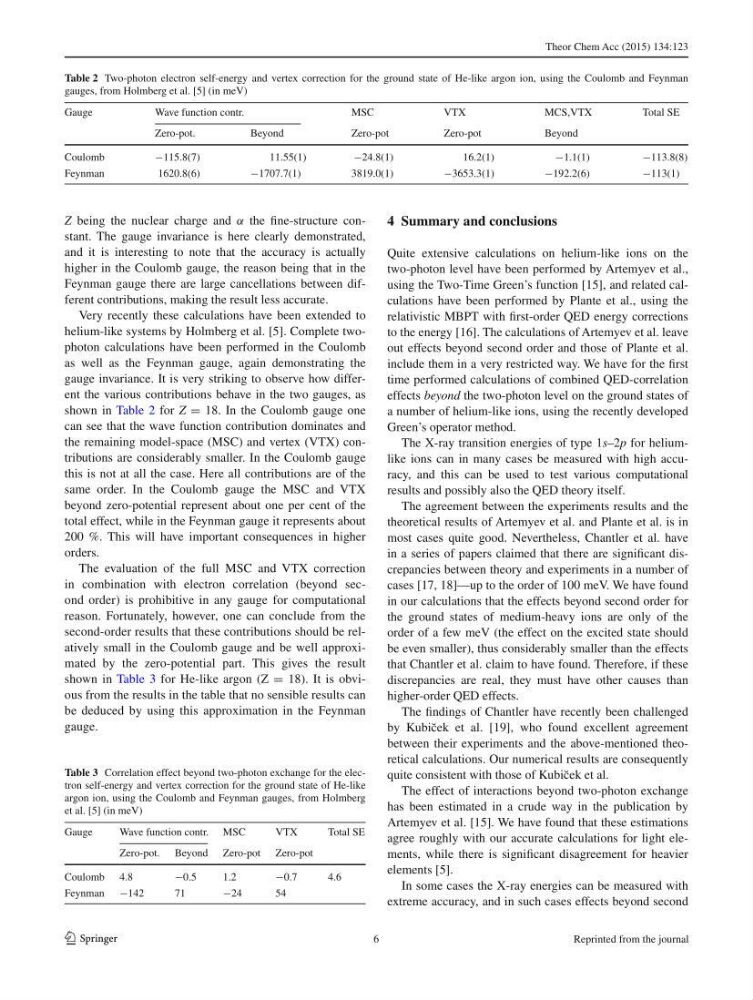
gauge invariance. It is very striking to observe how different the various contributions behave in the two gauges, as
shown in Table 2 for Z = 18. In the Coulomb gauge one
can see that the wave function contribution dominates and
the remaining model-space (MSC) and vertex (VTX) contributions are considerably smaller. In the Coulomb gauge
this is not at all the case. Here all contributions are of the
same order. In the Coulomb gauge the MSC and VTX
beyond zero-potential represent about one per cent of the
total effect, while in the Feynman gauge it represents about
200 %. This will have important consequences in higher
orders.
The evaluation of the full MSC and VTX correction
in combination with electron correlation (beyond second order) is prohibitive in any gauge for computational
reason. Fortunately, however, one can conclude from the
second-order results that these contributions should be relatively small in the Coulomb gauge and be well approximated by the zero-potential part. This gives the result
shown in Table 3 for He-like argon (Z = 18). It is obvious from the results in the table that no sensible results can
be deduced by using this approximation in the Feynman
gauge.
4 Summary and conclusions
Quite extensive calculations on helium-like ions on the
two-photon level have been performed by Artemyev et al.,
using the Two-Time Green’s function [ 15 ], and related calculations have been performed by Plante et al., using the
relativistic MBPT with fi rst-order QED energy corrections
to the energy [ 16 ]. The calculations of Artemyev et al. leave
out effects beyond second order and those of Plante et al.
include them in a very restricted way. We have for the fi rst
time performed calculations of combined QED-correlation
effects beyond the two-photon level on the ground states of
a number of helium-like ions, using the recently developed
Green’s operator method.
The X-ray transition energies of type 1 s –2 p for heliumlike ions can in many cases be measured with high accuracy, and this can be used to test various computational
results and possibly also the QED theory itself.
The agreement between the experiments results and the
theoretical results of Artemyev et al. and Plante et al. is in
most cases quite good. Nevertheless, Chantler et al. have
in a series of papers claimed that there are signifi cant discrepancies between theory and experiments in a number of
cases [ 17 , 18 ]—up to the order of 100 meV. We have found
in our calculations that the effects beyond second order for
the ground states of medium-heavy ions are only of the
order of a few meV (the effect on the excited state should
be even smaller), thus considerably smaller than the effects
that Chantler et al. claim to have found. Therefore, if these
discrepancies are real, they must have other causes than
higher-order QED effects.
The fi ndings of Chantler have recently been challenged
by Kubic̆ ek et al. [ 19 ], who found excellent agreement
between their experiments and the above-mentioned theoretical calculations. Our numerical results are consequently
quite consistent with those of Kubic̆ ek et al.
The effect of interactions beyond two-photon exchange
has been estimated in a crude way in the publication by
Artemyev et al. [ 15 ]. We have found that these estimations
agree roughly with our accurate calculations for light elements, while there is signifi cant disagreement for heavier
elements [ 5 ].
In some cases the X-ray energies can be measured with
extreme accuracy, and in such cases effects beyond second
Table 2 Two-photon electron self-energy and vertex correction for the ground state of He-like argon ion, using the Coulomb and Feynman
gauges, from Holmberg et al. [ 5 ] (in meV)
Gauge
Wave function contr.
MSC
VTX
MCS,VTX
Total SE
Zero-pot.
Beyond
Zero-pot
Zero-pot
Beyond
Coulomb
−115.8(7)
11.55(1)
−24.8(1)
16.2(1)
−1.1(1)
−113.8(8)
Feynman
1620.8(6)
−1707.7(1)
3819.0(1)
−3653.3(1)
−192.2(6)
−113(1)
Table 3 Correlation effect beyond two-photon exchange for the electron self-energy and vertex correction for the ground state of He-like
argon ion, using the Coulomb and Feynman gauges, from Holmberg
et al. [ 5 ] (in meV)
Gauge
Wave function contr. MSC
VTX
Total SE
Zero-pot. Beyond Zero-pot Zero-pot
Coulomb 4.8
−0.5
1.2
−0.7
4.6
Feynman −142
71
−24
54
6
Reprinted from the journal
1 3
Z being the nuclear charge and α the fi ne-structure constant. The gauge invariance is here clearly demonstrated,
and it is interesting to note that the accuracy is actually
higher in the Coulomb gauge, the reason being that in the
Feynman gauge there are large cancellations between different contributions, making the result less accurate.
Very recently these calculations have been extended to
helium-like systems by Holmberg et al. [ 5 ]. Complete twophoton calculations have been performed in the Coulomb
as well as the Feynman gauge, again demonstrating the
gauge invariance. It is very striking to observe how different the various contributions behave in the two gauges, as
shown in Table 2 for Z = 18. In the Coulomb gauge one
can see that the wave function contribution dominates and
the remaining model-space (MSC) and vertex (VTX) contributions are considerably smaller. In the Coulomb gauge
this is not at all the case. Here all contributions are of the
same order. In the Coulomb gauge the MSC and VTX
beyond zero-potential represent about one per cent of the
total effect, while in the Feynman gauge it represents about
200 %. This will have important consequences in higher
orders.
The evaluation of the full MSC and VTX correction
in combination with electron correlation (beyond second order) is prohibitive in any gauge for computational
reason. Fortunately, however, one can conclude from the
second-order results that these contributions should be relatively small in the Coulomb gauge and be well approximated by the zero-potential part. This gives the result
shown in Table 3 for He-like argon (Z = 18). It is obvious from the results in the table that no sensible results can
be deduced by using this approximation in the Feynman
gauge.
4 Summary and conclusions
Quite extensive calculations on helium-like ions on the
two-photon level have been performed by Artemyev et al.,
using the Two-Time Green’s function [ 15 ], and related calculations have been performed by Plante et al., using the
relativistic MBPT with fi rst-order QED energy corrections
to the energy [ 16 ]. The calculations of Artemyev et al. leave
out effects beyond second order and those of Plante et al.
include them in a very restricted way. We have for the fi rst
time performed calculations of combined QED-correlation
effects beyond the two-photon level on the ground states of
a number of helium-like ions, using the recently developed
Green’s operator method.
The X-ray transition energies of type 1 s –2 p for heliumlike ions can in many cases be measured with high accuracy, and this can be used to test various computational
results and possibly also the QED theory itself.
The agreement between the experiments results and the
theoretical results of Artemyev et al. and Plante et al. is in
most cases quite good. Nevertheless, Chantler et al. have
in a series of papers claimed that there are signifi cant discrepancies between theory and experiments in a number of
cases [ 17 , 18 ]—up to the order of 100 meV. We have found
in our calculations that the effects beyond second order for
the ground states of medium-heavy ions are only of the
order of a few meV (the effect on the excited state should
be even smaller), thus considerably smaller than the effects
that Chantler et al. claim to have found. Therefore, if these
discrepancies are real, they must have other causes than
higher-order QED effects.
The fi ndings of Chantler have recently been challenged
by Kubic̆ ek et al. [ 19 ], who found excellent agreement
between their experiments and the above-mentioned theoretical calculations. Our numerical results are consequently
quite consistent with those of Kubic̆ ek et al.
The effect of interactions beyond two-photon exchange
has been estimated in a crude way in the publication by
Artemyev et al. [ 15 ]. We have found that these estimations
agree roughly with our accurate calculations for light elements, while there is signifi cant disagreement for heavier
elements [ 5 ].
In some cases the X-ray energies can be measured with
extreme accuracy, and in such cases effects beyond second
Table 2 Two-photon electron self-energy and vertex correction for the ground state of He-like argon ion, using the Coulomb and Feynman
gauges, from Holmberg et al. [ 5 ] (in meV)
Gauge
Wave function contr.
MSC
VTX
MCS,VTX
Total SE
Zero-pot.
Beyond
Zero-pot
Zero-pot
Beyond
Coulomb
−115.8(7)
11.55(1)
−24.8(1)
16.2(1)
−1.1(1)
−113.8(8)
Feynman
1620.8(6)
−1707.7(1)
3819.0(1)
−3653.3(1)
−192.2(6)
−113(1)
Table 3 Correlation effect beyond two-photon exchange for the electron self-energy and vertex correction for the ground state of He-like
argon ion, using the Coulomb and Feynman gauges, from Holmberg
et al. [ 5 ] (in meV)
Gauge
Wave function contr. MSC
VTX
Total SE
Zero-pot. Beyond Zero-pot Zero-pot
Coulomb 4.8
−0.5
1.2
−0.7
4.6
Feynman −142
71
−24
54
6
Reprinted from the journal