

Theor Chem Acc (2015) 134:123
1 3
where the second term is the MSC.
The effective interaction that gives rise to the energy
shift is given by
and applied to the fi rst-order Green’s operator we fi nd that
the fi rst-order effective interaction is as expected
Continuing this process we fi nd that the second-order
Green’s operator becomes
where we have assumed that the interactions might be
different. If the interactions are energy independent, this
goes over into the second-order wave operator of standard
MBPT [ 1 ]
The second-order effective interaction becomes
The last terms in Eqs. ( 14 ) and ( 16 ) are MSC.
The Green’s operator satisfi es a Bloch-like equation
where the asterisk represents derivation with respect to the
last interaction Γ Q V and with respect to G (0) when no factor
of Γ Q V is present. When the interactions are energy independent, this equation goes over into the Bloch equation in
standard MBPT [ 1 , 6 , 7 ].
3 Application to Helium-like ions
The procedure sketched above has recently been applied
to the ground state of medium-heavy helium-like ions. We
have evaluated the effect of QED combined with electron
correlation, defi ned as the interaction with at least two Coulomb interactions. The QED part is here restricted to fi rst
order and consists of “non-radiative” effects (retardation of
the electromagnetic interaction and effect of virtual electron–positron pairs) as well as “radiative” effects (electron
self-energy, vacuum polarization and vertex correction).
(11)
G
(1)
(t, E)P E = G
(0)
(t, E)Γ Q VP E
+
δG (0) (t, E)
δE
P E V (E)P E ,
(12)
W = P
i
∂
∂t
G(t, −∞)
t=0
P,
(13)
W
(1)
= PVP.
(14)
G
(2)
(t, E)P E = Γ Q V 2 Γ Q V 1 +
δΓ Q V 2
δE
PV 1 P,
(15)
(2)
= Γ Q V 2 Γ Q V 1 − Γ Q
(1) W
(1) .
(16)
W
(2)
= PV 2 Γ Q V 1 + P
δV 2
δE
PV 1 P.
(17)
G = G
(0)
+ Γ Q V G +
δ ∗ G
δE
W ,
It is true that in this procedure we miss some secondorder QED effects which can be evaluated by standard QED
methods. To mix these in a general way with electron correlation is beyond reach for the moment. We have found,
however, that higher-order correlation is considerably more
important than second-order QED effects for medium-heavy
elements. Therefore, this procedure does include the most
important effects of many-body QED in the cases studied.
The effect of retardation in combination with electron
correlation was evaluated by Daniel Hedendahl in his PhD
thesis [ 8 ], including the effect of crossing Coulomb interaction and the effect of virtual pairs. The effect was found to
be of the order of 5–10 meV for the ground state of heliumlike ions in the range Z = 20–40. This is one order of magnitude smaller than the corresponding two-photon effect.
To evaluate the corresponding radiative effects is considerably more diffi cult. First or all, these effects are divergent and
the effects have to be regularized and renormalized, which
has to be done in a covariant way. Several schemes for this
procedure exist, but the most effective scheme is the dimensional regularization, where the calculations are performed in
(4 − ) dimensions, being a small positive number. Then all
integrals are fi nite, and fi nally the limit → 0 is taken.
All calculations of radiative QED effects have until very
recently been performed using the Feynman gauge. The
procedure for dimensional regularization was developed
for that gauge around 1990 mainly by Snyderman at Livermore Nat. Lab. [ 10 ], and the procedure has been applied
by several laboratories [ 11 , 12 ]. We have demonstrated
that it is more advantageous to use the Coulomb gauge in
combination with electron correlation. Here, the dimensional regularization is more complicated, but a working
procedure was developed a few years ago by Hedendahl
and Holmberg [ 9 ] at our laboratory, based upon the work of
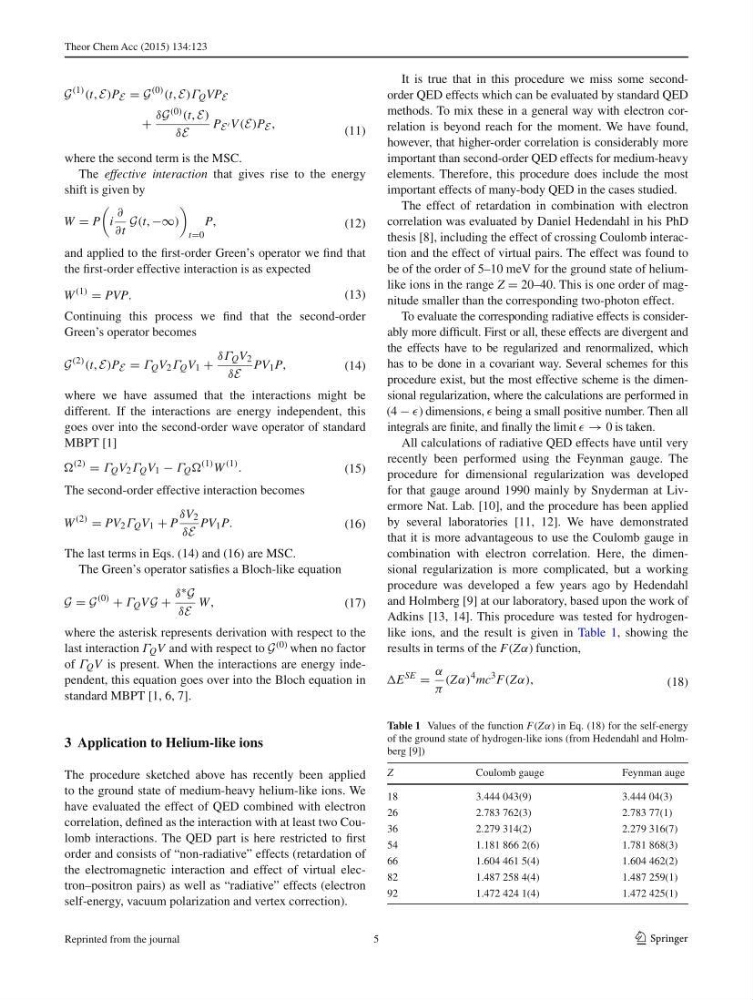
Adkins [ 13 , 14 ]. This procedure was tested for hydrogenlike ions, and the result is given in Table 1 , showing the
results in terms of the F(Zα) function,
(18)
E
SE
=
α
π
(Zα)
4 mc
3 F(Zα),
Table 1 Values of the function F(Zα) in Eq. ( 18 ) for the self-energy
of the ground state of hydrogen-like ions (from Hedendahl and Holmberg [ 9 ])
Z
Coulomb gauge
Feynman auge
18
3.444 043(9)
3.444 04(3)
26
2.783 762(3)
2.783 77(1)
36
2.279 314(2)
2.279 316(7)
54
1.181 866 2(6)
1.781 868(3)
66
1.604 461 5(4)
1.604 462(2)
82
1.487 258 4(4)
1.487 259(1)
92
1.472 424 1(4)
1.472 425(1)
5
Reprinted from the journal
1 3
where the second term is the MSC.
The effective interaction that gives rise to the energy
shift is given by
and applied to the fi rst-order Green’s operator we fi nd that
the fi rst-order effective interaction is as expected
Continuing this process we fi nd that the second-order
Green’s operator becomes
where we have assumed that the interactions might be
different. If the interactions are energy independent, this
goes over into the second-order wave operator of standard
MBPT [ 1 ]
The second-order effective interaction becomes
The last terms in Eqs. ( 14 ) and ( 16 ) are MSC.
The Green’s operator satisfi es a Bloch-like equation
where the asterisk represents derivation with respect to the
last interaction Γ Q V and with respect to G (0) when no factor
of Γ Q V is present. When the interactions are energy independent, this equation goes over into the Bloch equation in
standard MBPT [ 1 , 6 , 7 ].
3 Application to Helium-like ions
The procedure sketched above has recently been applied
to the ground state of medium-heavy helium-like ions. We
have evaluated the effect of QED combined with electron
correlation, defi ned as the interaction with at least two Coulomb interactions. The QED part is here restricted to fi rst
order and consists of “non-radiative” effects (retardation of
the electromagnetic interaction and effect of virtual electron–positron pairs) as well as “radiative” effects (electron
self-energy, vacuum polarization and vertex correction).
(11)
G
(1)
(t, E)P E = G
(0)
(t, E)Γ Q VP E
+
δG (0) (t, E)
δE
P E V (E)P E ,
(12)
W = P
i
∂
∂t
G(t, −∞)
t=0
P,
(13)
W
(1)
= PVP.
(14)
G
(2)
(t, E)P E = Γ Q V 2 Γ Q V 1 +
δΓ Q V 2
δE
PV 1 P,
(15)
(2)
= Γ Q V 2 Γ Q V 1 − Γ Q
(1) W
(1) .
(16)
W
(2)
= PV 2 Γ Q V 1 + P
δV 2
δE
PV 1 P.
(17)
G = G
(0)
+ Γ Q V G +
δ ∗ G
δE
W ,
It is true that in this procedure we miss some secondorder QED effects which can be evaluated by standard QED
methods. To mix these in a general way with electron correlation is beyond reach for the moment. We have found,
however, that higher-order correlation is considerably more
important than second-order QED effects for medium-heavy
elements. Therefore, this procedure does include the most
important effects of many-body QED in the cases studied.
The effect of retardation in combination with electron
correlation was evaluated by Daniel Hedendahl in his PhD
thesis [ 8 ], including the effect of crossing Coulomb interaction and the effect of virtual pairs. The effect was found to
be of the order of 5–10 meV for the ground state of heliumlike ions in the range Z = 20–40. This is one order of magnitude smaller than the corresponding two-photon effect.
To evaluate the corresponding radiative effects is considerably more diffi cult. First or all, these effects are divergent and
the effects have to be regularized and renormalized, which
has to be done in a covariant way. Several schemes for this
procedure exist, but the most effective scheme is the dimensional regularization, where the calculations are performed in
(4 − ) dimensions, being a small positive number. Then all
integrals are fi nite, and fi nally the limit → 0 is taken.
All calculations of radiative QED effects have until very
recently been performed using the Feynman gauge. The
procedure for dimensional regularization was developed
for that gauge around 1990 mainly by Snyderman at Livermore Nat. Lab. [ 10 ], and the procedure has been applied
by several laboratories [ 11 , 12 ]. We have demonstrated
that it is more advantageous to use the Coulomb gauge in
combination with electron correlation. Here, the dimensional regularization is more complicated, but a working
procedure was developed a few years ago by Hedendahl
and Holmberg [ 9 ] at our laboratory, based upon the work of
Adkins [ 13 , 14 ]. This procedure was tested for hydrogenlike ions, and the result is given in Table 1 , showing the
results in terms of the F(Zα) function,
(18)
E
SE
=
α
π
(Zα)
4 mc
3 F(Zα),
Table 1 Values of the function F(Zα) in Eq. ( 18 ) for the self-energy
of the ground state of hydrogen-like ions (from Hedendahl and Holmberg [ 9 ])
Z
Coulomb gauge
Feynman auge
18
3.444 043(9)
3.444 04(3)
26
2.783 762(3)
2.783 77(1)
36
2.279 314(2)
2.279 316(7)
54
1.181 866 2(6)
1.781 868(3)
66
1.604 461 5(4)
1.604 462(2)
82
1.487 258 4(4)
1.487 259(1)
92
1.472 424 1(4)
1.472 425(1)
5
Reprinted from the journal