

Theor Chem Acc (2015) 134:123
1 3
with the Hamiltonian in the Schrödinger representation
H = H 0 + V and E being the exact energy of the state. An
equation for the evolution operator follows from the timedependent Schrödinger equation.
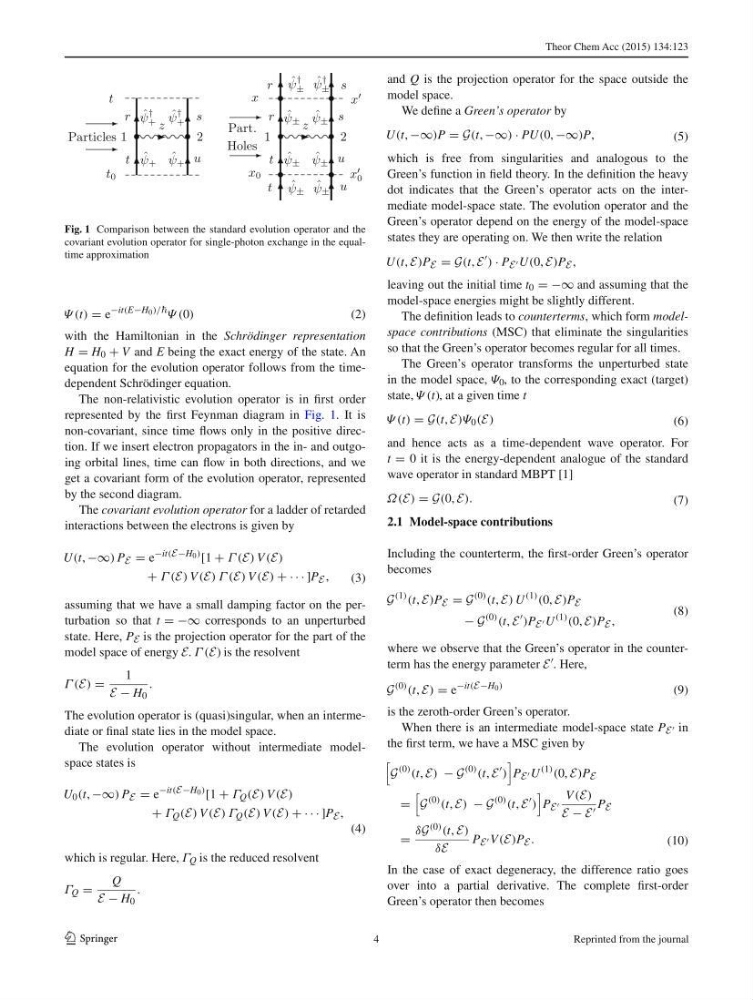
The non-relativistic evolution operator is in fi rst order
represented by the fi rst Feynman diagram in Fig. 1 . It is
non-covariant, since time fl ows only in the positive direction. If we insert electron propagators in the in- and outgoing orbital lines, time can fl ow in both directions, and we
get a covariant form of the evolution operator, represented
by the second diagram.
The covariant evolution operator for a ladder of retarded
interactions between the electrons is given by
assuming that we have a small damping factor on the perturbation so that t = −∞ corresponds to an unperturbed
state. Here, P E is the projection operator for the part of the
model space of energy E . Γ (E) is the resolvent
The evolution operator is (quasi)singular, when an intermediate or fi nal state lies in the model space.
The evolution operator without intermediate modelspace states is
which is regular. Here, Γ Q is the reduced resolvent
(2)
Ψ (t) = e
−it(E−H 0 )/
Ψ (0)
(3)
U(t, −∞) P E = e
−it(E−H 0 )
[1 + Γ (E) V (E)
+ Γ (E) V (E) Γ (E) V (E) + · · · ]P E ,
Γ (E) =
1
E − H 0
.
(4)
U 0 (t, −∞) P E = e
−it(E−H 0 )
[1 + Γ Q (E) V (E)
+ Γ Q (E) V (E) Γ Q (E) V (E) + · · · ]P E ,
Γ Q =
Q
E − H 0
.
and Q is the projection operator for the space outside the
model space.
We defi ne a Green’s operator by
which is free from singularities and analogous to the
Green’s function in fi eld theory. In the defi nition the heavy
dot indicates that the Green’s operator acts on the intermediate model-space state. The evolution operator and the
Green’s operator depend on the energy of the model-space
states they are operating on. We then write the relation
leaving out the initial time t 0 = −∞ and assuming that the
model-space energies might be slightly different.
The defi nition leads to counterterms , which form modelspace contributions (MSC) that eliminate the singularities
so that the Green’s operator becomes regular for all times.
The Green’s operator transforms the unperturbed state
in the model space, Ψ 0 , to the corresponding exact (target)
state, Ψ (t) , at a given time t
and hence acts as a time-dependent wave operator. For
t = 0 it is the energy-dependent analogue of the standard
wave operator in standard MBPT [ 1 ]
2.1 Model-space contributions
Including the counterterm, the fi rst-order Green’s operator
becomes
where we observe that the Green’s operator in the counterterm has the energy parameter E . Here,
is the zeroth-order Green’s operator.
When there is an intermediate model-space state P E in
the fi rst term, we have a MSC given by
In the case of exact degeneracy, the difference ratio goes
over into a partial derivative. The complete fi rst-order
Green’s operator then becomes
(5)
U(t, −∞)P = G(t, −∞) · PU(0, −∞)P,
U(t, E)P E = G(t, E
) · P E U(0, E)P E ,
(6)
Ψ (t) = G(t, E)Ψ 0 (E)
(7)
Ω(E) = G(0, E).
(8)
G
(1)
(t, E)P E = G
(0)
(t, E) U
(1)
(0, E)P E
− G
(0)
(t, E
)P E U
(1)
(0, E)P E ,
(9)
G
(0)
(t, E) = e
−it(E−H 0 )
(10)
G
(0)
(t, E) − G
(0)
(t, E
)
P E U
(1)
(0, E)P E
=
G
(0)
(t, E) − G
(0)
(t, E
)
P E
V (E)
E − E P E
=
δG (0) (t, E)
δE
P E V (E)P E .
t
t ˆ
ψ + ˆ
ψ + u
z
1
2
r ˆ
ψ
†
+
ˆ
ψ
†
+ s
t 0
Particles
x
x
r
s
ˆ
ψ
†
±
ˆ
ψ
†
±
t ˆ
ψ ± ˆ
ψ ± u
z
1
2
r ˆ
ψ ± ˆ
ψ ± s
x 0
x 0
t
u
ˆ
ψ ± ˆ
ψ ±
Part.
Holes
Fig. 1 Comparison between the standard evolution operator and the
covariant evolution operator for single-photon exchange in the equaltime approximation
4
Reprinted from the journal
1 3
with the Hamiltonian in the Schrödinger representation
H = H 0 + V and E being the exact energy of the state. An
equation for the evolution operator follows from the timedependent Schrödinger equation.
The non-relativistic evolution operator is in fi rst order
represented by the fi rst Feynman diagram in Fig. 1 . It is
non-covariant, since time fl ows only in the positive direction. If we insert electron propagators in the in- and outgoing orbital lines, time can fl ow in both directions, and we
get a covariant form of the evolution operator, represented
by the second diagram.
The covariant evolution operator for a ladder of retarded
interactions between the electrons is given by
assuming that we have a small damping factor on the perturbation so that t = −∞ corresponds to an unperturbed
state. Here, P E is the projection operator for the part of the
model space of energy E . Γ (E) is the resolvent
The evolution operator is (quasi)singular, when an intermediate or fi nal state lies in the model space.
The evolution operator without intermediate modelspace states is
which is regular. Here, Γ Q is the reduced resolvent
(2)
Ψ (t) = e
−it(E−H 0 )/
Ψ (0)
(3)
U(t, −∞) P E = e
−it(E−H 0 )
[1 + Γ (E) V (E)
+ Γ (E) V (E) Γ (E) V (E) + · · · ]P E ,
Γ (E) =
1
E − H 0
.
(4)
U 0 (t, −∞) P E = e
−it(E−H 0 )
[1 + Γ Q (E) V (E)
+ Γ Q (E) V (E) Γ Q (E) V (E) + · · · ]P E ,
Γ Q =
Q
E − H 0
.
and Q is the projection operator for the space outside the
model space.
We defi ne a Green’s operator by
which is free from singularities and analogous to the
Green’s function in fi eld theory. In the defi nition the heavy
dot indicates that the Green’s operator acts on the intermediate model-space state. The evolution operator and the
Green’s operator depend on the energy of the model-space
states they are operating on. We then write the relation
leaving out the initial time t 0 = −∞ and assuming that the
model-space energies might be slightly different.
The defi nition leads to counterterms , which form modelspace contributions (MSC) that eliminate the singularities
so that the Green’s operator becomes regular for all times.
The Green’s operator transforms the unperturbed state
in the model space, Ψ 0 , to the corresponding exact (target)
state, Ψ (t) , at a given time t
and hence acts as a time-dependent wave operator. For
t = 0 it is the energy-dependent analogue of the standard
wave operator in standard MBPT [ 1 ]
2.1 Model-space contributions
Including the counterterm, the fi rst-order Green’s operator
becomes
where we observe that the Green’s operator in the counterterm has the energy parameter E . Here,
is the zeroth-order Green’s operator.
When there is an intermediate model-space state P E in
the fi rst term, we have a MSC given by
In the case of exact degeneracy, the difference ratio goes
over into a partial derivative. The complete fi rst-order
Green’s operator then becomes
(5)
U(t, −∞)P = G(t, −∞) · PU(0, −∞)P,
U(t, E)P E = G(t, E
) · P E U(0, E)P E ,
(6)
Ψ (t) = G(t, E)Ψ 0 (E)
(7)
Ω(E) = G(0, E).
(8)
G
(1)
(t, E)P E = G
(0)
(t, E) U
(1)
(0, E)P E
− G
(0)
(t, E
)P E U
(1)
(0, E)P E ,
(9)
G
(0)
(t, E) = e
−it(E−H 0 )
(10)
G
(0)
(t, E) − G
(0)
(t, E
)
P E U
(1)
(0, E)P E
=
G
(0)
(t, E) − G
(0)
(t, E
)
P E
V (E)
E − E P E
=
δG (0) (t, E)
δE
P E V (E)P E .
t
t ˆ
ψ + ˆ
ψ + u
z
1
2
r ˆ
ψ
†
+
ˆ
ψ
†
+ s
t 0
Particles
x
x
r
s
ˆ
ψ
†
±
ˆ
ψ
†
±
t ˆ
ψ ± ˆ
ψ ± u
z
1
2
r ˆ
ψ ± ˆ
ψ ± s
x 0
x 0
t
u
ˆ
ψ ± ˆ
ψ ±
Part.
Holes
Fig. 1 Comparison between the standard evolution operator and the
covariant evolution operator for single-photon exchange in the equaltime approximation
4
Reprinted from the journal