

Theor Chem Acc (2015) 134:85
1 3
four- and six-electron Be, LiH, BeH + , Li 2 , BH, BH
+
2 , and
BeH 2 and the basis sets STO-3G, in order to face up to an
affordable computational cost. Moreover, we also report
results corresponding to the Be atom in the cc-pVDZ basis
set and the Mg one in the 6-31G basis sets, which are prototype examples of strongly correlated systems due to the
near-degeneracies between it s and p shells. The molecular
systems have been studied at equilibrium distances (R e ) and
at stretched ones (R st ) . The experimental geometrical distances have been used for the neutral species LiH, Li 2 , BH,
and BeH 2 [ 28 ]; in the molecular ion BeH + , we have used
the internuclear distance reported in Refs. [ 29 ] and [ 30 ],
while in the system BH
+
2 , the geometry was optimized with
the GAUSSIAN package [ 31 ] at single and double excitations. The one- and two-electron integrals and the Hartree–Fock canonical molecular orbitals basis sets required
for our calculations have been obtained from a modifi ed
version of the PSI 3.3 code [ 32 ]. We have constructed
our own codes to determine the ground-state FCI wave
functions for these systems expressed in the basis sets of
CMO and NO; the orbitals minimizing the seniority number for a given wave function have been obtained from an
iterative procedure reported in Ref. [ 27 ], using the CMO
sets as initial bases of that iteration. The results found for
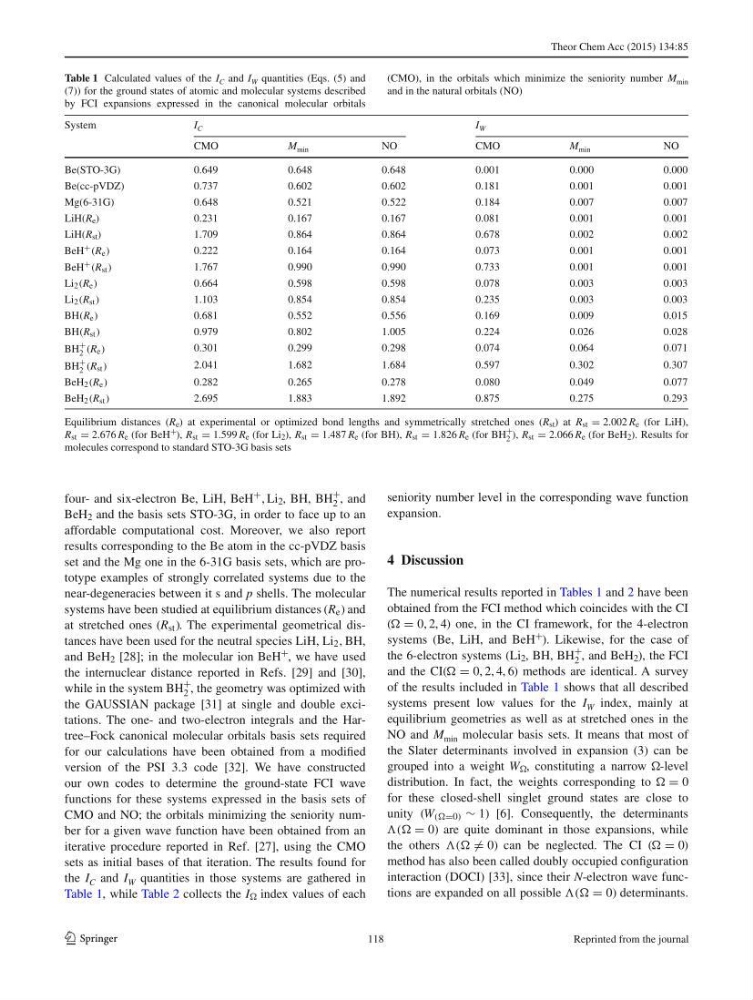
the I C and I W quantities in those systems are gathered in
Table 1 , while Table 2 collects the I index values of each
seniority number level in the corresponding wave function
expansion.
4 Discussion
The numerical results reported in Tables 1 and 2 have been
obtained from the FCI method which coincides with the CI
( = 0, 2, 4 ) one, in the CI framework, for the 4-electron
systems (Be, LiH, and BeH + ). Likewise, for the case of
the 6-electron systems ( Li 2 , BH, BH
+
2 , and BeH 2 ), the FCI
and the CI( = 0, 2, 4, 6 ) methods are identical. A survey
of the results included in Table 1 shows that all described
systems present low values for the I W index, mainly at
equilibrium geometries as well as at stretched ones in the
NO and M min molecular basis sets. It means that most of
the Slater determinants involved in expansion ( 3 ) can be
grouped into a weight W , constituting a narrow -level
distribution. In fact, the weights corresponding to = 0
for these closed-shell singlet ground states are close to
unity ( W ((=0) ∼ 1) [ 6 ]. Consequently, the determinants
( = 0) are quite dominant in those expansions, while
the others (( = 0) can be neglected. The CI ( = 0 )
method has also been called doubly occupied confi guration
interaction (DOCI) [ 33 ], since their N -electron wave functions are expanded on all possible ( = 0) determinants.
Table 1 Calculated values of the I C and I W quantities (Eqs. ( 5 ) and
( 7 )) for the ground states of atomic and molecular systems described
by FCI expansions expressed in the canonical molecular orbitals
(CMO), in the orbitals which minimize the seniority number M min
and in the natural orbitals (NO)
Equilibrium distances ( R e ) at experimental or optimized bond lengths and symmetrically stretched ones ( R st ) at R st = 2.002 R e (for LiH),
R st = 2.676 R e (for BeH + ), R st = 1.599 R e (for Li 2 ), R st = 1.487 R e (for BH), R st = 1.826 R e (for BH
+
2 ), R st = 2.066 R e (for BeH 2 ). Results for
molecules correspond to standard STO-3G basis sets
System
I C
I W
CMO
M min
NO
CMO
M min
NO
Be(STO-3G)
0.649
0.648
0.648
0.001
0.000
0.000
Be(cc-pVDZ)
0.737
0.602
0.602
0.181
0.001
0.001
Mg(6-31G)
0.648
0.521
0.522
0.184
0.007
0.007
LiH( R e )
0.231
0.167
0.167
0.081
0.001
0.001
LiH( R st )
1.709
0.864
0.864
0.678
0.002
0.002
BeH + (R e )
0.222
0.164
0.164
0.073
0.001
0.001
BeH + (R st )
1.767
0.990
0.990
0.733
0.001
0.001
Li 2 (R e )
0.664
0.598
0.598
0.078
0.003
0.003
Li 2 (R st )
1.103
0.854
0.854
0.235
0.003
0.003
BH(R e )
0.681
0.552
0.556
0.169
0.009
0.015
BH(R st )
0.979
0.802
1.005
0.224
0.026
0.028
BH
+
2 (R e )
0.301
0.299
0.298
0.074
0.064
0.071
BH
+
2 (R st )
2.041
1.682
1.684
0.597
0.302
0.307
BeH 2 (R e )
0.282
0.265
0.278
0.080
0.049
0.077
BeH 2 (R st )
2.695
1.883
1.892
0.875
0.275
0.293
118
Reprinted from the journal
1 3
four- and six-electron Be, LiH, BeH + , Li 2 , BH, BH
+
2 , and
BeH 2 and the basis sets STO-3G, in order to face up to an
affordable computational cost. Moreover, we also report
results corresponding to the Be atom in the cc-pVDZ basis
set and the Mg one in the 6-31G basis sets, which are prototype examples of strongly correlated systems due to the
near-degeneracies between it s and p shells. The molecular
systems have been studied at equilibrium distances (R e ) and
at stretched ones (R st ) . The experimental geometrical distances have been used for the neutral species LiH, Li 2 , BH,
and BeH 2 [ 28 ]; in the molecular ion BeH + , we have used
the internuclear distance reported in Refs. [ 29 ] and [ 30 ],
while in the system BH
+
2 , the geometry was optimized with
the GAUSSIAN package [ 31 ] at single and double excitations. The one- and two-electron integrals and the Hartree–Fock canonical molecular orbitals basis sets required
for our calculations have been obtained from a modifi ed
version of the PSI 3.3 code [ 32 ]. We have constructed
our own codes to determine the ground-state FCI wave
functions for these systems expressed in the basis sets of
CMO and NO; the orbitals minimizing the seniority number for a given wave function have been obtained from an
iterative procedure reported in Ref. [ 27 ], using the CMO
sets as initial bases of that iteration. The results found for
the I C and I W quantities in those systems are gathered in
Table 1 , while Table 2 collects the I index values of each
seniority number level in the corresponding wave function
expansion.
4 Discussion
The numerical results reported in Tables 1 and 2 have been
obtained from the FCI method which coincides with the CI
( = 0, 2, 4 ) one, in the CI framework, for the 4-electron
systems (Be, LiH, and BeH + ). Likewise, for the case of
the 6-electron systems ( Li 2 , BH, BH
+
2 , and BeH 2 ), the FCI
and the CI( = 0, 2, 4, 6 ) methods are identical. A survey
of the results included in Table 1 shows that all described
systems present low values for the I W index, mainly at
equilibrium geometries as well as at stretched ones in the
NO and M min molecular basis sets. It means that most of
the Slater determinants involved in expansion ( 3 ) can be
grouped into a weight W , constituting a narrow -level
distribution. In fact, the weights corresponding to = 0
for these closed-shell singlet ground states are close to
unity ( W ((=0) ∼ 1) [ 6 ]. Consequently, the determinants
( = 0) are quite dominant in those expansions, while
the others (( = 0) can be neglected. The CI ( = 0 )
method has also been called doubly occupied confi guration
interaction (DOCI) [ 33 ], since their N -electron wave functions are expanded on all possible ( = 0) determinants.
Table 1 Calculated values of the I C and I W quantities (Eqs. ( 5 ) and
( 7 )) for the ground states of atomic and molecular systems described
by FCI expansions expressed in the canonical molecular orbitals
(CMO), in the orbitals which minimize the seniority number M min
and in the natural orbitals (NO)
Equilibrium distances ( R e ) at experimental or optimized bond lengths and symmetrically stretched ones ( R st ) at R st = 2.002 R e (for LiH),
R st = 2.676 R e (for BeH + ), R st = 1.599 R e (for Li 2 ), R st = 1.487 R e (for BH), R st = 1.826 R e (for BH
+
2 ), R st = 2.066 R e (for BeH 2 ). Results for
molecules correspond to standard STO-3G basis sets
System
I C
I W
CMO
M min
NO
CMO
M min
NO
Be(STO-3G)
0.649
0.648
0.648
0.001
0.000
0.000
Be(cc-pVDZ)
0.737
0.602
0.602
0.181
0.001
0.001
Mg(6-31G)
0.648
0.521
0.522
0.184
0.007
0.007
LiH( R e )
0.231
0.167
0.167
0.081
0.001
0.001
LiH( R st )
1.709
0.864
0.864
0.678
0.002
0.002
BeH + (R e )
0.222
0.164
0.164
0.073
0.001
0.001
BeH + (R st )
1.767
0.990
0.990
0.733
0.001
0.001
Li 2 (R e )
0.664
0.598
0.598
0.078
0.003
0.003
Li 2 (R st )
1.103
0.854
0.854
0.235
0.003
0.003
BH(R e )
0.681
0.552
0.556
0.169
0.009
0.015
BH(R st )
0.979
0.802
1.005
0.224
0.026
0.028
BH
+
2 (R e )
0.301
0.299
0.298
0.074
0.064
0.071
BH
+
2 (R st )
2.041
1.682
1.684
0.597
0.302
0.307
BeH 2 (R e )
0.282
0.265
0.278
0.080
0.049
0.077
BeH 2 (R st )
2.695
1.883
1.892
0.875
0.275
0.293
118
Reprinted from the journal