

Theor Chem Acc (2015) 134:85
1 3
which is a spin-free quantity, independent of the S z value,
and consequently, we have dropped that quantum number.
The coeffi cients C (() and the ˆ
(N,S) values are strongly
dependent on the molecular orbital set utilized to formulate
the Slater determinants () in the expansion of the wave
function expressed by Eq. ( 3 ). As mentioned in the Introduction, in Refs. [ 6 , 9 , 11 ], we have performed unitary transformations of the molecular orbitals, based on iterative procedures [ 27 ], which lead to the minimization of the ˆ
(N,S)
values; the resulting molecular orbital basis sets have been
denominated M min . That minimization requires the search of
molecular orbitals leading to high values for the coeffi cients
|C (() | corresponding to the determinants which possess
greater doubly occupied orbital numbers, i.e., those providing higher values of the
K
i (()| ˆ
E ii
ii |(() quantities.
Our results [ 6 , 9 , 11 ] have proven that the expansions for
ground-state wave functions of atomic and molecular systems expressed in the molecular orbital basis sets M min turn
out to be more compact than those arising from the canonical
molecular orbitals (CMO) or natural orbitals (NO).
Quantitative measures of the compactness of an
N -electron wave function have been reported in Ref. [ 18 ]
by means of the informational content ( I C (or Shannon
entropy) within the traditional CI expansion method based
on Slater determinants classifi ed according to the excitation
level with respect to a given reference determinant. Assuming that the N -electron wave function is normalized to unity
(
(() |C (() | 2 = 1 ), the counterpart formulation
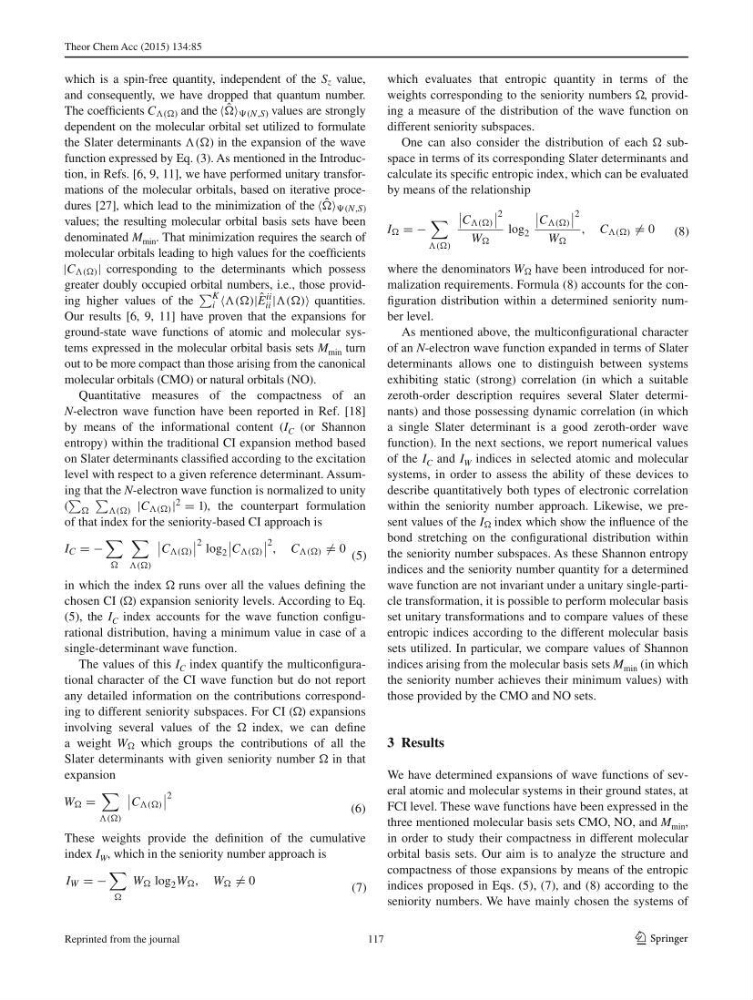
of that index for the seniority-based CI approach is
in which the index runs over all the values defi ning the
chosen CI ( ) expansion seniority levels. According to Eq.
( 5 ), the I C index accounts for the wave function confi gurational distribution, having a minimum value in case of a
single-determinant wave function.
The values of this I C index quantify the multiconfi gurational character of the CI wave function but do not report
any detailed information on the contributions corresponding to different seniority subspaces. For CI ( ) expansions
involving several values of the index, we can defi ne
a weight W which groups the contributions of all the
Slater determinants with given seniority number in that
expansion
These weights provide the defi nition of the cumulative
index I W , which in the seniority number approach is
(5)
I C = −
()
C (()
2 log 2
C (()
2 , C (() = 0
(6)
W =
()
C (()
2
(7)
I W = −
W log 2 W , W = 0
which evaluates that entropic quantity in terms of the
weights corresponding to the seniority numbers , providing a measure of the distribution of the wave function on
different seniority subspaces.
One can also consider the distribution of each subspace in terms of its corresponding Slater determinants and
calculate its specifi c entropic index, which can be evaluated
by means of the relationship
where the denominators W have been introduced for normalization requirements. Formula ( 8 ) accounts for the confi guration distribution within a determined seniority number level.
As mentioned above, the multiconfi gurational character
of an N -electron wave function expanded in terms of Slater
determinants allows one to distinguish between systems
exhibiting static (strong) correlation (in which a suitable
zeroth-order description requires several Slater determinants) and those possessing dynamic correlation (in which
a single Slater determinant is a good zeroth-order wave
function). In the next sections, we report numerical values
of the I C and I W indices in selected atomic and molecular
systems, in order to assess the ability of these devices to
describe quantitatively both types of electronic correlation
within the seniority number approach. Likewise, we present values of the I index which show the infl uence of the
bond stretching on the confi gurational distribution within
the seniority number subspaces. As these Shannon entropy
indices and the seniority number quantity for a determined
wave function are not invariant under a unitary single-particle transformation, it is possible to perform molecular basis
set unitary transformations and to compare values of these
entropic indices according to the different molecular basis
sets utilized. In particular, we compare values of Shannon
indices arising from the molecular basis sets M min (in which
the seniority number achieves their minimum values) with
those provided by the CMO and NO sets.
3 Results
We have determined expansions of wave functions of several atomic and molecular systems in their ground states, at
FCI level. These wave functions have been expressed in the
three mentioned molecular basis sets CMO, NO, and M min ,
in order to study their compactness in different molecular
orbital basis sets. Our aim is to analyze the structure and
compactness of those expansions by means of the entropic
indices proposed in Eqs. ( 5 ), ( 7 ), and ( 8 ) according to the
seniority numbers. We have mainly chosen the systems of
(8)
I = −
()
C (()
2
W
log 2
C (()
2
W
, C (() = 0
117
Reprinted from the journal
1 3
which is a spin-free quantity, independent of the S z value,
and consequently, we have dropped that quantum number.
The coeffi cients C (() and the ˆ
(N,S) values are strongly
dependent on the molecular orbital set utilized to formulate
the Slater determinants () in the expansion of the wave
function expressed by Eq. ( 3 ). As mentioned in the Introduction, in Refs. [ 6 , 9 , 11 ], we have performed unitary transformations of the molecular orbitals, based on iterative procedures [ 27 ], which lead to the minimization of the ˆ
(N,S)
values; the resulting molecular orbital basis sets have been
denominated M min . That minimization requires the search of
molecular orbitals leading to high values for the coeffi cients
|C (() | corresponding to the determinants which possess
greater doubly occupied orbital numbers, i.e., those providing higher values of the
K
i (()| ˆ
E ii
ii |(() quantities.
Our results [ 6 , 9 , 11 ] have proven that the expansions for
ground-state wave functions of atomic and molecular systems expressed in the molecular orbital basis sets M min turn
out to be more compact than those arising from the canonical
molecular orbitals (CMO) or natural orbitals (NO).
Quantitative measures of the compactness of an
N -electron wave function have been reported in Ref. [ 18 ]
by means of the informational content ( I C (or Shannon
entropy) within the traditional CI expansion method based
on Slater determinants classifi ed according to the excitation
level with respect to a given reference determinant. Assuming that the N -electron wave function is normalized to unity
(
(() |C (() | 2 = 1 ), the counterpart formulation
of that index for the seniority-based CI approach is
in which the index runs over all the values defi ning the
chosen CI ( ) expansion seniority levels. According to Eq.
( 5 ), the I C index accounts for the wave function confi gurational distribution, having a minimum value in case of a
single-determinant wave function.
The values of this I C index quantify the multiconfi gurational character of the CI wave function but do not report
any detailed information on the contributions corresponding to different seniority subspaces. For CI ( ) expansions
involving several values of the index, we can defi ne
a weight W which groups the contributions of all the
Slater determinants with given seniority number in that
expansion
These weights provide the defi nition of the cumulative
index I W , which in the seniority number approach is
(5)
I C = −
()
C (()
2 log 2
C (()
2 , C (() = 0
(6)
W =
()
C (()
2
(7)
I W = −
W log 2 W , W = 0
which evaluates that entropic quantity in terms of the
weights corresponding to the seniority numbers , providing a measure of the distribution of the wave function on
different seniority subspaces.
One can also consider the distribution of each subspace in terms of its corresponding Slater determinants and
calculate its specifi c entropic index, which can be evaluated
by means of the relationship
where the denominators W have been introduced for normalization requirements. Formula ( 8 ) accounts for the confi guration distribution within a determined seniority number level.
As mentioned above, the multiconfi gurational character
of an N -electron wave function expanded in terms of Slater
determinants allows one to distinguish between systems
exhibiting static (strong) correlation (in which a suitable
zeroth-order description requires several Slater determinants) and those possessing dynamic correlation (in which
a single Slater determinant is a good zeroth-order wave
function). In the next sections, we report numerical values
of the I C and I W indices in selected atomic and molecular
systems, in order to assess the ability of these devices to
describe quantitatively both types of electronic correlation
within the seniority number approach. Likewise, we present values of the I index which show the infl uence of the
bond stretching on the confi gurational distribution within
the seniority number subspaces. As these Shannon entropy
indices and the seniority number quantity for a determined
wave function are not invariant under a unitary single-particle transformation, it is possible to perform molecular basis
set unitary transformations and to compare values of these
entropic indices according to the different molecular basis
sets utilized. In particular, we compare values of Shannon
indices arising from the molecular basis sets M min (in which
the seniority number achieves their minimum values) with
those provided by the CMO and NO sets.
3 Results
We have determined expansions of wave functions of several atomic and molecular systems in their ground states, at
FCI level. These wave functions have been expressed in the
three mentioned molecular basis sets CMO, NO, and M min ,
in order to study their compactness in different molecular
orbital basis sets. Our aim is to analyze the structure and
compactness of those expansions by means of the entropic
indices proposed in Eqs. ( 5 ), ( 7 ), and ( 8 ) according to the
seniority numbers. We have mainly chosen the systems of
(8)
I = −
()
C (()
2
W
log 2
C (()
2
W
, C (() = 0
117
Reprinted from the journal