

Theor Chem Acc (2015) 134:85
1 3
The low values found for the I W index show that, in these
FCI wave functions, the CI ( = 0 ) or DOCI expansions
are close to the FCI ones, which is in agreement with the
conclusions reported in Ref. [ 34 ] where the DOCI method
has been picked up as a valuable tool to describe a wide
variety of systems possessing strong correlation. As shown
in Table 1 , the I C values are higher than their counterpart I W
ones, indicating that the expansions ( 3 ) involve signifi cant
contributions of ( = 0) Slater determinants other than
the ground closed-shell ones, which are usually chosen as
reference determinants within the traditional excitation CI
approach. This result is confi rmed by the values reported in
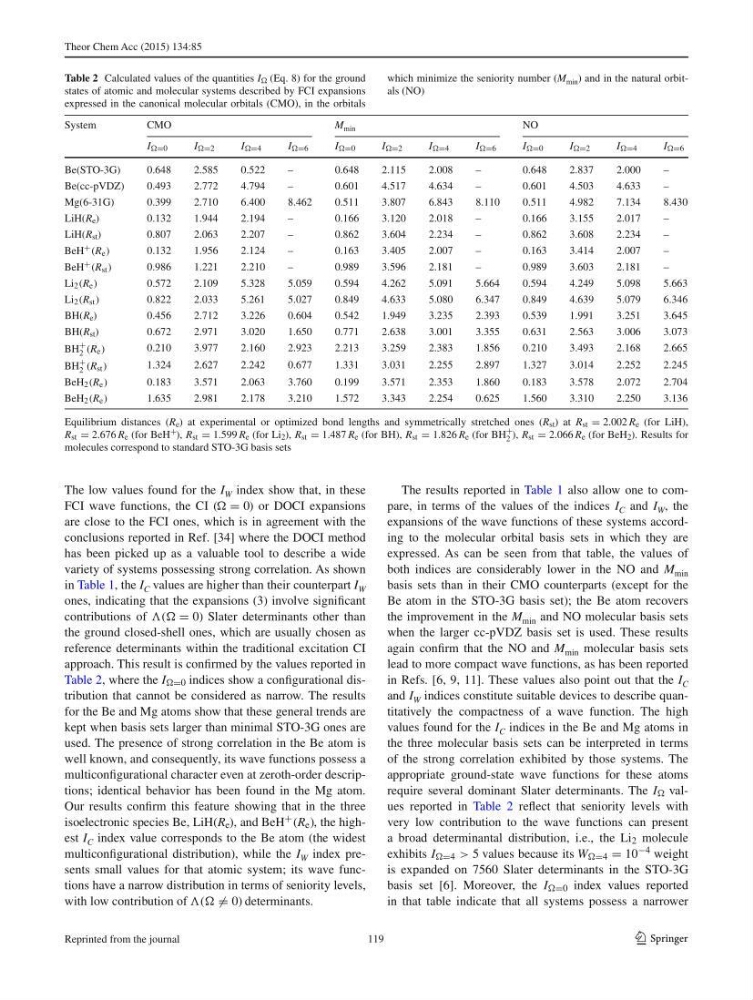
Table 2 , where the I =0 indices show a confi gurational distribution that cannot be considered as narrow. The results
for the Be and Mg atoms show that these general trends are
kept when basis sets larger than minimal STO-3G ones are
used. The presence of strong correlation in the Be atom is
well known, and consequently, its wave functions possess a
multiconfi gurational character even at zeroth-order descriptions; identical behavior has been found in the Mg atom.
Our results confi rm this feature showing that in the three
isoelectronic species Be, LiH( R e ), and BeH + (R e ) , the highest I C index value corresponds to the Be atom (the widest
multiconfi gurational distribution), while the I W index presents small values for that atomic system; its wave functions have a narrow distribution in terms of seniority levels,
with low contribution of (( = 0) determinants.
The results reported in Table 1 also allow one to compare, in terms of the values of the indices I C and I W , the
expansions of the wave functions of these systems according to the molecular orbital basis sets in which they are
expressed. As can be seen from that table, the values of
both indices are considerably lower in the NO and M min
basis sets than in their CMO counterparts (except for the
Be atom in the STO-3G basis set); the Be atom recovers
the improvement in the M min and NO molecular basis sets
when the larger cc-pVDZ basis set is used. These results
again confi rm that the NO and M min molecular basis sets
lead to more compact wave functions, as has been reported
in Refs. [ 6 , 9 , 11 ]. These values also point out that the I C
and I W indices constitute suitable devices to describe quantitatively the compactness of a wave function. The high
values found for the I C indices in the Be and Mg atoms in
the three molecular basis sets can be interpreted in terms
of the strong correlation exhibited by those systems. The
appropriate ground-state wave functions for these atoms
require several dominant Slater determinants. The I values reported in Table 2 refl ect that seniority levels with
very low contribution to the wave functions can present
a broad determinantal distribution, i.e., the Li 2 molecule
exhibits I =4 > 5 values because its W =4 = 10 −4 weight
is expanded on 7560 Slater determinants in the STO-3G
basis set [ 6 ]. Moreover, the I =0 index values reported
in that table indicate that all systems possess a narrower
Table 2 Calculated values of the quantities I (Eq. 8 ) for the ground
states of atomic and molecular systems described by FCI expansions
expressed in the canonical molecular orbitals (CMO), in the orbitals
which minimize the seniority number ( M min ) and in the natural orbitals (NO)
Equilibrium distances ( R e ) at experimental or optimized bond lengths and symmetrically stretched ones ( R st ) at R st = 2.002 R e (for LiH),
R st = 2.676 R e (for BeH + ), R st = 1.599 R e (for Li 2 ), R st = 1.487 R e (for BH), R st = 1.826 R e (for BH
+
2 ), R st = 2.066 R e (for BeH 2 ). Results for
molecules correspond to standard STO-3G basis sets
System
CMO
M min
NO
I =0
I =2
I =4
I =6
I =0
I =2
I =4
I =6
I =0
I =2
I =4
I =6
Be(STO-3G)
0.648
2.585
0.522
–
0.648
2.115
2.008
–
0.648
2.837
2.000
–
Be(cc-pVDZ)
0.493
2.772
4.794
–
0.601
4.517
4.634
–
0.601
4.503
4.633
–
Mg(6-31G)
0.399
2.710
6.400
8.462
0.511
3.807
6.843
8.110
0.511
4.982
7.134
8.430
LiH( R e )
0.132
1.944
2.194
–
0.166
3.120
2.018
–
0.166
3.155
2.017
–
LiH( R st )
0.807
2.063
2.207
–
0.862
3.604
2.234
–
0.862
3.608
2.234
–
BeH + (R e )
0.132
1.956
2.124
–
0.163
3.405
2.007
–
0.163
3.414
2.007
–
BeH + (R st )
0.986
1.221
2.210
–
0.989
3.596
2.181
–
0.989
3.603
2.181
–
Li 2 (R e )
0.572
2.109
5.328
5.059
0.594
4.262
5.091
5.664
0.594
4.249
5.098
5.663
Li 2 (R st )
0.822
2.033
5.261
5.027
0.849
4.633
5.080
6.347
0.849
4.639
5.079
6.346
BH( R e )
0.456
2.712
3.226
0.604
0.542
1.949
3.235
2.393
0.539
1.991
3.251
3.645
BH( R st )
0.672
2.971
3.020
1.650
0.771
2.638
3.001
3.355
0.631
2.563
3.006
3.073
BH
+
2 (R e )
0.210
3.977
2.160
2.923
2.213
3.259
2.383
1.856
0.210
3.493
2.168
2.665
BH
+
2 (R st )
1.324
2.627
2.242
0.677
1.331
3.031
2.255
2.897
1.327
3.014
2.252
2.245
BeH 2 (R e )
0.183
3.571
2.063
3.760
0.199
3.571
2.353
1.860
0.183
3.578
2.072
2.704
BeH 2 (R e )
1.635
2.981
2.178
3.210
1.572
3.343
2.254
0.625
1.560
3.310
2.250
3.136
119
Reprinted from the journal
1 3
The low values found for the I W index show that, in these
FCI wave functions, the CI ( = 0 ) or DOCI expansions
are close to the FCI ones, which is in agreement with the
conclusions reported in Ref. [ 34 ] where the DOCI method
has been picked up as a valuable tool to describe a wide
variety of systems possessing strong correlation. As shown
in Table 1 , the I C values are higher than their counterpart I W
ones, indicating that the expansions ( 3 ) involve signifi cant
contributions of ( = 0) Slater determinants other than
the ground closed-shell ones, which are usually chosen as
reference determinants within the traditional excitation CI
approach. This result is confi rmed by the values reported in
Table 2 , where the I =0 indices show a confi gurational distribution that cannot be considered as narrow. The results
for the Be and Mg atoms show that these general trends are
kept when basis sets larger than minimal STO-3G ones are
used. The presence of strong correlation in the Be atom is
well known, and consequently, its wave functions possess a
multiconfi gurational character even at zeroth-order descriptions; identical behavior has been found in the Mg atom.
Our results confi rm this feature showing that in the three
isoelectronic species Be, LiH( R e ), and BeH + (R e ) , the highest I C index value corresponds to the Be atom (the widest
multiconfi gurational distribution), while the I W index presents small values for that atomic system; its wave functions have a narrow distribution in terms of seniority levels,
with low contribution of (( = 0) determinants.
The results reported in Table 1 also allow one to compare, in terms of the values of the indices I C and I W , the
expansions of the wave functions of these systems according to the molecular orbital basis sets in which they are
expressed. As can be seen from that table, the values of
both indices are considerably lower in the NO and M min
basis sets than in their CMO counterparts (except for the
Be atom in the STO-3G basis set); the Be atom recovers
the improvement in the M min and NO molecular basis sets
when the larger cc-pVDZ basis set is used. These results
again confi rm that the NO and M min molecular basis sets
lead to more compact wave functions, as has been reported
in Refs. [ 6 , 9 , 11 ]. These values also point out that the I C
and I W indices constitute suitable devices to describe quantitatively the compactness of a wave function. The high
values found for the I C indices in the Be and Mg atoms in
the three molecular basis sets can be interpreted in terms
of the strong correlation exhibited by those systems. The
appropriate ground-state wave functions for these atoms
require several dominant Slater determinants. The I values reported in Table 2 refl ect that seniority levels with
very low contribution to the wave functions can present
a broad determinantal distribution, i.e., the Li 2 molecule
exhibits I =4 > 5 values because its W =4 = 10 −4 weight
is expanded on 7560 Slater determinants in the STO-3G
basis set [ 6 ]. Moreover, the I =0 index values reported
in that table indicate that all systems possess a narrower
Table 2 Calculated values of the quantities I (Eq. 8 ) for the ground
states of atomic and molecular systems described by FCI expansions
expressed in the canonical molecular orbitals (CMO), in the orbitals
which minimize the seniority number ( M min ) and in the natural orbitals (NO)
Equilibrium distances ( R e ) at experimental or optimized bond lengths and symmetrically stretched ones ( R st ) at R st = 2.002 R e (for LiH),
R st = 2.676 R e (for BeH + ), R st = 1.599 R e (for Li 2 ), R st = 1.487 R e (for BH), R st = 1.826 R e (for BH
+
2 ), R st = 2.066 R e (for BeH 2 ). Results for
molecules correspond to standard STO-3G basis sets
System
CMO
M min
NO
I =0
I =2
I =4
I =6
I =0
I =2
I =4
I =6
I =0
I =2
I =4
I =6
Be(STO-3G)
0.648
2.585
0.522
–
0.648
2.115
2.008
–
0.648
2.837
2.000
–
Be(cc-pVDZ)
0.493
2.772
4.794
–
0.601
4.517
4.634
–
0.601
4.503
4.633
–
Mg(6-31G)
0.399
2.710
6.400
8.462
0.511
3.807
6.843
8.110
0.511
4.982
7.134
8.430
LiH( R e )
0.132
1.944
2.194
–
0.166
3.120
2.018
–
0.166
3.155
2.017
–
LiH( R st )
0.807
2.063
2.207
–
0.862
3.604
2.234
–
0.862
3.608
2.234
–
BeH + (R e )
0.132
1.956
2.124
–
0.163
3.405
2.007
–
0.163
3.414
2.007
–
BeH + (R st )
0.986
1.221
2.210
–
0.989
3.596
2.181
–
0.989
3.603
2.181
–
Li 2 (R e )
0.572
2.109
5.328
5.059
0.594
4.262
5.091
5.664
0.594
4.249
5.098
5.663
Li 2 (R st )
0.822
2.033
5.261
5.027
0.849
4.633
5.080
6.347
0.849
4.639
5.079
6.346
BH( R e )
0.456
2.712
3.226
0.604
0.542
1.949
3.235
2.393
0.539
1.991
3.251
3.645
BH( R st )
0.672
2.971
3.020
1.650
0.771
2.638
3.001
3.355
0.631
2.563
3.006
3.073
BH
+
2 (R e )
0.210
3.977
2.160
2.923
2.213
3.259
2.383
1.856
0.210
3.493
2.168
2.665
BH
+
2 (R st )
1.324
2.627
2.242
0.677
1.331
3.031
2.255
2.897
1.327
3.014
2.252
2.245
BeH 2 (R e )
0.183
3.571
2.063
3.760
0.199
3.571
2.353
1.860
0.183
3.578
2.072
2.704
BeH 2 (R e )
1.635
2.981
2.178
3.210
1.572
3.343
2.254
0.625
1.560
3.310
2.250
3.136
119
Reprinted from the journal