

Theor Chem Acc (2015) 134:148
1 3
From now on, we will use the simplifi ed notations
|φ i ≡ |i and | ˜
φ i α ≡ |i α , in other words the subscript α
on the orbital index indicates that it is an oscillator orbital.
We designate the occupied (canonical or localized) molecular orbitals as i, j, k, . . . and the canonical virtual molecular
orbitals (VMOs) as a, b, c, . . . .
The oscillator orbitals are non-orthogonal among each
other; their overlap integral can be evaluated using the
idempotency of the projectors:
Note that the overlap matrix S is of size N POO × N POO ,
where N POO is the number of projected oscillator orbitals.
The POOs can be expanded in terms of a set of orthonormalized virtual orbitals (e.g. the set of canonical virtuals). Although later we eliminate explicit reference to the
set of virtual orbitals of the Fock/Kohn–Sham operator
(i.e., everything will be written only in terms of the occupied orbitals or equivalently in terms of the corresponding
density matrix), with the help of the resolution of identity,
we give the explicit form of the coeffi cient matrix linking
the POOs with the virtuals:
The matrix V is constructed simply from the elements
of the occupied/virtual block of the position operator,
V ai α = =a|ˆ r α |i. The overlap matrix of the expanded POOs
can be written in terms of the coeffi cient matrix V :
(5)
S i α ,j β = =i α |j β = =i|ˆ r α ˆ
r β |j −
occ
m
i|ˆ r α |mm|ˆ r β |j.
(6)
|i α =
all
p
|pp|
ˆ
Qˆ r α |i =
virt
a
|aa|ˆ r α |i =
virt
a
|aV ai α .
Higher order oscillator orbitals, not used in the present
work, can be generated in an analogous manner, using
higher order solid spherical harmonic functions.
2.2 Ring CCD-RPA equations with POOs
In the ring CCD (ring coupled cluster double excitations) formulation [ 39 ], the general RPA correlation
energy (direct-RPA or RPA-exchange) is a sum of paircontributions attributed to a pair of occupied (localized)
orbitals:
where the amplitudes T ij satisfy the Riccati equations,
which can be written in terms of orthogonalized occupied i, j, k, . . . and virtual a, b, c, . . . orbitals as:
with the matrix elements:
where f is the fock matrix of the fock operator ˆ
f and
with the two-electron integrals of spin-orbitals written
with the physicists’ notation:
(7)
S i α ,j β = =i α |j β =
virt
ab
V
†
i α a a|bV bj β =
V
† V
i α j β
.
(8)
E
RPA
c
=
1
2
occ
ij
tr
𨐾
B
ij T
ij
,
(9)
R
ij
= B
ij
+ (( + A)T)
ij
+ (T(A + ))
ij
+ (TBT)
ij
= 0,
(10)
ij
ab = δ ij f ab − f ij δ ab
A
ij
ab = K
ij
ab − J
ij
ab = =aj|ib − −aj|bi
B
ij
ab = K
ij
ab − K
ij
ab = =ij|ab − −ij|ba,
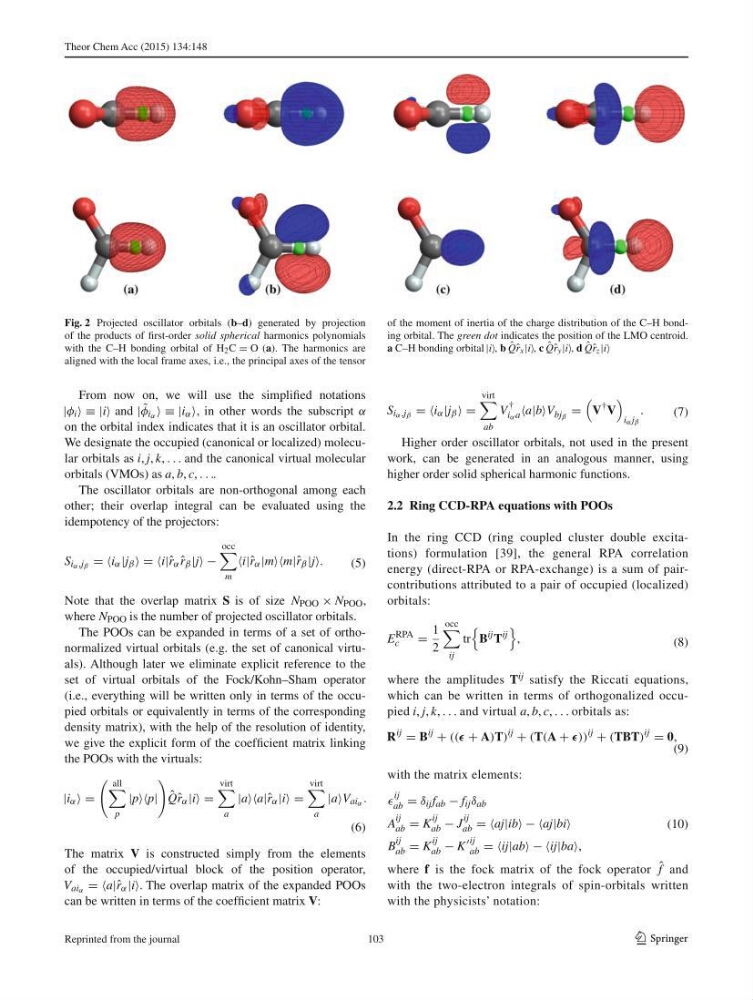
Fig. 2 Projected oscillator orbitals ( b – d ) generated by projection
of the products of fi rst-order solid spherical harmonics polynomials
with the C–H bonding orbital of H 2 C = O ( a ). The harmonics are
aligned with the local frame axes, i.e., the principal axes of the tensor
of the moment of inertia of the charge distribution of the C–H bonding orbital. The green dot indicates the position of the LMO centroid.
a C–H bonding orbital |i , b ˆ
Qˆ r x |i , c ˆ
Qˆ r y |i , d ˆ
Qˆ r z |i
103
Reprinted from the journal
1 3
From now on, we will use the simplifi ed notations
|φ i ≡ |i and | ˜
φ i α ≡ |i α , in other words the subscript α
on the orbital index indicates that it is an oscillator orbital.
We designate the occupied (canonical or localized) molecular orbitals as i, j, k, . . . and the canonical virtual molecular
orbitals (VMOs) as a, b, c, . . . .
The oscillator orbitals are non-orthogonal among each
other; their overlap integral can be evaluated using the
idempotency of the projectors:
Note that the overlap matrix S is of size N POO × N POO ,
where N POO is the number of projected oscillator orbitals.
The POOs can be expanded in terms of a set of orthonormalized virtual orbitals (e.g. the set of canonical virtuals). Although later we eliminate explicit reference to the
set of virtual orbitals of the Fock/Kohn–Sham operator
(i.e., everything will be written only in terms of the occupied orbitals or equivalently in terms of the corresponding
density matrix), with the help of the resolution of identity,
we give the explicit form of the coeffi cient matrix linking
the POOs with the virtuals:
The matrix V is constructed simply from the elements
of the occupied/virtual block of the position operator,
V ai α = =a|ˆ r α |i. The overlap matrix of the expanded POOs
can be written in terms of the coeffi cient matrix V :
(5)
S i α ,j β = =i α |j β = =i|ˆ r α ˆ
r β |j −
occ
m
i|ˆ r α |mm|ˆ r β |j.
(6)
|i α =
all
p
|pp|
ˆ
Qˆ r α |i =
virt
a
|aa|ˆ r α |i =
virt
a
|aV ai α .
Higher order oscillator orbitals, not used in the present
work, can be generated in an analogous manner, using
higher order solid spherical harmonic functions.
2.2 Ring CCD-RPA equations with POOs
In the ring CCD (ring coupled cluster double excitations) formulation [ 39 ], the general RPA correlation
energy (direct-RPA or RPA-exchange) is a sum of paircontributions attributed to a pair of occupied (localized)
orbitals:
where the amplitudes T ij satisfy the Riccati equations,
which can be written in terms of orthogonalized occupied i, j, k, . . . and virtual a, b, c, . . . orbitals as:
with the matrix elements:
where f is the fock matrix of the fock operator ˆ
f and
with the two-electron integrals of spin-orbitals written
with the physicists’ notation:
(7)
S i α ,j β = =i α |j β =
virt
ab
V
†
i α a a|bV bj β =
V
† V
i α j β
.
(8)
E
RPA
c
=
1
2
occ
ij
tr
𨐾
B
ij T
ij
,
(9)
R
ij
= B
ij
+ (( + A)T)
ij
+ (T(A + ))
ij
+ (TBT)
ij
= 0,
(10)
ij
ab = δ ij f ab − f ij δ ab
A
ij
ab = K
ij
ab − J
ij
ab = =aj|ib − −aj|bi
B
ij
ab = K
ij
ab − K
ij
ab = =ij|ab − −ij|ba,
Fig. 2 Projected oscillator orbitals ( b – d ) generated by projection
of the products of fi rst-order solid spherical harmonics polynomials
with the C–H bonding orbital of H 2 C = O ( a ). The harmonics are
aligned with the local frame axes, i.e., the principal axes of the tensor
of the moment of inertia of the charge distribution of the C–H bonding orbital. The green dot indicates the position of the LMO centroid.
a C–H bonding orbital |i , b ˆ
Qˆ r x |i , c ˆ
Qˆ r y |i , d ˆ
Qˆ r z |i
103
Reprinted from the journal