

III – Int´ egration num´ erique
69
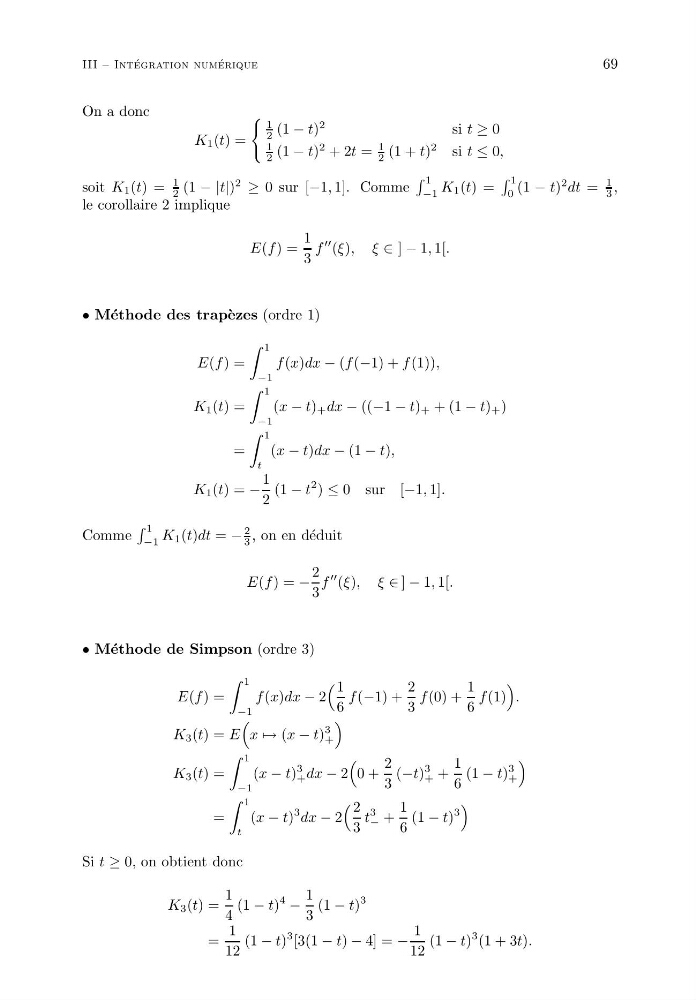
On a donc
K 1 (t) =
1
2 (1 − t)
2
si t ≥ 0
1
2 (1 − t)
2 + 2t =
1
2 (1 + t)
2
si t ≤ 0,
soit K 1 (t) =
1
2 (1 − |t|)
2
≥ 0 sur [−1, 1]. Comme
1
−1
K 1 (t) =
1
0
(1 − t)
2 dt =
1
3 ,
le corollaire 2 implique
E(f ) =
1
3
f
(ξ), ξ ∈ ] − 1, 1[.
• M´ ethode des trap` ezes (ordre 1)
E(f ) =
1
−1
f (x)dx − (f (−1) + f (1)),
K 1 (t) =
1
−1
(x − t) + dx − ((−1 − t) + + (1 − t) + )
=
1
t
(x − t)dx − (1 − t),
K 1 (t) = −
1
2
(1 − t
2 ) ≤ 0 sur [−1, 1].
Comme
1
−1
K 1 (t)dt = −
2
3 , on en d´ eduit
E(f ) = −
2
3
f
(ξ), ξ ∈ ] − 1, 1[.
• M´ ethode de Simpson (ordre 3)
E(f ) =
1
−1
f (x)dx − 2
1
6
f (−1) +
2
3
f (0) +
1
6
f (1)
.
K 3 (t) = E
x → (x − t)
3
+
K 3 (t) =
1
−1
(x − t)
3
+ dx − 2
0 +
2
3
(−t)
3
+ +
1
6
(1 − t)
3
+
=
1
t
(x − t)
3 dx − 2
2
3
t
3
− +
1
6
(1 − t)
3
Si t ≥ 0, on obtient donc
K 3 (t) =
1
4
(1 − t)
4
−
1
3
(1 − t)
3
=
1
12
(1 − t)
3 [3(1 − t) − 4] = −
1
12
(1 − t)
3 (1 + 3t).
69
On a donc
K 1 (t) =
1
2 (1 − t)
2
si t ≥ 0
1
2 (1 − t)
2 + 2t =
1
2 (1 + t)
2
si t ≤ 0,
soit K 1 (t) =
1
2 (1 − |t|)
2
≥ 0 sur [−1, 1]. Comme
1
−1
K 1 (t) =
1
0
(1 − t)
2 dt =
1
3 ,
le corollaire 2 implique
E(f ) =
1
3
f
(ξ), ξ ∈ ] − 1, 1[.
• M´ ethode des trap` ezes (ordre 1)
E(f ) =
1
−1
f (x)dx − (f (−1) + f (1)),
K 1 (t) =
1
−1
(x − t) + dx − ((−1 − t) + + (1 − t) + )
=
1
t
(x − t)dx − (1 − t),
K 1 (t) = −
1
2
(1 − t
2 ) ≤ 0 sur [−1, 1].
Comme
1
−1
K 1 (t)dt = −
2
3 , on en d´ eduit
E(f ) = −
2
3
f
(ξ), ξ ∈ ] − 1, 1[.
• M´ ethode de Simpson (ordre 3)
E(f ) =
1
−1
f (x)dx − 2
1
6
f (−1) +
2
3
f (0) +
1
6
f (1)
.
K 3 (t) = E
x → (x − t)
3
+
K 3 (t) =
1
−1
(x − t)
3
+ dx − 2
0 +
2
3
(−t)
3
+ +
1
6
(1 − t)
3
+
=
1
t
(x − t)
3 dx − 2
2
3
t
3
− +
1
6
(1 − t)
3
Si t ≥ 0, on obtient donc
K 3 (t) =
1
4
(1 − t)
4
−
1
3
(1 − t)
3
=
1
12
(1 − t)
3 [3(1 − t) − 4] = −
1
12
(1 − t)
3 (1 + 3t).