

34
Analyse num´ erique et ´ equations diff´ erentielles
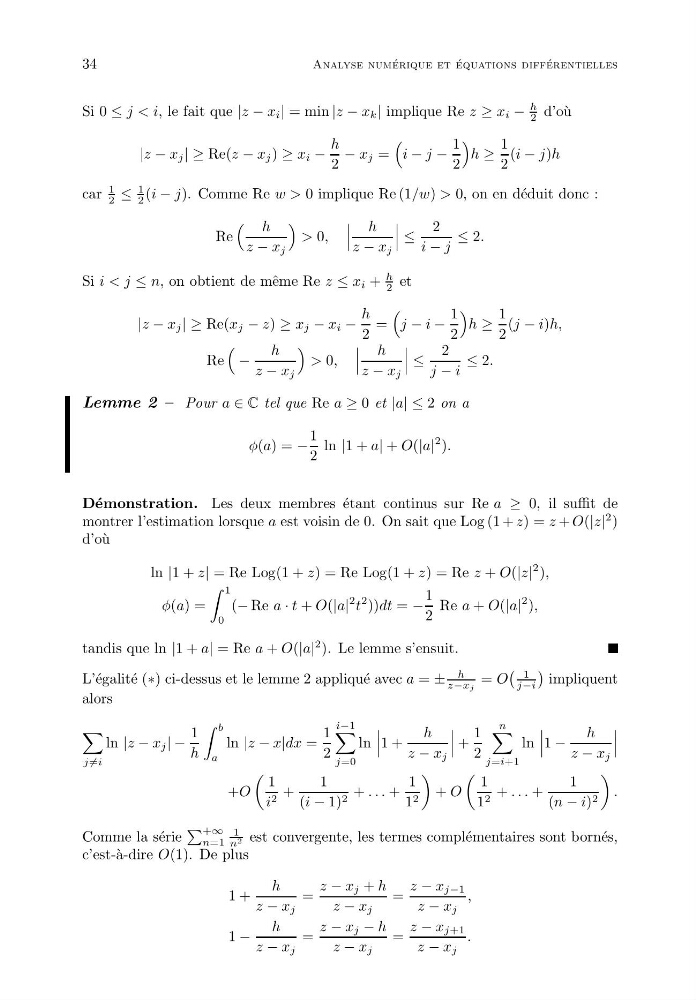
Si 0 ≤ j < i, le fait que |z − x i | = min |z − x k | implique Re z ≥ x i −
h
2 d’o` u
|z − x j | ≥ Re(z − x j ) ≥ x i −
h
2
− x j =
i − j −
1
2
h ≥
1
2
(i − j)h
car
1
2 ≤
1
2 (i − j). Comme Re w > 0 implique Re (1/w) > 0, on en d´ eduit donc :
Re
h
z − x j
> 0,
h
z − x j
≤
2
i − j
≤ 2.
Si i < j ≤ n, on obtient de mˆ eme Re z ≤ x i +
h
2 et
|z − x j | ≥ Re(x j − z) ≥ x j − x i −
h
2
=
j − i −
1
2
h ≥
1
2
(j − i)h,
Re
−
h
z − x j
> 0,
h
z − x j
≤
2
j − i
≤ 2.
Lemme 2 – Pour a ∈ C tel que Re a ≥ 0 et |a| ≤ 2 on a
φ(a) = −
1
2
ln |1 + a| + O(|a|
2 ).
D´ emonstration. Les deux membres ´ etant continus sur Re a ≥ 0, il suffit de
montrer l’estimation lorsque a est voisin de 0. On sait que Log (1 + z) = z + O(|z|
2 )
d’o` u
ln |1 + z| = Re Log(1 + z) = Re Log(1 + z) = Re z + O(|z|
2 ),
φ(a) =
1
0
(− Re a · t + O(|a|
2 t
2 ))dt = −
1
2
Re a + O(|a|
2 ),
tandis que ln |1 + a| = Re a + O(|a|
2 ). Le lemme s’ensuit.
L’´ egalit´ e (∗) ci-dessus et le lemme 2 appliqu´ e avec a = ±
h
z−xj = O
1
j−i
impliquent
alors
j =i
ln |z − x j | −
1
h
b
a
ln |z − x|dx =
1
2
i−1
j=0
ln
1 +
h
z − x j
+
1
2
n
j=i+1
ln
1 −
h
z − x j
+O
1
i 2 +
1
(i − 1) 2 + . . . +
1
1 2
+ O
1
1 2 + . . . +
1
(n − i) 2
.
Comme la s´ erie
+∞
n=1
1
n 2 est convergente, les termes compl´ ementaires sont born´ es,
c’est-` a-dire O(1). De plus
1 +
h
z − x j
=
z − x j + h
z − x j
=
z − x j−1
z − x j
,
1 −
h
z − x j
=
z − x j − h
z − x j
=
z − x j+1
z − x j
.
Analyse num´ erique et ´ equations diff´ erentielles
Si 0 ≤ j < i, le fait que |z − x i | = min |z − x k | implique Re z ≥ x i −
h
2 d’o` u
|z − x j | ≥ Re(z − x j ) ≥ x i −
h
2
− x j =
i − j −
1
2
h ≥
1
2
(i − j)h
car
1
2 ≤
1
2 (i − j). Comme Re w > 0 implique Re (1/w) > 0, on en d´ eduit donc :
Re
h
z − x j
> 0,
h
z − x j
≤
2
i − j
≤ 2.
Si i < j ≤ n, on obtient de mˆ eme Re z ≤ x i +
h
2 et
|z − x j | ≥ Re(x j − z) ≥ x j − x i −
h
2
=
j − i −
1
2
h ≥
1
2
(j − i)h,
Re
−
h
z − x j
> 0,
h
z − x j
≤
2
j − i
≤ 2.
Lemme 2 – Pour a ∈ C tel que Re a ≥ 0 et |a| ≤ 2 on a
φ(a) = −
1
2
ln |1 + a| + O(|a|
2 ).
D´ emonstration. Les deux membres ´ etant continus sur Re a ≥ 0, il suffit de
montrer l’estimation lorsque a est voisin de 0. On sait que Log (1 + z) = z + O(|z|
2 )
d’o` u
ln |1 + z| = Re Log(1 + z) = Re Log(1 + z) = Re z + O(|z|
2 ),
φ(a) =
1
0
(− Re a · t + O(|a|
2 t
2 ))dt = −
1
2
Re a + O(|a|
2 ),
tandis que ln |1 + a| = Re a + O(|a|
2 ). Le lemme s’ensuit.
L’´ egalit´ e (∗) ci-dessus et le lemme 2 appliqu´ e avec a = ±
h
z−xj = O
1
j−i
impliquent
alors
j =i
ln |z − x j | −
1
h
b
a
ln |z − x|dx =
1
2
i−1
j=0
ln
1 +
h
z − x j
+
1
2
n
j=i+1
ln
1 −
h
z − x j
+O
1
i 2 +
1
(i − 1) 2 + . . . +
1
1 2
+ O
1
1 2 + . . . +
1
(n − i) 2
.
Comme la s´ erie
+∞
n=1
1
n 2 est convergente, les termes compl´ ementaires sont born´ es,
c’est-` a-dire O(1). De plus
1 +
h
z − x j
=
z − x j + h
z − x j
=
z − x j−1
z − x j
,
1 −
h
z − x j
=
z − x j − h
z − x j
=
z − x j+1
z − x j
.