

110
Analyse num´ erique et ´ equations diff´ erentielles
¿º¿º Å ØØÓÓÓ ÆÆÛØÓÒ¹ÊÊÔÔ×ÓÒ
Soit `
a r´ esoudre une ´ equation f (x) = 0 o` u f : Ω → R
m est une application de
classe C
2 d´ efinie sur un ouvert Ω ⊂ R
m . On cherche `
a ´ evaluer num´ eriquement une
solution a du syst` eme f (x) = 0, connaissant une valeur approch´ ee grossi` ere x 0 de a.
Comme dans la m´ ethode de Newton usuelle, l’id´ ee est d’approximer f par sa partie
lin´ eaire au point x 0 :
f (x) = f (x 0 ) + f
(x 0 ) · (x − x 0 ) + o(x − x 0 )
On r´ esout alors l’´ equation f (x 0 ) + f
(x 0 ) · (x − x 0 ) = 0. Si f
(x 0 ) ∈ L(R
n , R
m ) est
inversible, on a une solution unique x 1 telle que x 1 − x 0 = −f
(x 0 )
−1
· f (x 0 ), soit
x 1 = x 0 − f
(x 0 )
−1
· f (x 0 ).
On va donc it´ erer ici l’application de classe C
1
ϕ(x) = x − f
(x)
−1
· f (x).
Th´ eor` eme – On suppose que f est de classe C
2 , que f (a) = 0 et que l’application
lin´ eaire tangente f
(a) ∈ L(R
m , R
m ) est inversible. Alors a est un point fixe
superattractif de ϕ.
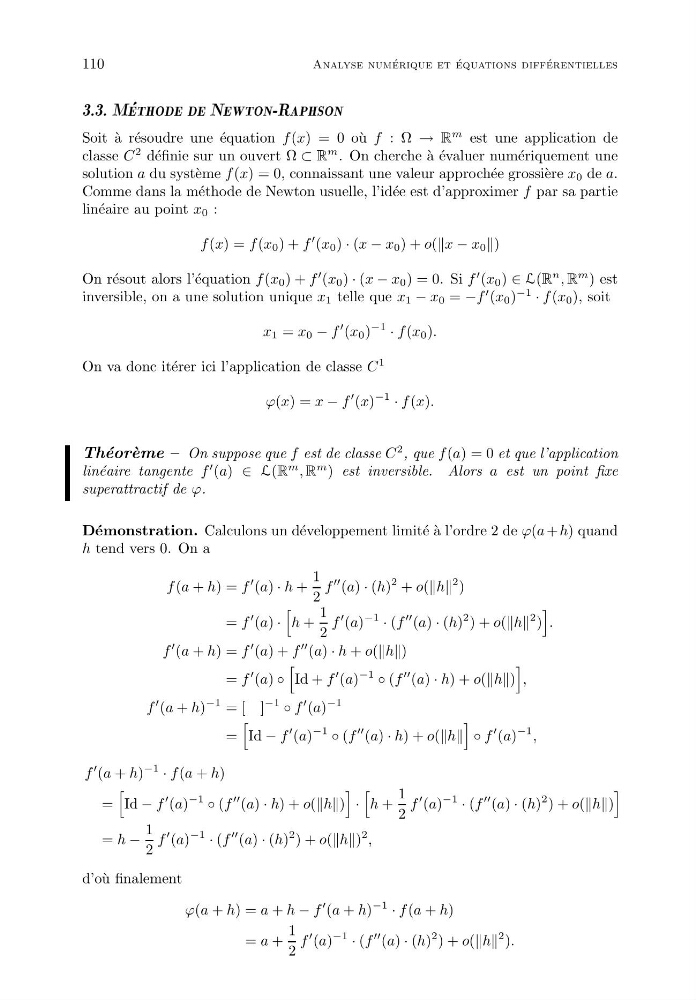
D´ emonstration. Calculons un d´ eveloppement limit´ e ` a l’ordre 2 de ϕ(a + h) quand
h tend vers 0. On a
f (a + h) = f
(a) · h +
1
2
f
(a) · (h)
2 + o(h
2 )
= f
(a) ·
h +
1
2
f
(a)
−1
· (f
(a) · (h)
2 ) + o(h
2 )
.
f
(a + h) = f
(a) + f
(a) · h + o(h)
= f
(a) ◦
Id + f
(a)
−1
◦ (f
(a) · h) + o(h)
,
f
(a + h)
−1 = [ ]
−1
◦ f
(a)
−1
=
Id − f
(a)
−1
◦ (f
(a) · h) + o(h
◦ f
(a)
−1 ,
f
(a + h)
−1
· f (a + h)
=
Id − f
(a)
−1
◦ (f
(a) · h) + o(h)
·
h +
1
2
f
(a)
−1
· (f
(a) · (h)
2 ) + o(h)
= h −
1
2
f
(a)
−1
· (f
(a) · (h)
2 ) + o(h)
2 ,
d’o` u finalement
ϕ(a + h) = a + h − f
(a + h)
−1
· f (a + h)
= a +
1
2
f
(a)
−1
· (f
(a) · (h)
2 ) + o(h
2 ).
Analyse num´ erique et ´ equations diff´ erentielles
¿º¿º Å ØØÓÓÓ ÆÆÛØÓÒ¹ÊÊÔÔ×ÓÒ
Soit `
a r´ esoudre une ´ equation f (x) = 0 o` u f : Ω → R
m est une application de
classe C
2 d´ efinie sur un ouvert Ω ⊂ R
m . On cherche `
a ´ evaluer num´ eriquement une
solution a du syst` eme f (x) = 0, connaissant une valeur approch´ ee grossi` ere x 0 de a.
Comme dans la m´ ethode de Newton usuelle, l’id´ ee est d’approximer f par sa partie
lin´ eaire au point x 0 :
f (x) = f (x 0 ) + f
(x 0 ) · (x − x 0 ) + o(x − x 0 )
On r´ esout alors l’´ equation f (x 0 ) + f
(x 0 ) · (x − x 0 ) = 0. Si f
(x 0 ) ∈ L(R
n , R
m ) est
inversible, on a une solution unique x 1 telle que x 1 − x 0 = −f
(x 0 )
−1
· f (x 0 ), soit
x 1 = x 0 − f
(x 0 )
−1
· f (x 0 ).
On va donc it´ erer ici l’application de classe C
1
ϕ(x) = x − f
(x)
−1
· f (x).
Th´ eor` eme – On suppose que f est de classe C
2 , que f (a) = 0 et que l’application
lin´ eaire tangente f
(a) ∈ L(R
m , R
m ) est inversible. Alors a est un point fixe
superattractif de ϕ.
D´ emonstration. Calculons un d´ eveloppement limit´ e ` a l’ordre 2 de ϕ(a + h) quand
h tend vers 0. On a
f (a + h) = f
(a) · h +
1
2
f
(a) · (h)
2 + o(h
2 )
= f
(a) ·
h +
1
2
f
(a)
−1
· (f
(a) · (h)
2 ) + o(h
2 )
.
f
(a + h) = f
(a) + f
(a) · h + o(h)
= f
(a) ◦
Id + f
(a)
−1
◦ (f
(a) · h) + o(h)
,
f
(a + h)
−1 = [ ]
−1
◦ f
(a)
−1
=
Id − f
(a)
−1
◦ (f
(a) · h) + o(h
◦ f
(a)
−1 ,
f
(a + h)
−1
· f (a + h)
=
Id − f
(a)
−1
◦ (f
(a) · h) + o(h)
·
h +
1
2
f
(a)
−1
· (f
(a) · (h)
2 ) + o(h)
= h −
1
2
f
(a)
−1
· (f
(a) · (h)
2 ) + o(h)
2 ,
d’o` u finalement
ϕ(a + h) = a + h − f
(a + h)
−1
· f (a + h)
= a +
1
2
f
(a)
−1
· (f
(a) · (h)
2 ) + o(h
2 ).