

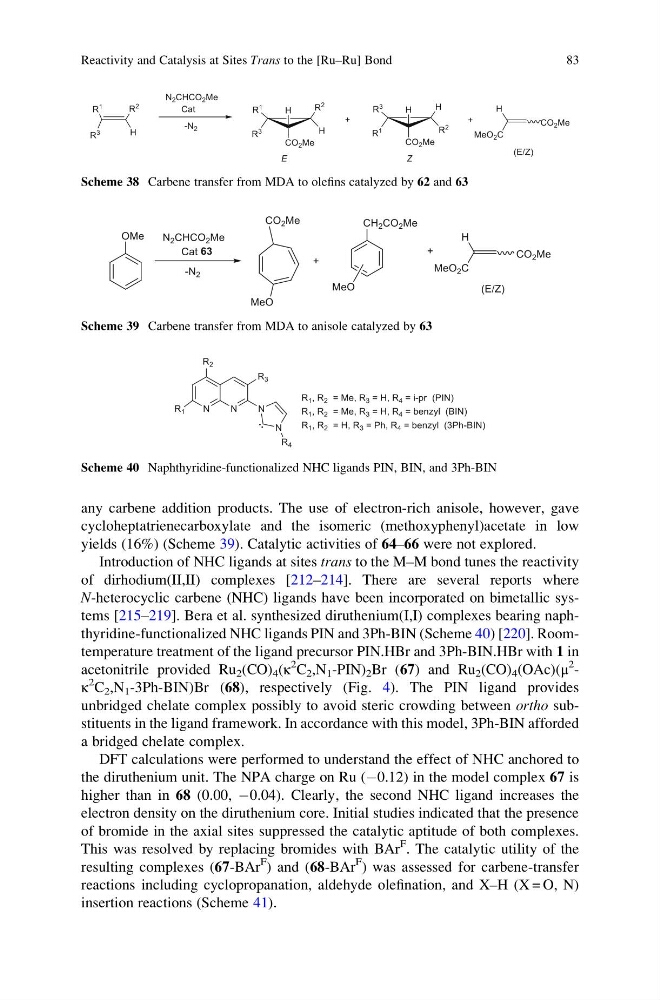
any carbene addition products. The use of electron-rich anisole, however, gave
cycloheptatrienecarboxylate and the isomeric (methoxyphenyl)acetate in low
yields (16%) (Scheme 39). Catalytic activities of 64–66 were not explored.
Introduction of NHC ligands at sites trans to the M–M bond tunes the reactivity
of dirhodium(II,II) complexes [212–214]. There are several reports where
N-heterocyclic carbene (NHC) ligands have been incorporated on bimetallic systems [215–219]. Bera et al. synthesized diruthenium(I,I) complexes bearing naphthyridine-functionalized NHC ligands PIN and 3Ph-BIN (Scheme 40) [220]. Roomtemperature treatment of the ligand precursor PIN.HBr and 3Ph-BIN.HBr with 1 in
acetonitrile provided Ru 2 (CO) 4 (κ
2 C 2 ,N 1 -PIN) 2 Br (67) and Ru 2 (CO) 4 (OAc)(μ
2 -
κ
2 C 2 ,N 1 -3Ph-BIN)Br (68), respectively (Fig. 4). The PIN ligand provides
unbridged chelate complex possibly to avoid steric crowding between ortho substituents in the ligand framework. In accordance with this model, 3Ph-BIN afforded
a bridged chelate complex.
DFT calculations were performed to understand the effect of NHC anchored to
the diruthenium unit. The NPA charge on Ru (À0.12) in the model complex 67 is
higher than in 68 (0.00, À0.04). Clearly, the second NHC ligand increases the
electron density on the diruthenium core. Initial studies indicated that the presence
of bromide in the axial sites suppressed the catalytic aptitude of both complexes.
This was resolved by replacing bromides with BAr
F . The catalytic utility of the
resulting complexes (67-BAr
F
) and (68-BAr
F ) was assessed for carbene-transfer
reactions including cyclopropanation, aldehyde olefination, and X–H (X = O, N)
insertion reactions (Scheme 41).
Scheme 38 Carbene transfer from MDA to olefins catalyzed by 62 and 63
Scheme 39 Carbene transfer from MDA to anisole catalyzed by 63
Scheme 40 Naphthyridine-functionalized NHC ligands PIN, BIN, and 3Ph-BIN
Reactivity and Catalysis at Sites Trans to the [Ru–Ru] Bond
83
cycloheptatrienecarboxylate and the isomeric (methoxyphenyl)acetate in low
yields (16%) (Scheme 39). Catalytic activities of 64–66 were not explored.
Introduction of NHC ligands at sites trans to the M–M bond tunes the reactivity
of dirhodium(II,II) complexes [212–214]. There are several reports where
N-heterocyclic carbene (NHC) ligands have been incorporated on bimetallic systems [215–219]. Bera et al. synthesized diruthenium(I,I) complexes bearing naphthyridine-functionalized NHC ligands PIN and 3Ph-BIN (Scheme 40) [220]. Roomtemperature treatment of the ligand precursor PIN.HBr and 3Ph-BIN.HBr with 1 in
acetonitrile provided Ru 2 (CO) 4 (κ
2 C 2 ,N 1 -PIN) 2 Br (67) and Ru 2 (CO) 4 (OAc)(μ
2 -
κ
2 C 2 ,N 1 -3Ph-BIN)Br (68), respectively (Fig. 4). The PIN ligand provides
unbridged chelate complex possibly to avoid steric crowding between ortho substituents in the ligand framework. In accordance with this model, 3Ph-BIN afforded
a bridged chelate complex.
DFT calculations were performed to understand the effect of NHC anchored to
the diruthenium unit. The NPA charge on Ru (À0.12) in the model complex 67 is
higher than in 68 (0.00, À0.04). Clearly, the second NHC ligand increases the
electron density on the diruthenium core. Initial studies indicated that the presence
of bromide in the axial sites suppressed the catalytic aptitude of both complexes.
This was resolved by replacing bromides with BAr
F . The catalytic utility of the
resulting complexes (67-BAr
F
) and (68-BAr
F ) was assessed for carbene-transfer
reactions including cyclopropanation, aldehyde olefination, and X–H (X = O, N)
insertion reactions (Scheme 41).
Scheme 38 Carbene transfer from MDA to olefins catalyzed by 62 and 63
Scheme 39 Carbene transfer from MDA to anisole catalyzed by 63
Scheme 40 Naphthyridine-functionalized NHC ligands PIN, BIN, and 3Ph-BIN
Reactivity and Catalysis at Sites Trans to the [Ru–Ru] Bond
83