

Aldehyde olefination reaction was carried out using 1.5 mmol of EDA, 1.2 mmol
of PPh 3 , and 1 mol% of catalyst in toluene to give excellent to moderate yield.
Although the catalyst 68-BAr
F exhibits lesser reactivity compared to 67-BAr
F ,
selectivity is not compromised. The reaction does not occur without PPh 3 . The
diruthenium catalysts also catalyze cyclopropanation reactions. Cis or trans cyclopropanes are obtained using 1.5 mmol of EDA as added in a DCM solution of
catalyst (0.5 mol%) and olefins (10 mmol) in room temperature. The dimerization
of EDA was minimized by its slow addition to an excess of olefin solution. The
trans to cis ratio in all these cases is found to be 75:25. Similar to aldehyde
olefination reaction, 67-BAr
F was found to be superior. Insertion of EDA into
N–H and O–H bonds were also studied with amines and alcohols to obtain amino
acid derivatives and ethers, respectively. Catalyst 67-BAr
F affords higher yields
than 68-BAr
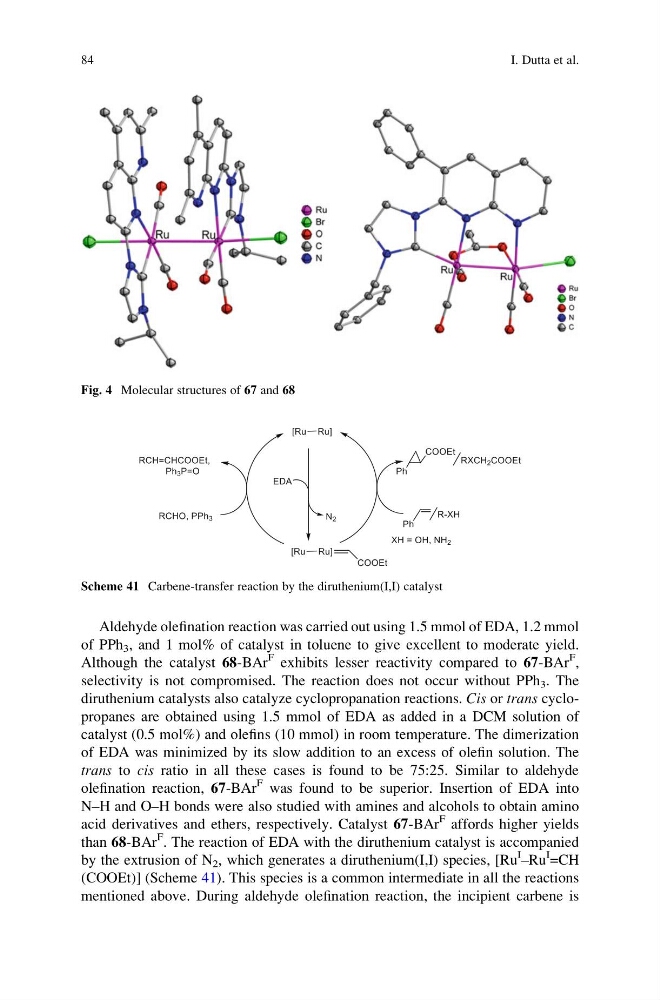
F . The reaction of EDA with the diruthenium catalyst is accompanied
by the extrusion of N 2 , which generates a diruthenium(I,I) species, [Ru
I –Ru
I =CH
(COOEt)] (Scheme 41). This species is a common intermediate in all the reactions
mentioned above. During aldehyde olefination reaction, the incipient carbene is
Fig. 4 Molecular structures of 67 and 68
Scheme 41 Carbene-transfer reaction by the diruthenium(I,I) catalyst
84
I. Dutta et al.
of PPh 3 , and 1 mol% of catalyst in toluene to give excellent to moderate yield.
Although the catalyst 68-BAr
F exhibits lesser reactivity compared to 67-BAr
F ,
selectivity is not compromised. The reaction does not occur without PPh 3 . The
diruthenium catalysts also catalyze cyclopropanation reactions. Cis or trans cyclopropanes are obtained using 1.5 mmol of EDA as added in a DCM solution of
catalyst (0.5 mol%) and olefins (10 mmol) in room temperature. The dimerization
of EDA was minimized by its slow addition to an excess of olefin solution. The
trans to cis ratio in all these cases is found to be 75:25. Similar to aldehyde
olefination reaction, 67-BAr
F was found to be superior. Insertion of EDA into
N–H and O–H bonds were also studied with amines and alcohols to obtain amino
acid derivatives and ethers, respectively. Catalyst 67-BAr
F affords higher yields
than 68-BAr
F . The reaction of EDA with the diruthenium catalyst is accompanied
by the extrusion of N 2 , which generates a diruthenium(I,I) species, [Ru
I –Ru
I =CH
(COOEt)] (Scheme 41). This species is a common intermediate in all the reactions
mentioned above. During aldehyde olefination reaction, the incipient carbene is
Fig. 4 Molecular structures of 67 and 68
Scheme 41 Carbene-transfer reaction by the diruthenium(I,I) catalyst
84
I. Dutta et al.