

of the HH complexes 54–59 [72, 73] revealed that one of the axial sites is
inaccessible due to steric crowding of the halides. Hence, the EDA can only
approach from the other axial site by replacing the axial ligand. Therefore, the
steric crowding does not necessarily lead to diastereoselectivity. A correlation
between diastereoselectivity and different bridging ligands could not be obtained
due to the fast rearrangement of HT and HH complexes under the reaction conditions [70, 124, 210].
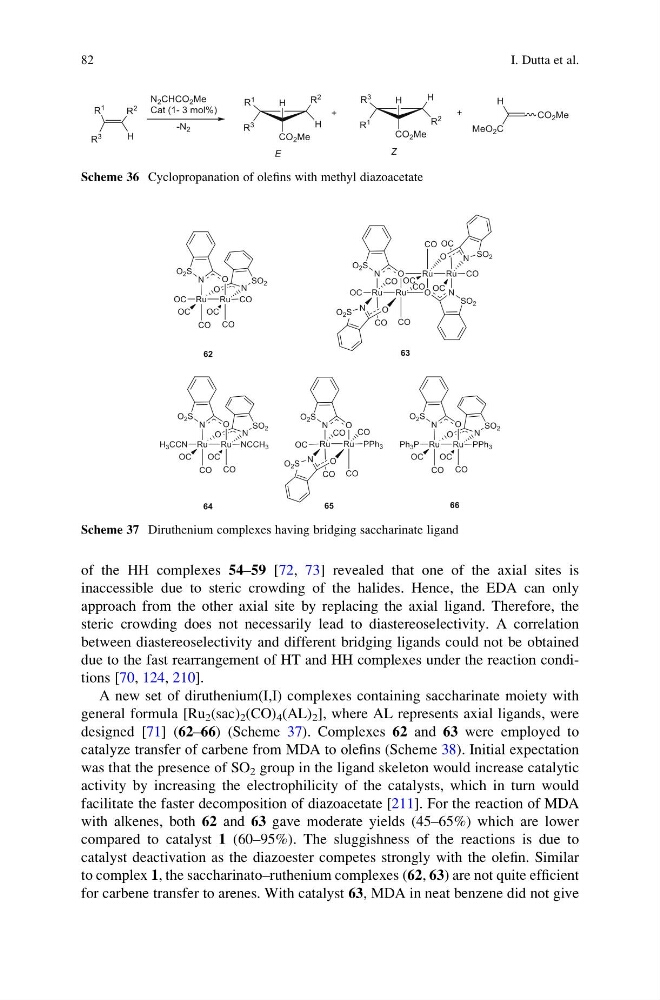
A new set of diruthenium(I,I) complexes containing saccharinate moiety with
general formula [Ru 2 (sac) 2 (CO) 4 (AL) 2 ], where AL represents axial ligands, were
designed [71] (62–66) (Scheme 37). Complexes 62 and 63 were employed to
catalyze transfer of carbene from MDA to olefins (Scheme 38). Initial expectation
was that the presence of SO 2 group in the ligand skeleton would increase catalytic
activity by increasing the electrophilicity of the catalysts, which in turn would
facilitate the faster decomposition of diazoacetate [211]. For the reaction of MDA
with alkenes, both 62 and 63 gave moderate yields (45–65%) which are lower
compared to catalyst 1 (60–95%). The sluggishness of the reactions is due to
catalyst deactivation as the diazoester competes strongly with the olefin. Similar
to complex 1, the saccharinato–ruthenium complexes (62, 63) are not quite efficient
for carbene transfer to arenes. With catalyst 63, MDA in neat benzene did not give
Scheme 36 Cyclopropanation of olefins with methyl diazoacetate
Scheme 37 Diruthenium complexes having bridging saccharinate ligand
82
I. Dutta et al.
inaccessible due to steric crowding of the halides. Hence, the EDA can only
approach from the other axial site by replacing the axial ligand. Therefore, the
steric crowding does not necessarily lead to diastereoselectivity. A correlation
between diastereoselectivity and different bridging ligands could not be obtained
due to the fast rearrangement of HT and HH complexes under the reaction conditions [70, 124, 210].
A new set of diruthenium(I,I) complexes containing saccharinate moiety with
general formula [Ru 2 (sac) 2 (CO) 4 (AL) 2 ], where AL represents axial ligands, were
designed [71] (62–66) (Scheme 37). Complexes 62 and 63 were employed to
catalyze transfer of carbene from MDA to olefins (Scheme 38). Initial expectation
was that the presence of SO 2 group in the ligand skeleton would increase catalytic
activity by increasing the electrophilicity of the catalysts, which in turn would
facilitate the faster decomposition of diazoacetate [211]. For the reaction of MDA
with alkenes, both 62 and 63 gave moderate yields (45–65%) which are lower
compared to catalyst 1 (60–95%). The sluggishness of the reactions is due to
catalyst deactivation as the diazoester competes strongly with the olefin. Similar
to complex 1, the saccharinato–ruthenium complexes (62, 63) are not quite efficient
for carbene transfer to arenes. With catalyst 63, MDA in neat benzene did not give
Scheme 36 Cyclopropanation of olefins with methyl diazoacetate
Scheme 37 Diruthenium complexes having bridging saccharinate ligand
82
I. Dutta et al.