

7 Cyclopropanation
The diruthenium(II,II) complexes [Ru 2 (O 2 CR) 4 ] (R = CH 3 (50), CF 3 (51)) have also
been studied for catalytic activity toward cyclopropanation as they are immediate
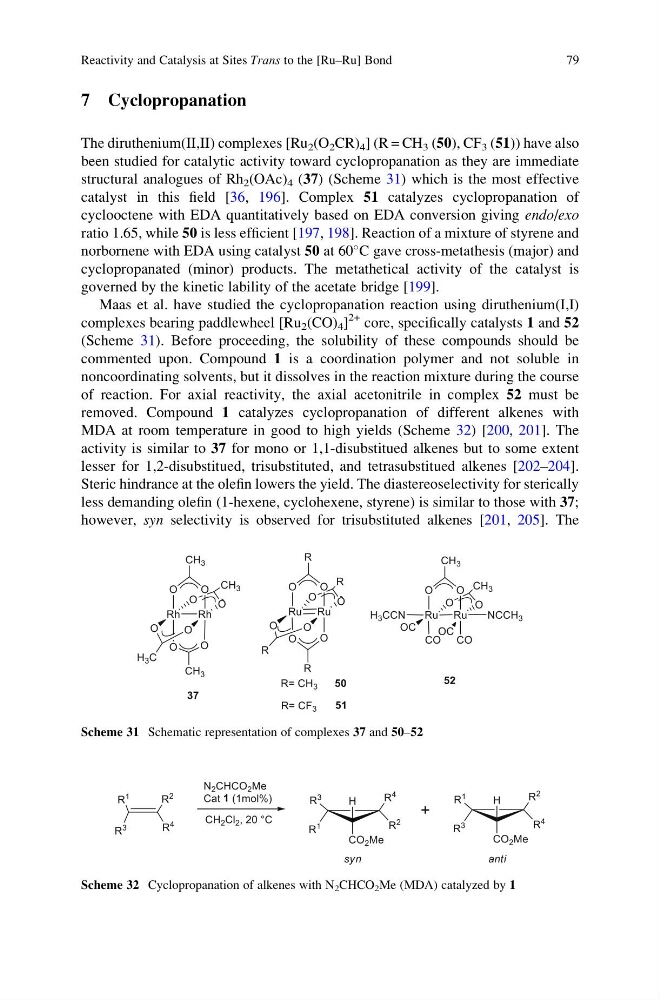
structural analogues of Rh 2 (OAc) 4 (37) (Scheme 31) which is the most effective
catalyst in this field [36, 196]. Complex 51 catalyzes cyclopropanation of
cyclooctene with EDA quantitatively based on EDA conversion giving endo/exo
ratio 1.65, while 50 is less efficient [197, 198]. Reaction of a mixture of styrene and
norbornene with EDA using catalyst 50 at 60
C gave cross-metathesis (major) and
cyclopropanated (minor) products. The metathetical activity of the catalyst is
governed by the kinetic lability of the acetate bridge [199].
Maas et al. have studied the cyclopropanation reaction using diruthenium(I,I)
complexes bearing paddlewheel [Ru 2 (CO) 4 ]
2+ core, specifically catalysts 1 and 52
(Scheme 31). Before proceeding, the solubility of these compounds should be
commented upon. Compound 1 is a coordination polymer and not soluble in
noncoordinating solvents, but it dissolves in the reaction mixture during the course
of reaction. For axial reactivity, the axial acetonitrile in complex 52 must be
removed. Compound 1 catalyzes cyclopropanation of different alkenes with
MDA at room temperature in good to high yields (Scheme 32) [200, 201]. The
activity is similar to 37 for mono or 1,1-disubstitued alkenes but to some extent
lesser for 1,2-disubstitued, trisubstituted, and tetrasubstitued alkenes [202–204].
Steric hindrance at the olefin lowers the yield. The diastereoselectivity for sterically
less demanding olefin (1-hexene, cyclohexene, styrene) is similar to those with 37;
however, syn selectivity is observed for trisubstituted alkenes [201, 205]. The
Scheme 32 Cyclopropanation of alkenes with N 2 CHCO 2 Me (MDA) catalyzed by 1
Scheme 31 Schematic representation of complexes 37 and 50–52
Reactivity and Catalysis at Sites Trans to the [Ru–Ru] Bond
79
The diruthenium(II,II) complexes [Ru 2 (O 2 CR) 4 ] (R = CH 3 (50), CF 3 (51)) have also
been studied for catalytic activity toward cyclopropanation as they are immediate
structural analogues of Rh 2 (OAc) 4 (37) (Scheme 31) which is the most effective
catalyst in this field [36, 196]. Complex 51 catalyzes cyclopropanation of
cyclooctene with EDA quantitatively based on EDA conversion giving endo/exo
ratio 1.65, while 50 is less efficient [197, 198]. Reaction of a mixture of styrene and
norbornene with EDA using catalyst 50 at 60
C gave cross-metathesis (major) and
cyclopropanated (minor) products. The metathetical activity of the catalyst is
governed by the kinetic lability of the acetate bridge [199].
Maas et al. have studied the cyclopropanation reaction using diruthenium(I,I)
complexes bearing paddlewheel [Ru 2 (CO) 4 ]
2+ core, specifically catalysts 1 and 52
(Scheme 31). Before proceeding, the solubility of these compounds should be
commented upon. Compound 1 is a coordination polymer and not soluble in
noncoordinating solvents, but it dissolves in the reaction mixture during the course
of reaction. For axial reactivity, the axial acetonitrile in complex 52 must be
removed. Compound 1 catalyzes cyclopropanation of different alkenes with
MDA at room temperature in good to high yields (Scheme 32) [200, 201]. The
activity is similar to 37 for mono or 1,1-disubstitued alkenes but to some extent
lesser for 1,2-disubstitued, trisubstituted, and tetrasubstitued alkenes [202–204].
Steric hindrance at the olefin lowers the yield. The diastereoselectivity for sterically
less demanding olefin (1-hexene, cyclohexene, styrene) is similar to those with 37;
however, syn selectivity is observed for trisubstituted alkenes [201, 205]. The
Scheme 32 Cyclopropanation of alkenes with N 2 CHCO 2 Me (MDA) catalyzed by 1
Scheme 31 Schematic representation of complexes 37 and 50–52
Reactivity and Catalysis at Sites Trans to the [Ru–Ru] Bond
79