

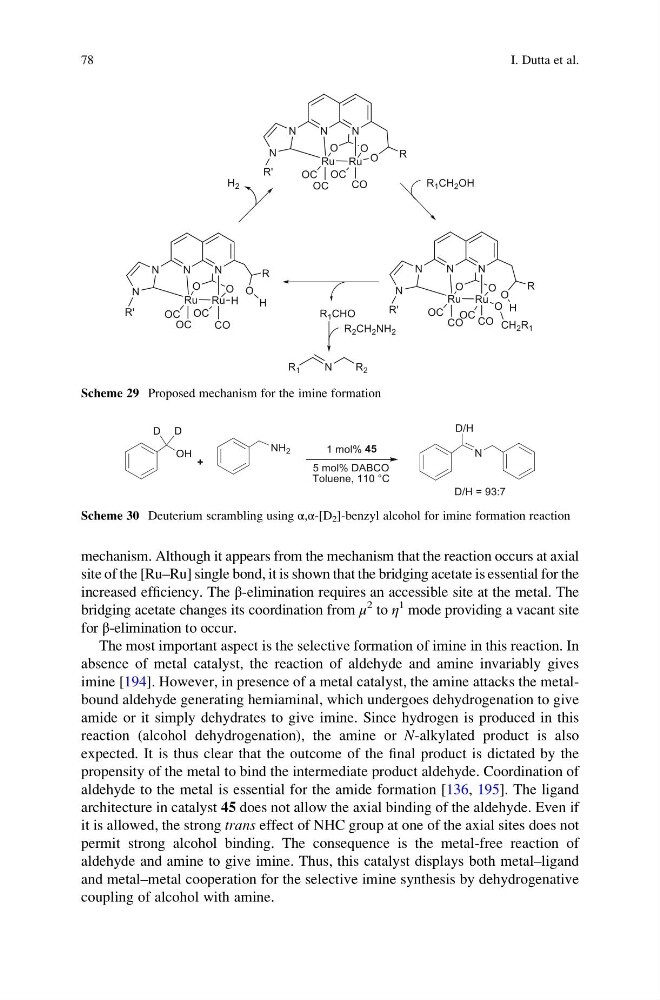
mechanism. Although it appears from the mechanism that the reaction occurs at axial
site of the [Ru–Ru] single bond, it is shown that the bridging acetate is essential for the
increased efficiency. The β-elimination requires an accessible site at the metal. The
bridging acetate changes its coordination from μ
2 to η
1 mode providing a vacant site
for β-elimination to occur.
The most important aspect is the selective formation of imine in this reaction. In
absence of metal catalyst, the reaction of aldehyde and amine invariably gives
imine [194]. However, in presence of a metal catalyst, the amine attacks the metalbound aldehyde generating hemiaminal, which undergoes dehydrogenation to give
amide or it simply dehydrates to give imine. Since hydrogen is produced in this
reaction (alcohol dehydrogenation), the amine or N-alkylated product is also
expected. It is thus clear that the outcome of the final product is dictated by the
propensity of the metal to bind the intermediate product aldehyde. Coordination of
aldehyde to the metal is essential for the amide formation [136, 195]. The ligand
architecture in catalyst 45 does not allow the axial binding of the aldehyde. Even if
it is allowed, the strong trans effect of NHC group at one of the axial sites does not
permit strong alcohol binding. The consequence is the metal-free reaction of
aldehyde and amine to give imine. Thus, this catalyst displays both metal–ligand
and metal–metal cooperation for the selective imine synthesis by dehydrogenative
coupling of alcohol with amine.
Scheme 30 Deuterium scrambling using α,α-[D 2 ]-benzyl alcohol for imine formation reaction
Scheme 29 Proposed mechanism for the imine formation
78
I. Dutta et al.
site of the [Ru–Ru] single bond, it is shown that the bridging acetate is essential for the
increased efficiency. The β-elimination requires an accessible site at the metal. The
bridging acetate changes its coordination from μ
2 to η
1 mode providing a vacant site
for β-elimination to occur.
The most important aspect is the selective formation of imine in this reaction. In
absence of metal catalyst, the reaction of aldehyde and amine invariably gives
imine [194]. However, in presence of a metal catalyst, the amine attacks the metalbound aldehyde generating hemiaminal, which undergoes dehydrogenation to give
amide or it simply dehydrates to give imine. Since hydrogen is produced in this
reaction (alcohol dehydrogenation), the amine or N-alkylated product is also
expected. It is thus clear that the outcome of the final product is dictated by the
propensity of the metal to bind the intermediate product aldehyde. Coordination of
aldehyde to the metal is essential for the amide formation [136, 195]. The ligand
architecture in catalyst 45 does not allow the axial binding of the aldehyde. Even if
it is allowed, the strong trans effect of NHC group at one of the axial sites does not
permit strong alcohol binding. The consequence is the metal-free reaction of
aldehyde and amine to give imine. Thus, this catalyst displays both metal–ligand
and metal–metal cooperation for the selective imine synthesis by dehydrogenative
coupling of alcohol with amine.
Scheme 30 Deuterium scrambling using α,α-[D 2 ]-benzyl alcohol for imine formation reaction
Scheme 29 Proposed mechanism for the imine formation
78
I. Dutta et al.