

allowed acceptorless dehydrogenation of alcohol to aldehyde. In particular, the
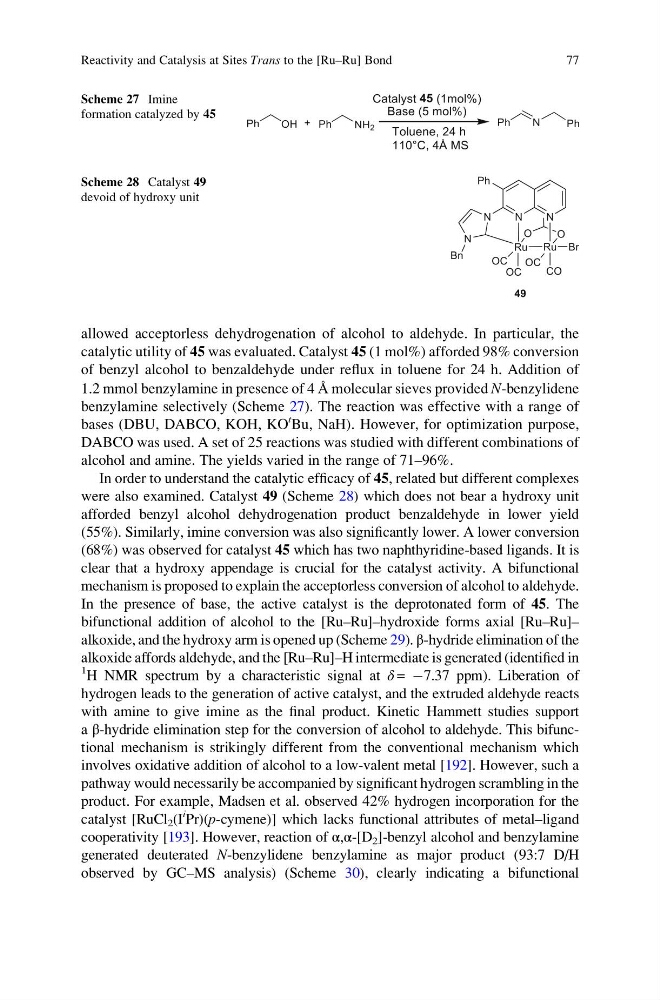
catalytic utility of 45 was evaluated. Catalyst 45 (1 mol%) afforded 98% conversion
of benzyl alcohol to benzaldehyde under reflux in toluene for 24 h. Addition of
1.2 mmol benzylamine in presence of 4 Å molecular sieves provided N-benzylidene
benzylamine selectively (Scheme 27). The reaction was effective with a range of
bases (DBU, DABCO, KOH, KO
t
Bu, NaH). However, for optimization purpose,
DABCO was used. A set of 25 reactions was studied with different combinations of
alcohol and amine. The yields varied in the range of 71–96%.
In order to understand the catalytic efficacy of 45, related but different complexes
were also examined. Catalyst 49 (Scheme 28) which does not bear a hydroxy unit
afforded benzyl alcohol dehydrogenation product benzaldehyde in lower yield
(55%). Similarly, imine conversion was also significantly lower. A lower conversion
(68%) was observed for catalyst 45 which has two naphthyridine-based ligands. It is
clear that a hydroxy appendage is crucial for the catalyst activity. A bifunctional
mechanism is proposed to explain the acceptorless conversion of alcohol to aldehyde.
In the presence of base, the active catalyst is the deprotonated form of 45. The
bifunctional addition of alcohol to the [Ru–Ru]–hydroxide forms axial [Ru–Ru]–
alkoxide, and the hydroxy arm is opened up (Scheme 29). β-hydride elimination of the
alkoxide affords aldehyde, and the [Ru–Ru]–H intermediate is generated (identified in
1
H NMR spectrum by a characteristic signal at δ = À7.37 ppm). Liberation of
hydrogen leads to the generation of active catalyst, and the extruded aldehyde reacts
with amine to give imine as the final product. Kinetic Hammett studies support
a β-hydride elimination step for the conversion of alcohol to aldehyde. This bifunctional mechanism is strikingly different from the conventional mechanism which
involves oxidative addition of alcohol to a low-valent metal [192]. However, such a
pathway would necessarily be accompanied by significant hydrogen scrambling in the
product. For example, Madsen et al. observed 42% hydrogen incorporation for the
catalyst [RuCl 2 (I
i
Pr)(p-cymene)] which lacks functional attributes of metal–ligand
cooperativity [193]. However, reaction of α,α-[D 2 ]-benzyl alcohol and benzylamine
generated deuterated N-benzylidene benzylamine as major product (93:7 D/H
observed by GC–MS analysis) (Scheme 30), clearly indicating a bifunctional
Scheme 27 Imine
formation catalyzed by 45
Scheme 28 Catalyst 49
devoid of hydroxy unit
Reactivity and Catalysis at Sites Trans to the [Ru–Ru] Bond
77
catalytic utility of 45 was evaluated. Catalyst 45 (1 mol%) afforded 98% conversion
of benzyl alcohol to benzaldehyde under reflux in toluene for 24 h. Addition of
1.2 mmol benzylamine in presence of 4 Å molecular sieves provided N-benzylidene
benzylamine selectively (Scheme 27). The reaction was effective with a range of
bases (DBU, DABCO, KOH, KO
t
Bu, NaH). However, for optimization purpose,
DABCO was used. A set of 25 reactions was studied with different combinations of
alcohol and amine. The yields varied in the range of 71–96%.
In order to understand the catalytic efficacy of 45, related but different complexes
were also examined. Catalyst 49 (Scheme 28) which does not bear a hydroxy unit
afforded benzyl alcohol dehydrogenation product benzaldehyde in lower yield
(55%). Similarly, imine conversion was also significantly lower. A lower conversion
(68%) was observed for catalyst 45 which has two naphthyridine-based ligands. It is
clear that a hydroxy appendage is crucial for the catalyst activity. A bifunctional
mechanism is proposed to explain the acceptorless conversion of alcohol to aldehyde.
In the presence of base, the active catalyst is the deprotonated form of 45. The
bifunctional addition of alcohol to the [Ru–Ru]–hydroxide forms axial [Ru–Ru]–
alkoxide, and the hydroxy arm is opened up (Scheme 29). β-hydride elimination of the
alkoxide affords aldehyde, and the [Ru–Ru]–H intermediate is generated (identified in
1
H NMR spectrum by a characteristic signal at δ = À7.37 ppm). Liberation of
hydrogen leads to the generation of active catalyst, and the extruded aldehyde reacts
with amine to give imine as the final product. Kinetic Hammett studies support
a β-hydride elimination step for the conversion of alcohol to aldehyde. This bifunctional mechanism is strikingly different from the conventional mechanism which
involves oxidative addition of alcohol to a low-valent metal [192]. However, such a
pathway would necessarily be accompanied by significant hydrogen scrambling in the
product. For example, Madsen et al. observed 42% hydrogen incorporation for the
catalyst [RuCl 2 (I
i
Pr)(p-cymene)] which lacks functional attributes of metal–ligand
cooperativity [193]. However, reaction of α,α-[D 2 ]-benzyl alcohol and benzylamine
generated deuterated N-benzylidene benzylamine as major product (93:7 D/H
observed by GC–MS analysis) (Scheme 30), clearly indicating a bifunctional
Scheme 27 Imine
formation catalyzed by 45
Scheme 28 Catalyst 49
devoid of hydroxy unit
Reactivity and Catalysis at Sites Trans to the [Ru–Ru] Bond
77