

6 Alcohol Dehydrogenation at Axial Site of a [Ru
I –Ru
I
]
Bond
Synergic cooperation between two metal ions has been widely recognized to
execute a chemical reaction with enhanced rate and selectivity [144–151]. A new
class of catalysts is emerging where active participation of ligand in the substrate
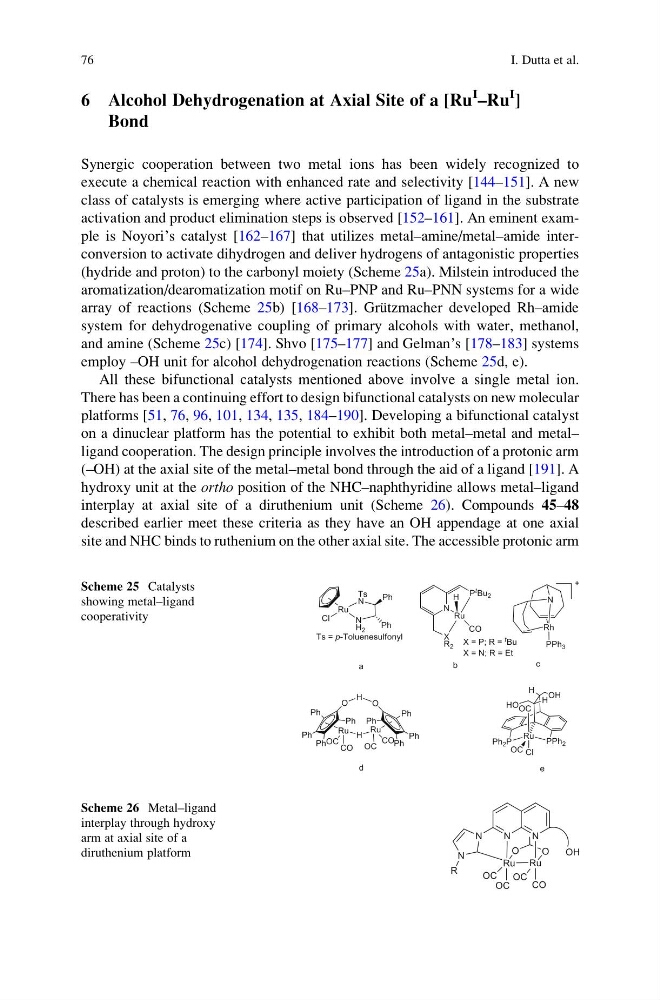
activation and product elimination steps is observed [152–161]. An eminent example is Noyori’s catalyst [162–167] that utilizes metal–amine/metal–amide interconversion to activate dihydrogen and deliver hydrogens of antagonistic properties
(hydride and proton) to the carbonyl moiety (Scheme 25a). Milstein introduced the
aromatization/dearomatization motif on Ru–PNP and Ru–PNN systems for a wide
array of reactions (Scheme 25b) [168–173]. Gru ¨tzmacher developed Rh–amide
system for dehydrogenative coupling of primary alcohols with water, methanol,
and amine (Scheme 25c) [174]. Shvo [175–177] and Gelman’s [178–183] systems
employ –OH unit for alcohol dehydrogenation reactions (Scheme 25d, e).
All these bifunctional catalysts mentioned above involve a single metal ion.
There has been a continuing effort to design bifunctional catalysts on new molecular
platforms [51, 76, 96, 101, 134, 135, 184–190]. Developing a bifunctional catalyst
on a dinuclear platform has the potential to exhibit both metal–metal and metal–
ligand cooperation. The design principle involves the introduction of a protonic arm
(–OH) at the axial site of the metal–metal bond through the aid of a ligand [191]. A
hydroxy unit at the ortho position of the NHC–naphthyridine allows metal–ligand
interplay at axial site of a diruthenium unit (Scheme 26). Compounds 45–48
described earlier meet these criteria as they have an OH appendage at one axial
site and NHC binds to ruthenium on the other axial site. The accessible protonic arm
Scheme 25 Catalysts
showing metal–ligand
cooperativity
Scheme 26 Metal–ligand
interplay through hydroxy
arm at axial site of a
diruthenium platform
76
I. Dutta et al.
I –Ru
I
]
Bond
Synergic cooperation between two metal ions has been widely recognized to
execute a chemical reaction with enhanced rate and selectivity [144–151]. A new
class of catalysts is emerging where active participation of ligand in the substrate
activation and product elimination steps is observed [152–161]. An eminent example is Noyori’s catalyst [162–167] that utilizes metal–amine/metal–amide interconversion to activate dihydrogen and deliver hydrogens of antagonistic properties
(hydride and proton) to the carbonyl moiety (Scheme 25a). Milstein introduced the
aromatization/dearomatization motif on Ru–PNP and Ru–PNN systems for a wide
array of reactions (Scheme 25b) [168–173]. Gru ¨tzmacher developed Rh–amide
system for dehydrogenative coupling of primary alcohols with water, methanol,
and amine (Scheme 25c) [174]. Shvo [175–177] and Gelman’s [178–183] systems
employ –OH unit for alcohol dehydrogenation reactions (Scheme 25d, e).
All these bifunctional catalysts mentioned above involve a single metal ion.
There has been a continuing effort to design bifunctional catalysts on new molecular
platforms [51, 76, 96, 101, 134, 135, 184–190]. Developing a bifunctional catalyst
on a dinuclear platform has the potential to exhibit both metal–metal and metal–
ligand cooperation. The design principle involves the introduction of a protonic arm
(–OH) at the axial site of the metal–metal bond through the aid of a ligand [191]. A
hydroxy unit at the ortho position of the NHC–naphthyridine allows metal–ligand
interplay at axial site of a diruthenium unit (Scheme 26). Compounds 45–48
described earlier meet these criteria as they have an OH appendage at one axial
site and NHC binds to ruthenium on the other axial site. The accessible protonic arm
Scheme 25 Catalysts
showing metal–ligand
cooperativity
Scheme 26 Metal–ligand
interplay through hydroxy
arm at axial site of a
diruthenium platform
76
I. Dutta et al.