

ineffective, presumably because triflates block the axial sites as it competes with
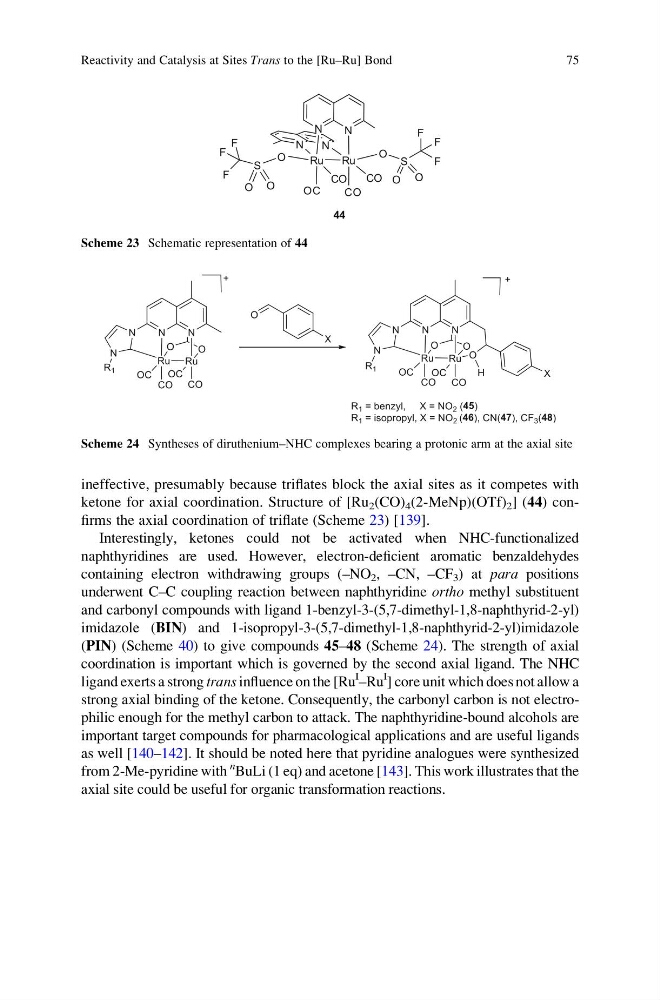
ketone for axial coordination. Structure of [Ru 2 (CO) 4 (2-MeNp)(OTf) 2 ] (44) confirms the axial coordination of triflate (Scheme 23) [139].
Interestingly, ketones could not be activated when NHC-functionalized
naphthyridines are used. However, electron-deficient aromatic benzaldehydes
containing electron withdrawing groups (–NO 2 , –CN, –CF 3 ) at para positions
underwent C–C coupling reaction between naphthyridine ortho methyl substituent
and carbonyl compounds with ligand 1-benzyl-3-(5,7-dimethyl-1,8-naphthyrid-2-yl)
imidazole (BIN) and 1-isopropyl-3-(5,7-dimethyl-1,8-naphthyrid-2-yl)imidazole
(PIN) (Scheme 40) to give compounds 45–48 (Scheme 24). The strength of axial
coordination is important which is governed by the second axial ligand. The NHC
ligand exerts a strong trans influence on the [Ru
I
–Ru
I
] core unit which does not allow a
strong axial binding of the ketone. Consequently, the carbonyl carbon is not electrophilic enough for the methyl carbon to attack. The naphthyridine-bound alcohols are
important target compounds for pharmacological applications and are useful ligands
as well [140–142]. It should be noted here that pyridine analogues were synthesized
from 2-Me-pyridine with
n
BuLi (1 eq) and acetone [143]. This work illustrates that the
axial site could be useful for organic transformation reactions.
N
N
Ru
Ru
N
N
OC
CO
CO
CO
O S
F
F
F
O
O
S
F
F
F
O O
O
44
Scheme 23 Schematic representation of 44
Scheme 24 Syntheses of diruthenium–NHC complexes bearing a protonic arm at the axial site
Reactivity and Catalysis at Sites Trans to the [Ru–Ru] Bond
75
ketone for axial coordination. Structure of [Ru 2 (CO) 4 (2-MeNp)(OTf) 2 ] (44) confirms the axial coordination of triflate (Scheme 23) [139].
Interestingly, ketones could not be activated when NHC-functionalized
naphthyridines are used. However, electron-deficient aromatic benzaldehydes
containing electron withdrawing groups (–NO 2 , –CN, –CF 3 ) at para positions
underwent C–C coupling reaction between naphthyridine ortho methyl substituent
and carbonyl compounds with ligand 1-benzyl-3-(5,7-dimethyl-1,8-naphthyrid-2-yl)
imidazole (BIN) and 1-isopropyl-3-(5,7-dimethyl-1,8-naphthyrid-2-yl)imidazole
(PIN) (Scheme 40) to give compounds 45–48 (Scheme 24). The strength of axial
coordination is important which is governed by the second axial ligand. The NHC
ligand exerts a strong trans influence on the [Ru
I
–Ru
I
] core unit which does not allow a
strong axial binding of the ketone. Consequently, the carbonyl carbon is not electrophilic enough for the methyl carbon to attack. The naphthyridine-bound alcohols are
important target compounds for pharmacological applications and are useful ligands
as well [140–142]. It should be noted here that pyridine analogues were synthesized
from 2-Me-pyridine with
n
BuLi (1 eq) and acetone [143]. This work illustrates that the
axial site could be useful for organic transformation reactions.
N
N
Ru
Ru
N
N
OC
CO
CO
CO
O S
F
F
F
O
O
S
F
F
F
O O
O
44
Scheme 23 Schematic representation of 44
Scheme 24 Syntheses of diruthenium–NHC complexes bearing a protonic arm at the axial site
Reactivity and Catalysis at Sites Trans to the [Ru–Ru] Bond
75