

σ orbital. Hence, the acidity of the hydrogen atom is increased favoring electrophilic C–H cleavage. The lone pair on imidazole nitrogen is involved in resonance
with the Np π cloud. The ortho C(p π ) orbital is thus not sufficiently electron rich to
interact strongly with [Ru–Ru] σ* orbital. But, the C–H σ bond interacts with [Ru–
Ru] σ* orbital and back donation occurs from filled [Ru–Ru] π* to C–H σ* orbital.
The result is the C–H oxidative addition to Ru–Ru resulting in its oxidative
cleavage.
5 C–C Bond Formation at Axial Site of a [Ru
I –Ru
I ] Bond
The formation of C–C coupled products without the aid of base is highly important
[137, 138]. The C–C bond formation reactions were observed at room temperature
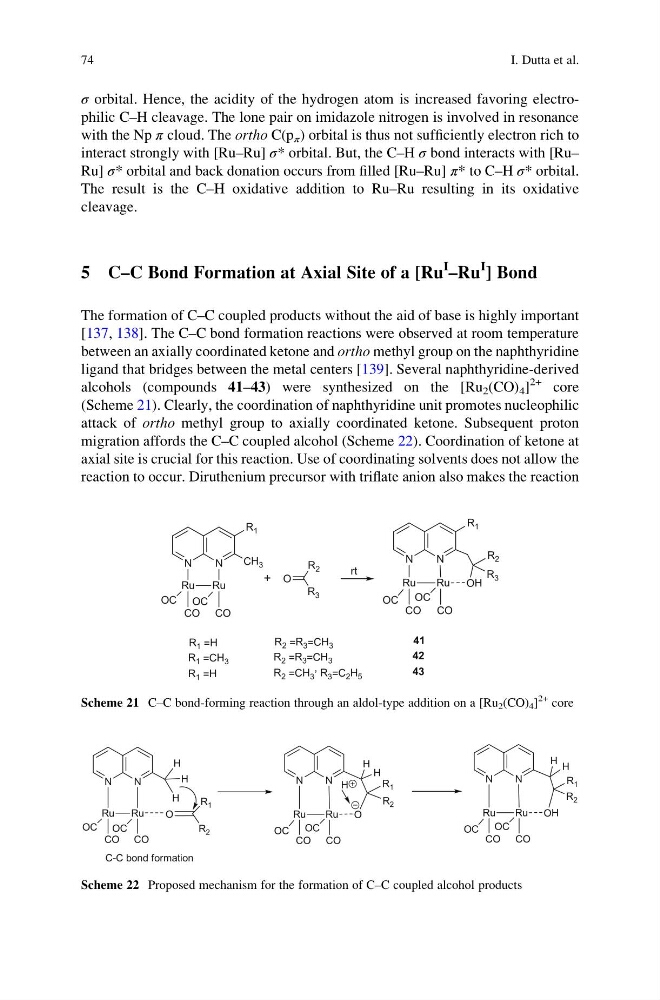
between an axially coordinated ketone and ortho methyl group on the naphthyridine
ligand that bridges between the metal centers [139]. Several naphthyridine-derived
alcohols (compounds 41–43) were synthesized on the [Ru 2 (CO) 4 ]
2+ core
(Scheme 21). Clearly, the coordination of naphthyridine unit promotes nucleophilic
attack of ortho methyl group to axially coordinated ketone. Subsequent proton
migration affords the C–C coupled alcohol (Scheme 22). Coordination of ketone at
axial site is crucial for this reaction. Use of coordinating solvents does not allow the
reaction to occur. Diruthenium precursor with triflate anion also makes the reaction
N
CH 3
N
Ru
Ru
CO
OC
CO
OC
N
N
Ru
Ru
CO
OC
CO
OC
OH
R 3
R 2
R 2
R 3
O
R 1
R 1
rt
+
R 1 =H
R 1 =CH 3
R 1 =H
R 2 =R 3 =CH 3
R 2 =R 3 =CH 3
R 2 =CH 3
, R 3 =C 2 H 5
41
42
43
Scheme 21 C–C bond-forming reaction through an aldol-type addition on a [Ru 2 (CO) 4 ]
2+ core
N
N
Ru
Ru
CO
OC
CO
OC
R 2
R 1
O
H
H
H
C-C bond formation
N
N
Ru
Ru
CO
OC
CO
OC
OH
R 1
R 2
N
N
Ru
Ru
CO
OC
CO
OC
O
R 1
R 2
H
H
H
H
H
Scheme 22 Proposed mechanism for the formation of C–C coupled alcohol products
74
I. Dutta et al.
with the Np π cloud. The ortho C(p π ) orbital is thus not sufficiently electron rich to
interact strongly with [Ru–Ru] σ* orbital. But, the C–H σ bond interacts with [Ru–
Ru] σ* orbital and back donation occurs from filled [Ru–Ru] π* to C–H σ* orbital.
The result is the C–H oxidative addition to Ru–Ru resulting in its oxidative
cleavage.
5 C–C Bond Formation at Axial Site of a [Ru
I –Ru
I ] Bond
The formation of C–C coupled products without the aid of base is highly important
[137, 138]. The C–C bond formation reactions were observed at room temperature
between an axially coordinated ketone and ortho methyl group on the naphthyridine
ligand that bridges between the metal centers [139]. Several naphthyridine-derived
alcohols (compounds 41–43) were synthesized on the [Ru 2 (CO) 4 ]
2+ core
(Scheme 21). Clearly, the coordination of naphthyridine unit promotes nucleophilic
attack of ortho methyl group to axially coordinated ketone. Subsequent proton
migration affords the C–C coupled alcohol (Scheme 22). Coordination of ketone at
axial site is crucial for this reaction. Use of coordinating solvents does not allow the
reaction to occur. Diruthenium precursor with triflate anion also makes the reaction
N
CH 3
N
Ru
Ru
CO
OC
CO
OC
N
N
Ru
Ru
CO
OC
CO
OC
OH
R 3
R 2
R 2
R 3
O
R 1
R 1
rt
+
R 1 =H
R 1 =CH 3
R 1 =H
R 2 =R 3 =CH 3
R 2 =R 3 =CH 3
R 2 =CH 3
, R 3 =C 2 H 5
41
42
43
Scheme 21 C–C bond-forming reaction through an aldol-type addition on a [Ru 2 (CO) 4 ]
2+ core
N
N
Ru
Ru
CO
OC
CO
OC
R 2
R 1
O
H
H
H
C-C bond formation
N
N
Ru
Ru
CO
OC
CO
OC
OH
R 1
R 2
N
N
Ru
Ru
CO
OC
CO
OC
O
R 1
R 2
H
H
H
H
H
Scheme 22 Proposed mechanism for the formation of C–C coupled alcohol products
74
I. Dutta et al.