

second cyclometalation difficult. The [Ru–Ru] σ* orbital is no longer a good
acceptor orbital to interact with the second C–H bond [86].
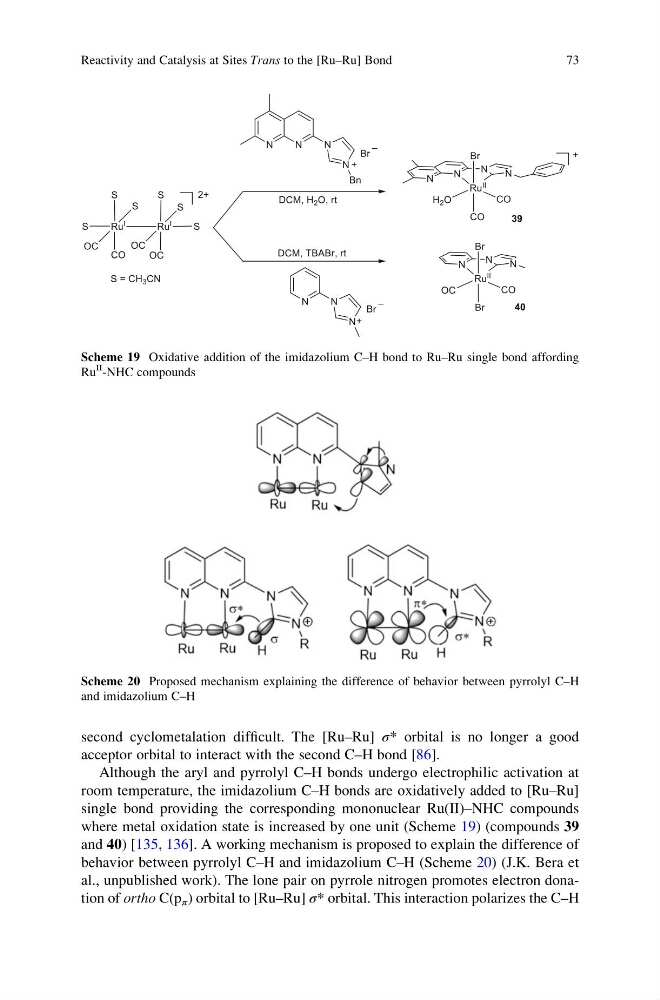
Although the aryl and pyrrolyl C–H bonds undergo electrophilic activation at
room temperature, the imidazolium C–H bonds are oxidatively added to [Ru–Ru]
single bond providing the corresponding mononuclear Ru(II)–NHC compounds
where metal oxidation state is increased by one unit (Scheme 19) (compounds 39
and 40) [135, 136]. A working mechanism is proposed to explain the difference of
behavior between pyrrolyl C–H and imidazolium C–H (Scheme 20) (J.K. Bera et
al., unpublished work). The lone pair on pyrrole nitrogen promotes electron donation of ortho C(p π ) orbital to [Ru–Ru] σ* orbital. This interaction polarizes the C–H
Scheme 19 Oxidative addition of the imidazolium C–H bond to Ru–Ru single bond affording
Ru
II -NHC compounds
Scheme 20 Proposed mechanism explaining the difference of behavior between pyrrolyl C–H
and imidazolium C–H
Reactivity and Catalysis at Sites Trans to the [Ru–Ru] Bond
73
acceptor orbital to interact with the second C–H bond [86].
Although the aryl and pyrrolyl C–H bonds undergo electrophilic activation at
room temperature, the imidazolium C–H bonds are oxidatively added to [Ru–Ru]
single bond providing the corresponding mononuclear Ru(II)–NHC compounds
where metal oxidation state is increased by one unit (Scheme 19) (compounds 39
and 40) [135, 136]. A working mechanism is proposed to explain the difference of
behavior between pyrrolyl C–H and imidazolium C–H (Scheme 20) (J.K. Bera et
al., unpublished work). The lone pair on pyrrole nitrogen promotes electron donation of ortho C(p π ) orbital to [Ru–Ru] σ* orbital. This interaction polarizes the C–H
Scheme 19 Oxidative addition of the imidazolium C–H bond to Ru–Ru single bond affording
Ru
II -NHC compounds
Scheme 20 Proposed mechanism explaining the difference of behavior between pyrrolyl C–H
and imidazolium C–H
Reactivity and Catalysis at Sites Trans to the [Ru–Ru] Bond
73