

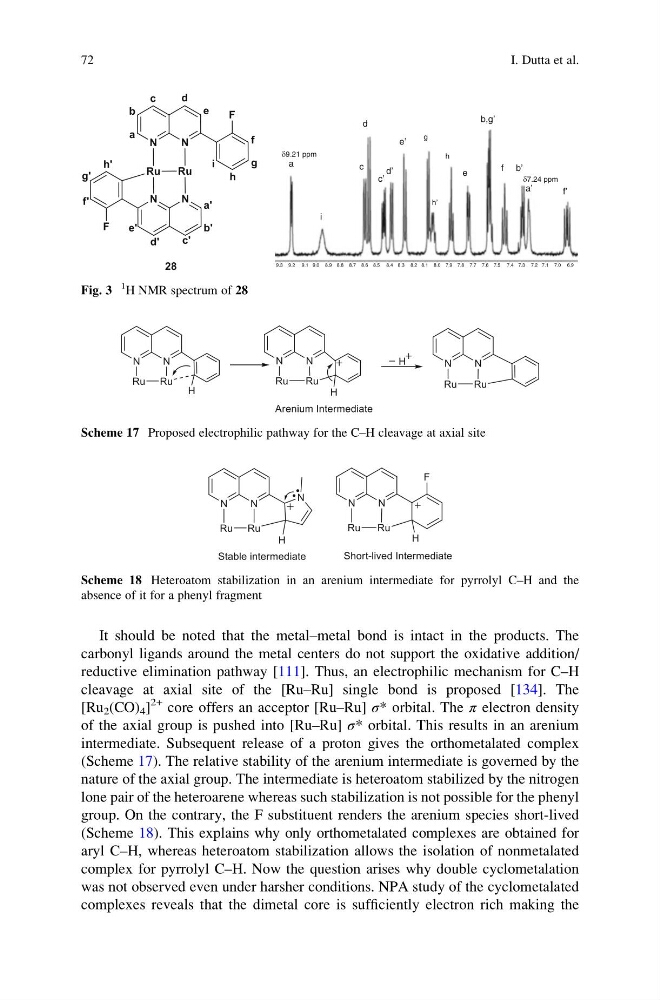
It should be noted that the metal–metal bond is intact in the products. The
carbonyl ligands around the metal centers do not support the oxidative addition/
reductive elimination pathway [111]. Thus, an electrophilic mechanism for C–H
cleavage at axial site of the [Ru–Ru] single bond is proposed [134]. The
[Ru 2 (CO) 4 ]
2+ core offers an acceptor [Ru–Ru] σ* orbital. The π electron density
of the axial group is pushed into [Ru–Ru] σ* orbital. This results in an arenium
intermediate. Subsequent release of a proton gives the orthometalated complex
(Scheme 17). The relative stability of the arenium intermediate is governed by the
nature of the axial group. The intermediate is heteroatom stabilized by the nitrogen
lone pair of the heteroarene whereas such stabilization is not possible for the phenyl
group. On the contrary, the F substituent renders the arenium species short-lived
(Scheme 18). This explains why only orthometalated complexes are obtained for
aryl C–H, whereas heteroatom stabilization allows the isolation of nonmetalated
complex for pyrrolyl C–H. Now the question arises why double cyclometalation
was not observed even under harsher conditions. NPA study of the cyclometalated
complexes reveals that the dimetal core is sufficiently electron rich making the
d
d’
e’
c
a
δ9.21 ppm
δ7.24 ppm
9.3 9.2 9.1 9.0 8.9 8.8 8.7 8.6 8.5 8.4 8.3 8.2 8.1 8.0
6.9
7.9 7.8 7.7 7.6 7.5 7.4 7.3 7.2 7.1 7.0
i
a’
c’
e
f
f’
b’
b,g’
g
h
h’
Fig. 3
1
H NMR spectrum of 28
Scheme 17 Proposed electrophilic pathway for the C–H cleavage at axial site
Scheme 18 Heteroatom stabilization in an arenium intermediate for pyrrolyl C–H and the
absence of it for a phenyl fragment
72
I. Dutta et al.
carbonyl ligands around the metal centers do not support the oxidative addition/
reductive elimination pathway [111]. Thus, an electrophilic mechanism for C–H
cleavage at axial site of the [Ru–Ru] single bond is proposed [134]. The
[Ru 2 (CO) 4 ]
2+ core offers an acceptor [Ru–Ru] σ* orbital. The π electron density
of the axial group is pushed into [Ru–Ru] σ* orbital. This results in an arenium
intermediate. Subsequent release of a proton gives the orthometalated complex
(Scheme 17). The relative stability of the arenium intermediate is governed by the
nature of the axial group. The intermediate is heteroatom stabilized by the nitrogen
lone pair of the heteroarene whereas such stabilization is not possible for the phenyl
group. On the contrary, the F substituent renders the arenium species short-lived
(Scheme 18). This explains why only orthometalated complexes are obtained for
aryl C–H, whereas heteroatom stabilization allows the isolation of nonmetalated
complex for pyrrolyl C–H. Now the question arises why double cyclometalation
was not observed even under harsher conditions. NPA study of the cyclometalated
complexes reveals that the dimetal core is sufficiently electron rich making the
d
d’
e’
c
a
δ9.21 ppm
δ7.24 ppm
9.3 9.2 9.1 9.0 8.9 8.8 8.7 8.6 8.5 8.4 8.3 8.2 8.1 8.0
6.9
7.9 7.8 7.7 7.6 7.5 7.4 7.3 7.2 7.1 7.0
i
a’
c’
e
f
f’
b’
b,g’
g
h
h’
Fig. 3
1
H NMR spectrum of 28
Scheme 17 Proposed electrophilic pathway for the C–H cleavage at axial site
Scheme 18 Heteroatom stabilization in an arenium intermediate for pyrrolyl C–H and the
absence of it for a phenyl fragment
72
I. Dutta et al.