

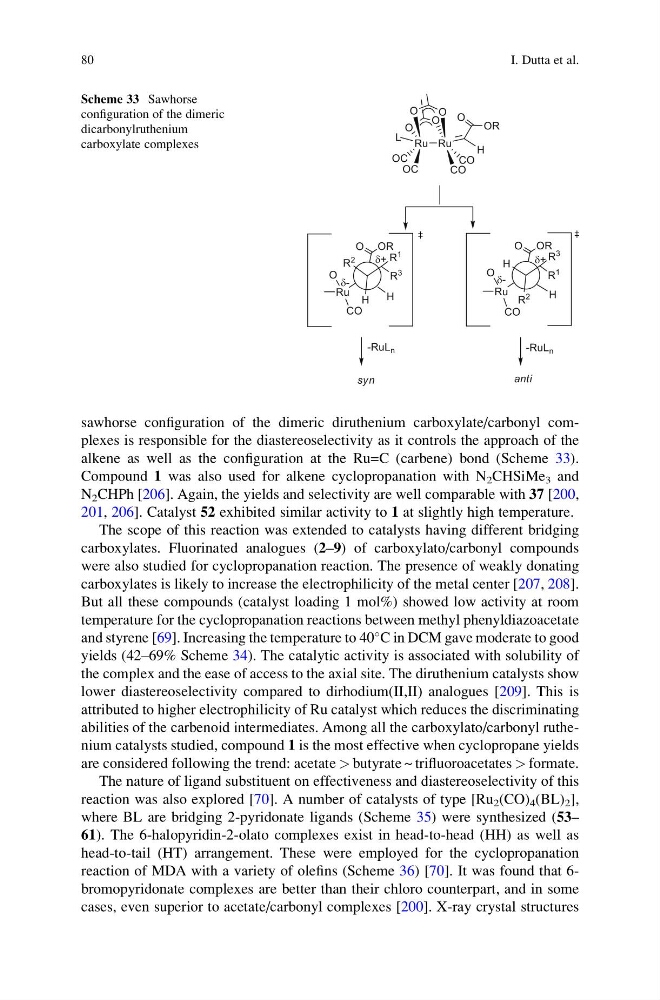
sawhorse configuration of the dimeric diruthenium carboxylate/carbonyl complexes is responsible for the diastereoselectivity as it controls the approach of the
alkene as well as the configuration at the Ru=C (carbene) bond (Scheme 33).
Compound 1 was also used for alkene cyclopropanation with N 2 CHSiMe 3 and
N 2 CHPh [206]. Again, the yields and selectivity are well comparable with 37 [200,
201, 206]. Catalyst 52 exhibited similar activity to 1 at slightly high temperature.
The scope of this reaction was extended to catalysts having different bridging
carboxylates. Fluorinated analogues (2–9) of carboxylato/carbonyl compounds
were also studied for cyclopropanation reaction. The presence of weakly donating
carboxylates is likely to increase the electrophilicity of the metal center [207, 208].
But all these compounds (catalyst loading 1 mol%) showed low activity at room
temperature for the cyclopropanation reactions between methyl phenyldiazoacetate
and styrene [69]. Increasing the temperature to 40
C in DCM gave moderate to good
yields (42–69% Scheme 34). The catalytic activity is associated with solubility of
the complex and the ease of access to the axial site. The diruthenium catalysts show
lower diastereoselectivity compared to dirhodium(II,II) analogues [209]. This is
attributed to higher electrophilicity of Ru catalyst which reduces the discriminating
abilities of the carbenoid intermediates. Among all the carboxylato/carbonyl ruthenium catalysts studied, compound 1 is the most effective when cyclopropane yields
are considered following the trend: acetate > butyrate ~ trifluoroacetates > formate.
The nature of ligand substituent on effectiveness and diastereoselectivity of this
reaction was also explored [70]. A number of catalysts of type [Ru 2 (CO) 4 (BL) 2 ],
where BL are bridging 2-pyridonate ligands (Scheme 35) were synthesized (53–
61). The 6-halopyridin-2-olato complexes exist in head-to-head (HH) as well as
head-to-tail (HT) arrangement. These were employed for the cyclopropanation
reaction of MDA with a variety of olefins (Scheme 36) [70]. It was found that 6bromopyridonate complexes are better than their chloro counterpart, and in some
cases, even superior to acetate/carbonyl complexes [200]. X-ray crystal structures
Scheme 33 Sawhorse
configuration of the dimeric
dicarbonylruthenium
carboxylate complexes
80
I. Dutta et al.
alkene as well as the configuration at the Ru=C (carbene) bond (Scheme 33).
Compound 1 was also used for alkene cyclopropanation with N 2 CHSiMe 3 and
N 2 CHPh [206]. Again, the yields and selectivity are well comparable with 37 [200,
201, 206]. Catalyst 52 exhibited similar activity to 1 at slightly high temperature.
The scope of this reaction was extended to catalysts having different bridging
carboxylates. Fluorinated analogues (2–9) of carboxylato/carbonyl compounds
were also studied for cyclopropanation reaction. The presence of weakly donating
carboxylates is likely to increase the electrophilicity of the metal center [207, 208].
But all these compounds (catalyst loading 1 mol%) showed low activity at room
temperature for the cyclopropanation reactions between methyl phenyldiazoacetate
and styrene [69]. Increasing the temperature to 40
C in DCM gave moderate to good
yields (42–69% Scheme 34). The catalytic activity is associated with solubility of
the complex and the ease of access to the axial site. The diruthenium catalysts show
lower diastereoselectivity compared to dirhodium(II,II) analogues [209]. This is
attributed to higher electrophilicity of Ru catalyst which reduces the discriminating
abilities of the carbenoid intermediates. Among all the carboxylato/carbonyl ruthenium catalysts studied, compound 1 is the most effective when cyclopropane yields
are considered following the trend: acetate > butyrate ~ trifluoroacetates > formate.
The nature of ligand substituent on effectiveness and diastereoselectivity of this
reaction was also explored [70]. A number of catalysts of type [Ru 2 (CO) 4 (BL) 2 ],
where BL are bridging 2-pyridonate ligands (Scheme 35) were synthesized (53–
61). The 6-halopyridin-2-olato complexes exist in head-to-head (HH) as well as
head-to-tail (HT) arrangement. These were employed for the cyclopropanation
reaction of MDA with a variety of olefins (Scheme 36) [70]. It was found that 6bromopyridonate complexes are better than their chloro counterpart, and in some
cases, even superior to acetate/carbonyl complexes [200]. X-ray crystal structures
Scheme 33 Sawhorse
configuration of the dimeric
dicarbonylruthenium
carboxylate complexes
80
I. Dutta et al.