

[BF 4 ] (31), [Ru 2 (HL
11 )(L
11 )(CO) 4 ][BF 4 ] (32), and [Ru 2 (HL
12 )(L
12 )(CO) 4 ][BF 4 ]
(33) [133]. An interesting chemistry was observed for HL
12 . Although roomtemperature reaction provided the orthometalated compound 33, reaction at low
temperature (4
C) yielded a nonmetalated compound [Ru 2 (HL
12 ) 2 (CO) 4 ][BF 4 ] 2
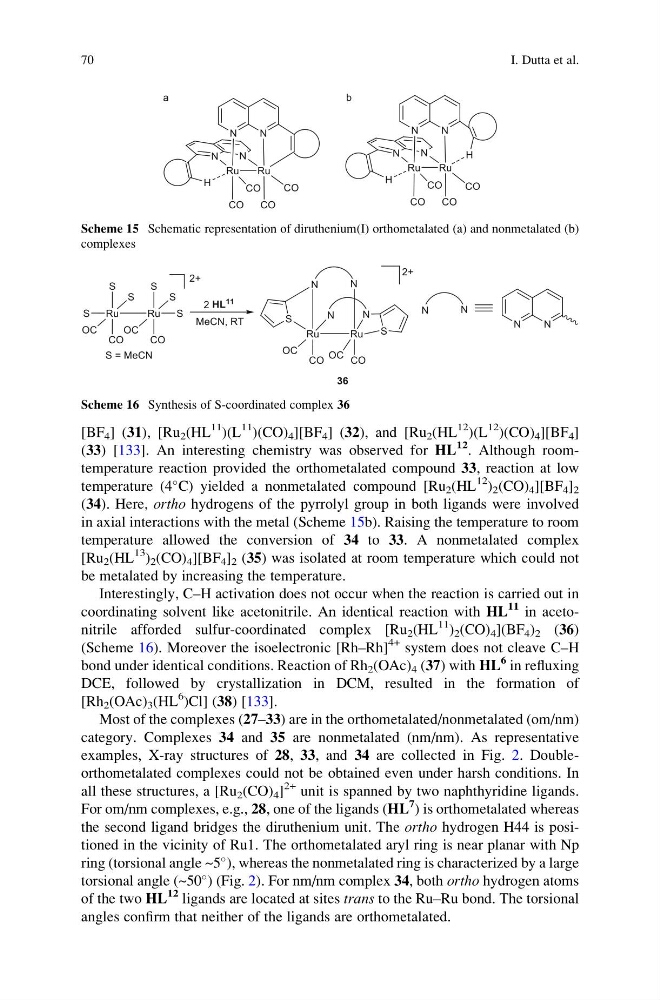
(34). Here, ortho hydrogens of the pyrrolyl group in both ligands were involved
in axial interactions with the metal (Scheme 15b). Raising the temperature to room
temperature allowed the conversion of 34 to 33. A nonmetalated complex
[Ru 2 (HL
13
) 2 (CO) 4 ][BF 4 ] 2 (35) was isolated at room temperature which could not
be metalated by increasing the temperature.
Interestingly, C–H activation does not occur when the reaction is carried out in
coordinating solvent like acetonitrile. An identical reaction with HL
11 in acetonitrile afforded sulfur-coordinated complex [Ru 2 (HL
11 ) 2 (CO) 4 ](BF 4 ) 2 (36)
(Scheme 16). Moreover the isoelectronic [Rh–Rh]
4+ system does not cleave C–H
bond under identical conditions. Reaction of Rh 2 (OAc) 4 (37) with HL
6 in refluxing
DCE, followed by crystallization in DCM, resulted in the formation of
[Rh 2 (OAc) 3 (HL
6 )Cl] (38) [133].
Most of the complexes (27–33) are in the orthometalated/nonmetalated (om/nm)
category. Complexes 34 and 35 are nonmetalated (nm/nm). As representative
examples, X-ray structures of 28, 33, and 34 are collected in Fig. 2. Doubleorthometalated complexes could not be obtained even under harsh conditions. In
all these structures, a [Ru 2 (CO) 4 ]
2+ unit is spanned by two naphthyridine ligands.
For om/nm complexes, e.g., 28, one of the ligands (HL
7 ) is orthometalated whereas
the second ligand bridges the diruthenium unit. The ortho hydrogen H44 is positioned in the vicinity of Ru1. The orthometalated aryl ring is near planar with Np
ring (torsional angle ~5
), whereas the nonmetalated ring is characterized by a large
torsional angle (~50
) (Fig. 2). For nm/nm complex 34, both ortho hydrogen atoms
of the two HL
12 ligands are located at sites trans to the Ru–Ru bond. The torsional
angles confirm that neither of the ligands are orthometalated.
Scheme 16 Synthesis of S-coordinated complex 36
Scheme 15 Schematic representation of diruthenium(I) orthometalated (a) and nonmetalated (b)
complexes
70
I. Dutta et al.
11 )(L
11 )(CO) 4 ][BF 4 ] (32), and [Ru 2 (HL
12 )(L
12 )(CO) 4 ][BF 4 ]
(33) [133]. An interesting chemistry was observed for HL
12 . Although roomtemperature reaction provided the orthometalated compound 33, reaction at low
temperature (4
C) yielded a nonmetalated compound [Ru 2 (HL
12 ) 2 (CO) 4 ][BF 4 ] 2
(34). Here, ortho hydrogens of the pyrrolyl group in both ligands were involved
in axial interactions with the metal (Scheme 15b). Raising the temperature to room
temperature allowed the conversion of 34 to 33. A nonmetalated complex
[Ru 2 (HL
13
) 2 (CO) 4 ][BF 4 ] 2 (35) was isolated at room temperature which could not
be metalated by increasing the temperature.
Interestingly, C–H activation does not occur when the reaction is carried out in
coordinating solvent like acetonitrile. An identical reaction with HL
11 in acetonitrile afforded sulfur-coordinated complex [Ru 2 (HL
11 ) 2 (CO) 4 ](BF 4 ) 2 (36)
(Scheme 16). Moreover the isoelectronic [Rh–Rh]
4+ system does not cleave C–H
bond under identical conditions. Reaction of Rh 2 (OAc) 4 (37) with HL
6 in refluxing
DCE, followed by crystallization in DCM, resulted in the formation of
[Rh 2 (OAc) 3 (HL
6 )Cl] (38) [133].
Most of the complexes (27–33) are in the orthometalated/nonmetalated (om/nm)
category. Complexes 34 and 35 are nonmetalated (nm/nm). As representative
examples, X-ray structures of 28, 33, and 34 are collected in Fig. 2. Doubleorthometalated complexes could not be obtained even under harsh conditions. In
all these structures, a [Ru 2 (CO) 4 ]
2+ unit is spanned by two naphthyridine ligands.
For om/nm complexes, e.g., 28, one of the ligands (HL
7 ) is orthometalated whereas
the second ligand bridges the diruthenium unit. The ortho hydrogen H44 is positioned in the vicinity of Ru1. The orthometalated aryl ring is near planar with Np
ring (torsional angle ~5
), whereas the nonmetalated ring is characterized by a large
torsional angle (~50
) (Fig. 2). For nm/nm complex 34, both ortho hydrogen atoms
of the two HL
12 ligands are located at sites trans to the Ru–Ru bond. The torsional
angles confirm that neither of the ligands are orthometalated.
Scheme 16 Synthesis of S-coordinated complex 36
Scheme 15 Schematic representation of diruthenium(I) orthometalated (a) and nonmetalated (b)
complexes
70
I. Dutta et al.