

the symmetry to C s . For category 3 complexes, the bridging oxypyridinate ligands
bind tighter through the N-ends whereas the O-bonded Ru moves toward the axial
ligand. The [Ru–Ru] distance increases going from category 1 to category 3. In
conclusion, the π acidic character of axial ligand alters heavily the δ
*
/π
* ordering
and therefore the ground-state electronic configuration. Nevertheless, the extent of
axial ligand binding is governed by σ-donor character of the ligand.
4 C–H Bond Activation at Axial Site of a [Ru
I –Ru
I ] Bond
C–H bond activation on a metal center is of fundamental interest [104–113].
Several metal catalysts have been developed over the years for C–H functionalization reactions. An extensive range of studies have been undertaken to understand
the nature of the metalÁ Á ÁC–H interaction. Nearly all studies involve complexes
with single metal [114–117]. On the contrary, there are few reports available on
C–H activation on a bimetallic complex or metal cluster [118–120].
Orthometalation of aryl phosphines, bis(2-pyridyl)amine, and 2-((α-Rbenzylidene)amino)pyridines [R = CH 3 , 4-(CH 3 O)C 6 H 4 ] has been achieved on a
[Rh
II –Rh
II
] platform [121–125]. C–H bond activation is also reported on Ru 3 (CO) 12
[126–130]. The Os analogue activated C–H bond of (Ph 2 P)C 60 H [131]. Studies on
C–H activation at axial site of a metal–metal bond paved the way for designing
catalytic systems based on bimetallic complexes [132].
Suitably designed naphthyridine-based ligands allowed the introduction of aryl
C–H bond at axial site of the [Ru 2 (CO) 4 ]
2+ unit [96]. The ligand systems that were
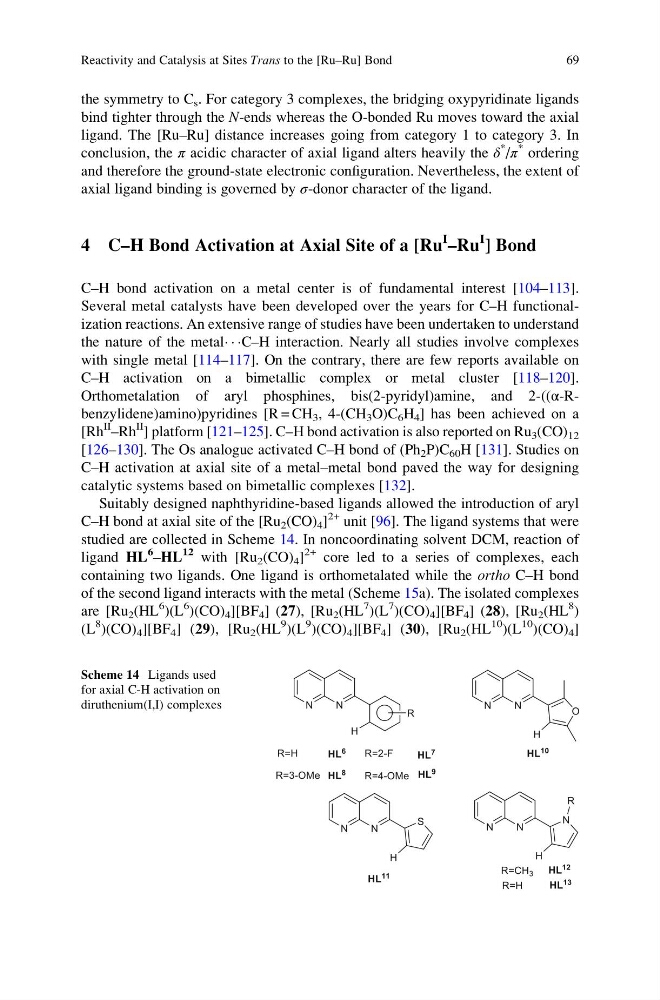
studied are collected in Scheme 14. In noncoordinating solvent DCM, reaction of
ligand HL
6 –HL
12 with [Ru 2 (CO) 4 ]
2+ core led to a series of complexes, each
containing two ligands. One ligand is orthometalated while the ortho C–H bond
of the second ligand interacts with the metal (Scheme 15a). The isolated complexes
are [Ru 2 (HL
6 )(L
6 )(CO) 4 ][BF 4 ] (27), [Ru 2 (HL
7 )(L
7
)(CO) 4 ][BF 4 ] (28), [Ru 2 (HL
8 )
(L
8 )(CO) 4 ][BF 4 ] (29), [Ru 2 (HL
9 )(L
9 )(CO) 4 ][BF 4 ] (30), [Ru 2 (HL
10 )(L
10 )(CO) 4 ]
Scheme 14 Ligands used
for axial C-H activation on
diruthenium(I,I) complexes
Reactivity and Catalysis at Sites Trans to the [Ru–Ru] Bond
69
bind tighter through the N-ends whereas the O-bonded Ru moves toward the axial
ligand. The [Ru–Ru] distance increases going from category 1 to category 3. In
conclusion, the π acidic character of axial ligand alters heavily the δ
*
/π
* ordering
and therefore the ground-state electronic configuration. Nevertheless, the extent of
axial ligand binding is governed by σ-donor character of the ligand.
4 C–H Bond Activation at Axial Site of a [Ru
I –Ru
I ] Bond
C–H bond activation on a metal center is of fundamental interest [104–113].
Several metal catalysts have been developed over the years for C–H functionalization reactions. An extensive range of studies have been undertaken to understand
the nature of the metalÁ Á ÁC–H interaction. Nearly all studies involve complexes
with single metal [114–117]. On the contrary, there are few reports available on
C–H activation on a bimetallic complex or metal cluster [118–120].
Orthometalation of aryl phosphines, bis(2-pyridyl)amine, and 2-((α-Rbenzylidene)amino)pyridines [R = CH 3 , 4-(CH 3 O)C 6 H 4 ] has been achieved on a
[Rh
II –Rh
II
] platform [121–125]. C–H bond activation is also reported on Ru 3 (CO) 12
[126–130]. The Os analogue activated C–H bond of (Ph 2 P)C 60 H [131]. Studies on
C–H activation at axial site of a metal–metal bond paved the way for designing
catalytic systems based on bimetallic complexes [132].
Suitably designed naphthyridine-based ligands allowed the introduction of aryl
C–H bond at axial site of the [Ru 2 (CO) 4 ]
2+ unit [96]. The ligand systems that were
studied are collected in Scheme 14. In noncoordinating solvent DCM, reaction of
ligand HL
6 –HL
12 with [Ru 2 (CO) 4 ]
2+ core led to a series of complexes, each
containing two ligands. One ligand is orthometalated while the ortho C–H bond
of the second ligand interacts with the metal (Scheme 15a). The isolated complexes
are [Ru 2 (HL
6 )(L
6 )(CO) 4 ][BF 4 ] (27), [Ru 2 (HL
7 )(L
7
)(CO) 4 ][BF 4 ] (28), [Ru 2 (HL
8 )
(L
8 )(CO) 4 ][BF 4 ] (29), [Ru 2 (HL
9 )(L
9 )(CO) 4 ][BF 4 ] (30), [Ru 2 (HL
10 )(L
10 )(CO) 4 ]
Scheme 14 Ligands used
for axial C-H activation on
diruthenium(I,I) complexes
Reactivity and Catalysis at Sites Trans to the [Ru–Ru] Bond
69