

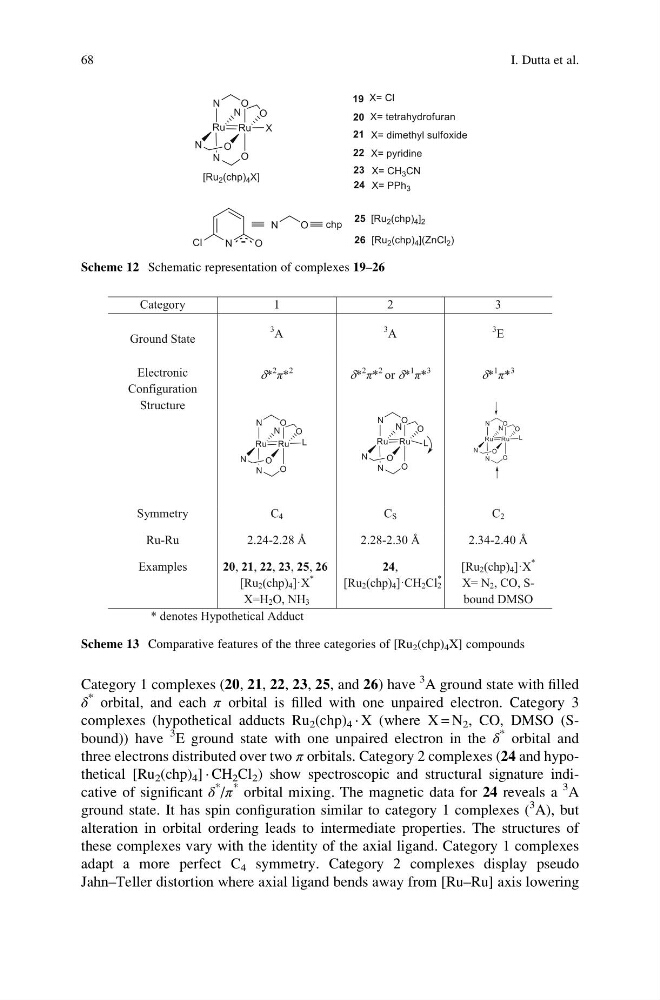
Category 1 complexes (20, 21, 22, 23, 25, and 26) have
3 A ground state with filled
δ
* orbital, and each π orbital is filled with one unpaired electron. Category 3
complexes (hypothetical adducts Ru 2 (chp) 4 · X (where X = N 2 , CO, DMSO (Sbound)) have
3 E ground state with one unpaired electron in the δ
* orbital and
three electrons distributed over two π orbitals. Category 2 complexes (24 and hypothetical [Ru 2 (chp) 4 ] · CH 2 Cl 2 ) show spectroscopic and structural signature indicative of significant δ
* /π
* orbital mixing. The magnetic data for 24 reveals a
3 A
ground state. It has spin configuration similar to category 1 complexes (
3 A), but
alteration in orbital ordering leads to intermediate properties. The structures of
these complexes vary with the identity of the axial ligand. Category 1 complexes
adapt a more perfect C 4 symmetry. Category 2 complexes display pseudo
Jahn–Teller distortion where axial ligand bends away from [Ru–Ru] axis lowering
Category
1
2
3
Ground State
3 A
3 A
3 E
Electronic
Configuration
δ*
2 π*
2
δ*
2 π*
2 or δ*
1 π*
3
δ*
1 π*
3
Structure
Symmetry
C 4
C S
C 2
Ru-Ru
2.24-2.28 Å
2.28-2.30 Å
2.34-2.40 Å
Examples
20, 21, 22, 23, 25, 26
[Ru 2 (chp) 4 ]·X
*
X=H 2 O, NH 3
24,
[Ru 2 (chp) 4 ]·CH 2 Cl2
*
[Ru 2 (chp) 4 ]·X
*
X= N 2 , CO, Sbound DMSO
* denotes Hypothetical Adduct
N
N
O
O
Ru
N
O
Ru
N
O
L
N
N
O
O
Ru
N
O
Ru
N
O
L
N
N
O
O
Ru
N
O
Ru
N
O
L
Scheme 13 Comparative features of the three categories of [Ru 2 (chp) 4 X] compounds
Scheme 12 Schematic representation of complexes 19–26
68
I. Dutta et al.
3 A ground state with filled
δ
* orbital, and each π orbital is filled with one unpaired electron. Category 3
complexes (hypothetical adducts Ru 2 (chp) 4 · X (where X = N 2 , CO, DMSO (Sbound)) have
3 E ground state with one unpaired electron in the δ
* orbital and
three electrons distributed over two π orbitals. Category 2 complexes (24 and hypothetical [Ru 2 (chp) 4 ] · CH 2 Cl 2 ) show spectroscopic and structural signature indicative of significant δ
* /π
* orbital mixing. The magnetic data for 24 reveals a
3 A
ground state. It has spin configuration similar to category 1 complexes (
3 A), but
alteration in orbital ordering leads to intermediate properties. The structures of
these complexes vary with the identity of the axial ligand. Category 1 complexes
adapt a more perfect C 4 symmetry. Category 2 complexes display pseudo
Jahn–Teller distortion where axial ligand bends away from [Ru–Ru] axis lowering
Category
1
2
3
Ground State
3 A
3 A
3 E
Electronic
Configuration
δ*
2 π*
2
δ*
2 π*
2 or δ*
1 π*
3
δ*
1 π*
3
Structure
Symmetry
C 4
C S
C 2
Ru-Ru
2.24-2.28 Å
2.28-2.30 Å
2.34-2.40 Å
Examples
20, 21, 22, 23, 25, 26
[Ru 2 (chp) 4 ]·X
*
X=H 2 O, NH 3
24,
[Ru 2 (chp) 4 ]·CH 2 Cl2
*
[Ru 2 (chp) 4 ]·X
*
X= N 2 , CO, Sbound DMSO
* denotes Hypothetical Adduct
N
N
O
O
Ru
N
O
Ru
N
O
L
N
N
O
O
Ru
N
O
Ru
N
O
L
N
N
O
O
Ru
N
O
Ru
N
O
L
Scheme 13 Comparative features of the three categories of [Ru 2 (chp) 4 X] compounds
Scheme 12 Schematic representation of complexes 19–26
68
I. Dutta et al.