

destabilizes the [Ru–Ru] σ orbital. The extent of destabilization depends on the
strength of the donor ligand. DFT calculations show that the [Ru–Ru] σ orbital for
furyl complex is destabilized because of the interaction of furyl appendages with O
lone pairs, and it lies below the pair of π* orbitals. The extent of destabilization for
axial pyridyl donors is significantly higher, making the [Ru–Ru] σ orbital the
HOMO. The same is true for thiazole and pyrrole axial donors. For triflate, the σ
orbital is low-lying and LUMO is primarily [Ru–Ru] σ*. For other complexes, the
LUMO is ligand-based π* orbital. Thus, the lengthening of [Ru–Ru] bond distances
as a function of axial donor follows the trend: pyrrolyl > pyridyl ~ thiazolyl >
furyl > triflate which agrees well with the calculated destabilization of the [Ru–
Ru] σ orbitals.
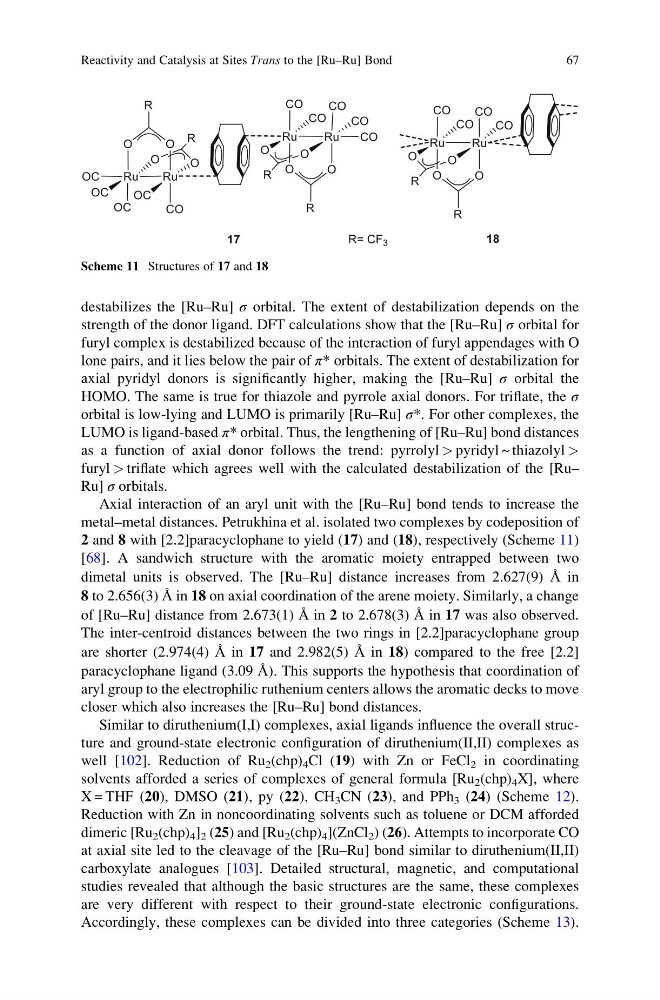
Axial interaction of an aryl unit with the [Ru–Ru] bond tends to increase the
metal–metal distances. Petrukhina et al. isolated two complexes by codeposition of
2 and 8 with [2.2]paracyclophane to yield (17) and (18), respectively (Scheme 11)
[68]. A sandwich structure with the aromatic moiety entrapped between two
dimetal units is observed. The [Ru–Ru] distance increases from 2.627(9) Å in
8 to 2.656(3) Å in 18 on axial coordination of the arene moiety. Similarly, a change
of [Ru–Ru] distance from 2.673(1) Å in 2 to 2.678(3) Å in 17 was also observed.
The inter-centroid distances between the two rings in [2.2]paracyclophane group
are shorter (2.974(4) Å in 17 and 2.982(5) Å in 18) compared to the free [2.2]
paracyclophane ligand (3.09 Å). This supports the hypothesis that coordination of
aryl group to the electrophilic ruthenium centers allows the aromatic decks to move
closer which also increases the [Ru–Ru] bond distances.
Similar to diruthenium(I,I) complexes, axial ligands influence the overall structure and ground-state electronic configuration of diruthenium(II,II) complexes as
well [102]. Reduction of Ru 2 (chp) 4 Cl (19) with Zn or FeCl 2 in coordinating
solvents afforded a series of complexes of general formula [Ru 2 (chp) 4 X], where
X = THF (20), DMSO (21), py (22), CH 3 CN (23), and PPh 3 (24) (Scheme 12).
Reduction with Zn in noncoordinating solvents such as toluene or DCM afforded
dimeric [Ru 2 (chp) 4 ] 2 (25) and [Ru 2 (chp) 4 ](ZnCl 2 ) (26). Attempts to incorporate CO
at axial site led to the cleavage of the [Ru–Ru] bond similar to diruthenium(II,II)
carboxylate analogues [103]. Detailed structural, magnetic, and computational
studies revealed that although the basic structures are the same, these complexes
are very different with respect to their ground-state electronic configurations.
Accordingly, these complexes can be divided into three categories (Scheme 13).
Scheme 11 Structures of 17 and 18
Reactivity and Catalysis at Sites Trans to the [Ru–Ru] Bond
67
strength of the donor ligand. DFT calculations show that the [Ru–Ru] σ orbital for
furyl complex is destabilized because of the interaction of furyl appendages with O
lone pairs, and it lies below the pair of π* orbitals. The extent of destabilization for
axial pyridyl donors is significantly higher, making the [Ru–Ru] σ orbital the
HOMO. The same is true for thiazole and pyrrole axial donors. For triflate, the σ
orbital is low-lying and LUMO is primarily [Ru–Ru] σ*. For other complexes, the
LUMO is ligand-based π* orbital. Thus, the lengthening of [Ru–Ru] bond distances
as a function of axial donor follows the trend: pyrrolyl > pyridyl ~ thiazolyl >
furyl > triflate which agrees well with the calculated destabilization of the [Ru–
Ru] σ orbitals.
Axial interaction of an aryl unit with the [Ru–Ru] bond tends to increase the
metal–metal distances. Petrukhina et al. isolated two complexes by codeposition of
2 and 8 with [2.2]paracyclophane to yield (17) and (18), respectively (Scheme 11)
[68]. A sandwich structure with the aromatic moiety entrapped between two
dimetal units is observed. The [Ru–Ru] distance increases from 2.627(9) Å in
8 to 2.656(3) Å in 18 on axial coordination of the arene moiety. Similarly, a change
of [Ru–Ru] distance from 2.673(1) Å in 2 to 2.678(3) Å in 17 was also observed.
The inter-centroid distances between the two rings in [2.2]paracyclophane group
are shorter (2.974(4) Å in 17 and 2.982(5) Å in 18) compared to the free [2.2]
paracyclophane ligand (3.09 Å). This supports the hypothesis that coordination of
aryl group to the electrophilic ruthenium centers allows the aromatic decks to move
closer which also increases the [Ru–Ru] bond distances.
Similar to diruthenium(I,I) complexes, axial ligands influence the overall structure and ground-state electronic configuration of diruthenium(II,II) complexes as
well [102]. Reduction of Ru 2 (chp) 4 Cl (19) with Zn or FeCl 2 in coordinating
solvents afforded a series of complexes of general formula [Ru 2 (chp) 4 X], where
X = THF (20), DMSO (21), py (22), CH 3 CN (23), and PPh 3 (24) (Scheme 12).
Reduction with Zn in noncoordinating solvents such as toluene or DCM afforded
dimeric [Ru 2 (chp) 4 ] 2 (25) and [Ru 2 (chp) 4 ](ZnCl 2 ) (26). Attempts to incorporate CO
at axial site led to the cleavage of the [Ru–Ru] bond similar to diruthenium(II,II)
carboxylate analogues [103]. Detailed structural, magnetic, and computational
studies revealed that although the basic structures are the same, these complexes
are very different with respect to their ground-state electronic configurations.
Accordingly, these complexes can be divided into three categories (Scheme 13).
Scheme 11 Structures of 17 and 18
Reactivity and Catalysis at Sites Trans to the [Ru–Ru] Bond
67