

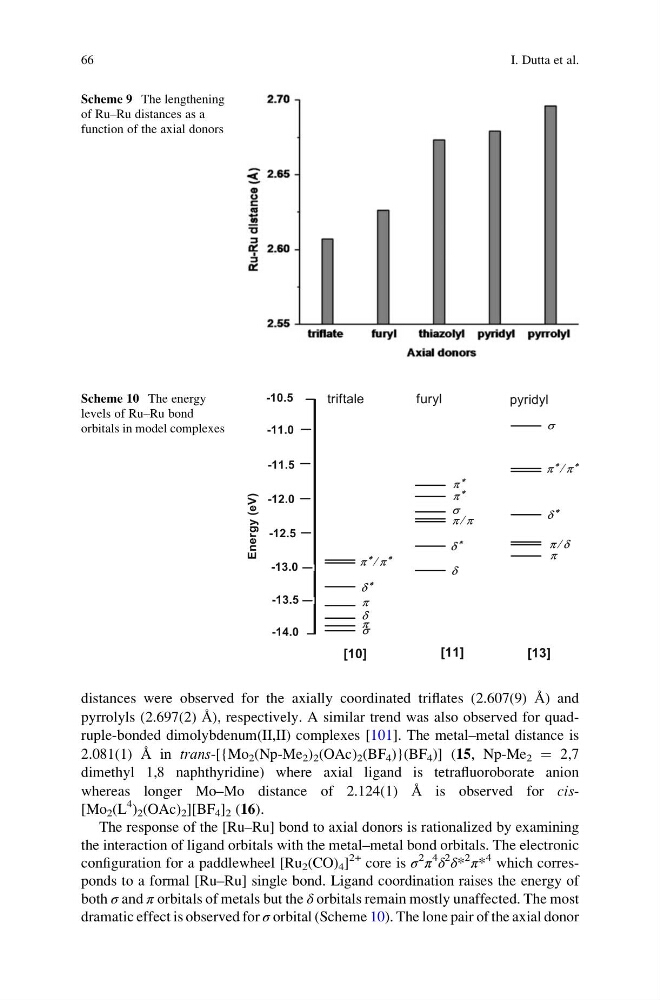
distances were observed for the axially coordinated triflates (2.607(9) Å) and
pyrrolyls (2.697(2) Å), respectively. A similar trend was also observed for quadruple-bonded dimolybdenum(II,II) complexes [101]. The metal–metal distance is
2.081(1) Å in trans-[{Mo 2 (Np-Me 2 ) 2 (OAc) 2 (BF 4 )}(BF 4 )] (15, Np-Me 2 ¼ 2,7
dimethyl 1,8 naphthyridine) where axial ligand is tetrafluoroborate anion
whereas longer Mo–Mo distance of 2.124(1) Å is observed for cis[Mo 2 (L
4 ) 2 (OAc) 2 ][BF 4 ] 2 (16).
The response of the [Ru–Ru] bond to axial donors is rationalized by examining
the interaction of ligand orbitals with the metal–metal bond orbitals. The electronic
configuration for a paddlewheel [Ru 2 (CO) 4 ]
2+ core is σ
2
π
4
δ
2
δ*
2
π*
4 which corresponds to a formal [Ru–Ru] single bond. Ligand coordination raises the energy of
both σ and π orbitals of metals but the δ orbitals remain mostly unaffected. The most
dramatic effect is observed for σ orbital (Scheme 10). The lone pair of the axial donor
Scheme 9 The lengthening
of Ru–Ru distances as a
function of the axial donors
Scheme 10 The energy
levels of Ru–Ru bond
orbitals in model complexes
66
I. Dutta et al.
pyrrolyls (2.697(2) Å), respectively. A similar trend was also observed for quadruple-bonded dimolybdenum(II,II) complexes [101]. The metal–metal distance is
2.081(1) Å in trans-[{Mo 2 (Np-Me 2 ) 2 (OAc) 2 (BF 4 )}(BF 4 )] (15, Np-Me 2 ¼ 2,7
dimethyl 1,8 naphthyridine) where axial ligand is tetrafluoroborate anion
whereas longer Mo–Mo distance of 2.124(1) Å is observed for cis[Mo 2 (L
4 ) 2 (OAc) 2 ][BF 4 ] 2 (16).
The response of the [Ru–Ru] bond to axial donors is rationalized by examining
the interaction of ligand orbitals with the metal–metal bond orbitals. The electronic
configuration for a paddlewheel [Ru 2 (CO) 4 ]
2+ core is σ
2
π
4
δ
2
δ*
2
π*
4 which corresponds to a formal [Ru–Ru] single bond. Ligand coordination raises the energy of
both σ and π orbitals of metals but the δ orbitals remain mostly unaffected. The most
dramatic effect is observed for σ orbital (Scheme 10). The lone pair of the axial donor
Scheme 9 The lengthening
of Ru–Ru distances as a
function of the axial donors
Scheme 10 The energy
levels of Ru–Ru bond
orbitals in model complexes
66
I. Dutta et al.