

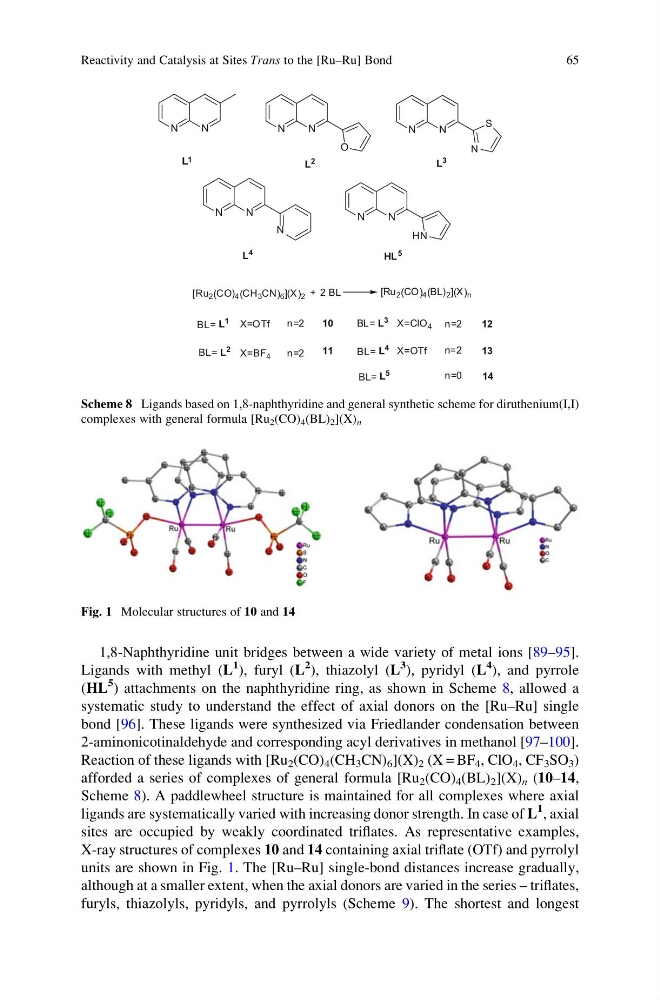
1,8-Naphthyridine unit bridges between a wide variety of metal ions [89–95].
Ligands with methyl (L
1 ), furyl (L
2 ), thiazolyl (L
3 ), pyridyl (L
4 ), and pyrrole
(HL
5 ) attachments on the naphthyridine ring, as shown in Scheme 8, allowed a
systematic study to understand the effect of axial donors on the [Ru–Ru] single
bond [96]. These ligands were synthesized via Friedlander condensation between
2-aminonicotinaldehyde and corresponding acyl derivatives in methanol [97–100].
Reaction of these ligands with [Ru 2 (CO) 4 (CH 3 CN) 6 ](X) 2 (X = BF 4 , ClO 4 , CF 3 SO 3 )
afforded a series of complexes of general formula [Ru 2 (CO) 4 (BL) 2 ](X) n (10–14,
Scheme 8). A paddlewheel structure is maintained for all complexes where axial
ligands are systematically varied with increasing donor strength. In case of L
1 , axial
sites are occupied by weakly coordinated triflates. As representative examples,
X-ray structures of complexes 10 and 14 containing axial triflate (OTf) and pyrrolyl
units are shown in Fig. 1. The [Ru–Ru] single-bond distances increase gradually,
although at a smaller extent, when the axial donors are varied in the series – triflates,
furyls, thiazolyls, pyridyls, and pyrrolyls (Scheme 9). The shortest and longest
[Ru 2 (CO) 4 (CH 3 CN) 6 ](X) 2 + 2 BL
[Ru 2 (CO) 4 (BL) 2 ](X) n
BL= L
1 X=OTf
10
BL= L
2
11
BL= L
3
12
BL= L
4
BL= L
5
n=2
n=2
n=2
n=2
n=0
13
14
X=BF 4
X=ClO 4
X=OTf
HL
5
L
2
L
3
L
4
L 1
N
N
N
N
N
S
N
N
O
N
N
HN
N
N
N
Scheme 8 Ligands based on 1,8-naphthyridine and general synthetic scheme for diruthenium(I,I)
complexes with general formula [Ru 2 (CO) 4 (BL) 2 ](X) n
Fig. 1 Molecular structures of 10 and 14
Reactivity and Catalysis at Sites Trans to the [Ru–Ru] Bond
65
Ligands with methyl (L
1 ), furyl (L
2 ), thiazolyl (L
3 ), pyridyl (L
4 ), and pyrrole
(HL
5 ) attachments on the naphthyridine ring, as shown in Scheme 8, allowed a
systematic study to understand the effect of axial donors on the [Ru–Ru] single
bond [96]. These ligands were synthesized via Friedlander condensation between
2-aminonicotinaldehyde and corresponding acyl derivatives in methanol [97–100].
Reaction of these ligands with [Ru 2 (CO) 4 (CH 3 CN) 6 ](X) 2 (X = BF 4 , ClO 4 , CF 3 SO 3 )
afforded a series of complexes of general formula [Ru 2 (CO) 4 (BL) 2 ](X) n (10–14,
Scheme 8). A paddlewheel structure is maintained for all complexes where axial
ligands are systematically varied with increasing donor strength. In case of L
1 , axial
sites are occupied by weakly coordinated triflates. As representative examples,
X-ray structures of complexes 10 and 14 containing axial triflate (OTf) and pyrrolyl
units are shown in Fig. 1. The [Ru–Ru] single-bond distances increase gradually,
although at a smaller extent, when the axial donors are varied in the series – triflates,
furyls, thiazolyls, pyridyls, and pyrrolyls (Scheme 9). The shortest and longest
[Ru 2 (CO) 4 (CH 3 CN) 6 ](X) 2 + 2 BL
[Ru 2 (CO) 4 (BL) 2 ](X) n
BL= L
1 X=OTf
10
BL= L
2
11
BL= L
3
12
BL= L
4
BL= L
5
n=2
n=2
n=2
n=2
n=0
13
14
X=BF 4
X=ClO 4
X=OTf
HL
5
L
2
L
3
L
4
L 1
N
N
N
N
N
S
N
N
O
N
N
HN
N
N
N
Scheme 8 Ligands based on 1,8-naphthyridine and general synthetic scheme for diruthenium(I,I)
complexes with general formula [Ru 2 (CO) 4 (BL) 2 ](X) n
Fig. 1 Molecular structures of 10 and 14
Reactivity and Catalysis at Sites Trans to the [Ru–Ru] Bond
65