

3 Effect of Axial Donor on the [Ru–Ru] Bond
Substrate coordination to axial site is necessary for its activation. It is therefore
important to understand the nature of the interaction between [M–M] bond orbitals
and ligand orbital. The metal–metal distance is modulated by the bridging and axial
ligands as well [2, 6, 7]. Longer metal–metal distances are observed for unsupported
complexes whereas bridging ligands tend to bring the metal ions closer. Quadruple
bonds between metal ions are more sensitive to axial ligands than metal–metal bonds
of lower bond order. Effects of axial coordination on Cr–Cr [78, 79] and Mo–Mo
[80–82] quadruple bonds are well studied. Although the effect is less pronounced,
lengthening of Rh–Rh distance by axial coordination is reported in metal–metal
singly bonded [Rh–Rh] complexes [83–87]. As a general principle, short metal–
metal distance (higher bond order) leads to long metal–ligand distance and vice versa
[6, 88]. As a consequence, long metal–ligand (axial) distance is observed for quadruple-bonded [Mo–Mo]
4+ complexes compared to singly bonded [Rh–Rh]
4+ analogue for the same ligand. The extent of interaction between the axial ligand with the
metal–metal bonded orbital is less than for cases where metal–metal bond is absent.
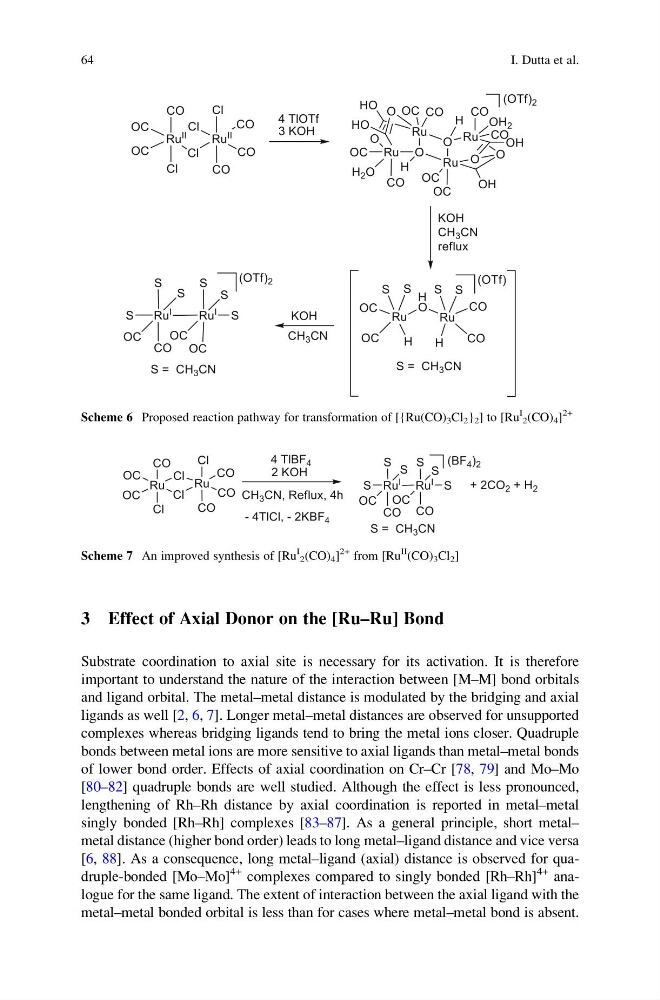
Scheme 7 An improved synthesis of [Ru
I
2 (CO) 4 ]
2+ from [Ru
II
(CO) 3 Cl 2 ]
Scheme 6 Proposed reaction pathway for transformation of [{Ru(CO) 3 Cl 2 } 2 ] to [Ru
I
2 (CO) 4 ]
2+
64
I. Dutta et al.
Substrate coordination to axial site is necessary for its activation. It is therefore
important to understand the nature of the interaction between [M–M] bond orbitals
and ligand orbital. The metal–metal distance is modulated by the bridging and axial
ligands as well [2, 6, 7]. Longer metal–metal distances are observed for unsupported
complexes whereas bridging ligands tend to bring the metal ions closer. Quadruple
bonds between metal ions are more sensitive to axial ligands than metal–metal bonds
of lower bond order. Effects of axial coordination on Cr–Cr [78, 79] and Mo–Mo
[80–82] quadruple bonds are well studied. Although the effect is less pronounced,
lengthening of Rh–Rh distance by axial coordination is reported in metal–metal
singly bonded [Rh–Rh] complexes [83–87]. As a general principle, short metal–
metal distance (higher bond order) leads to long metal–ligand distance and vice versa
[6, 88]. As a consequence, long metal–ligand (axial) distance is observed for quadruple-bonded [Mo–Mo]
4+ complexes compared to singly bonded [Rh–Rh]
4+ analogue for the same ligand. The extent of interaction between the axial ligand with the
metal–metal bonded orbital is less than for cases where metal–metal bond is absent.
Scheme 7 An improved synthesis of [Ru
I
2 (CO) 4 ]
2+ from [Ru
II
(CO) 3 Cl 2 ]
Scheme 6 Proposed reaction pathway for transformation of [{Ru(CO) 3 Cl 2 } 2 ] to [Ru
I
2 (CO) 4 ]
2+
64
I. Dutta et al.