

“dimer of dimer” structure analogous to 2, where two diruthenium units are
connected by RuÁ Á ÁO inter-dimer axial contacts. Complex 7 also has a “dimer of
dimer” structure, but here two diruthenium units are connected by RuÁ Á ÁRu interaction. Complexes 8 and 9 exhibit polymeric structures similar to 1.
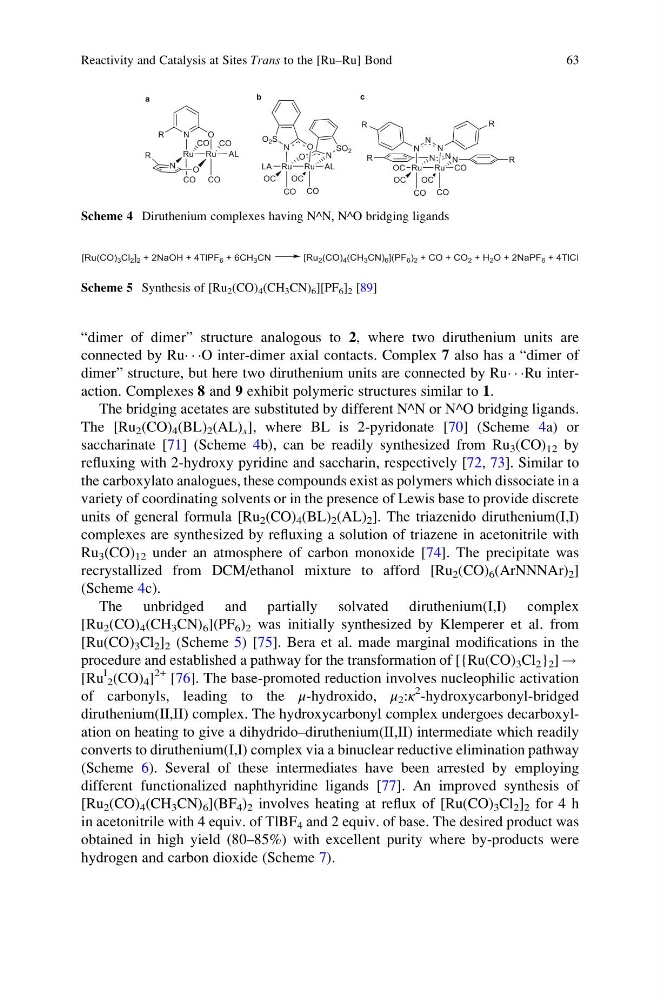
The bridging acetates are substituted by different N^N or N^O bridging ligands.
The [Ru 2 (CO) 4 (BL) 2 (AL) x ], where BL is 2-pyridonate [70] (Scheme 4a) or
saccharinate [71] (Scheme 4b), can be readily synthesized from Ru 3 (CO) 12 by
refluxing with 2-hydroxy pyridine and saccharin, respectively [72, 73]. Similar to
the carboxylato analogues, these compounds exist as polymers which dissociate in a
variety of coordinating solvents or in the presence of Lewis base to provide discrete
units of general formula [Ru 2 (CO) 4 (BL) 2 (AL) 2 ]. The triazenido diruthenium(I,I)
complexes are synthesized by refluxing a solution of triazene in acetonitrile with
Ru 3 (CO) 12 under an atmosphere of carbon monoxide [74]. The precipitate was
recrystallized from DCM/ethanol mixture to afford [Ru 2 (CO) 6 (ArNNNAr) 2 ]
(Scheme 4c).
The unbridged and partially solvated diruthenium(I,I) complex
[Ru 2 (CO) 4 (CH 3 CN) 6 ](PF 6 ) 2 was initially synthesized by Klemperer et al. from
[Ru(CO) 3 Cl 2 ] 2 (Scheme 5) [75]. Bera et al. made marginal modifications in the
procedure and established a pathway for the transformation of [{Ru(CO) 3 Cl 2 } 2 ] !
[Ru
I
2 (CO) 4 ]
2+ [76]. The base-promoted reduction involves nucleophilic activation
of carbonyls, leading to the μ-hydroxido, μ 2 :κ
2 -hydroxycarbonyl-bridged
diruthenium(II,II) complex. The hydroxycarbonyl complex undergoes decarboxylation on heating to give a dihydrido–diruthenium(II,II) intermediate which readily
converts to diruthenium(I,I) complex via a binuclear reductive elimination pathway
(Scheme 6). Several of these intermediates have been arrested by employing
different functionalized naphthyridine ligands [77]. An improved synthesis of
[Ru 2 (CO) 4 (CH 3 CN) 6 ](BF 4 ) 2 involves heating at reflux of [Ru(CO) 3 Cl 2 ] 2 for 4 h
in acetonitrile with 4 equiv. of TlBF 4 and 2 equiv. of base. The desired product was
obtained in high yield (80–85%) with excellent purity where by-products were
hydrogen and carbon dioxide (Scheme 7).
Scheme 4 Diruthenium complexes having N^N, N^O bridging ligands
Scheme 5 Synthesis of [Ru 2 (CO) 4 (CH 3 CN) 6 ][PF 6 ] 2 [89]
Reactivity and Catalysis at Sites Trans to the [Ru–Ru] Bond
63
connected by RuÁ Á ÁO inter-dimer axial contacts. Complex 7 also has a “dimer of
dimer” structure, but here two diruthenium units are connected by RuÁ Á ÁRu interaction. Complexes 8 and 9 exhibit polymeric structures similar to 1.
The bridging acetates are substituted by different N^N or N^O bridging ligands.
The [Ru 2 (CO) 4 (BL) 2 (AL) x ], where BL is 2-pyridonate [70] (Scheme 4a) or
saccharinate [71] (Scheme 4b), can be readily synthesized from Ru 3 (CO) 12 by
refluxing with 2-hydroxy pyridine and saccharin, respectively [72, 73]. Similar to
the carboxylato analogues, these compounds exist as polymers which dissociate in a
variety of coordinating solvents or in the presence of Lewis base to provide discrete
units of general formula [Ru 2 (CO) 4 (BL) 2 (AL) 2 ]. The triazenido diruthenium(I,I)
complexes are synthesized by refluxing a solution of triazene in acetonitrile with
Ru 3 (CO) 12 under an atmosphere of carbon monoxide [74]. The precipitate was
recrystallized from DCM/ethanol mixture to afford [Ru 2 (CO) 6 (ArNNNAr) 2 ]
(Scheme 4c).
The unbridged and partially solvated diruthenium(I,I) complex
[Ru 2 (CO) 4 (CH 3 CN) 6 ](PF 6 ) 2 was initially synthesized by Klemperer et al. from
[Ru(CO) 3 Cl 2 ] 2 (Scheme 5) [75]. Bera et al. made marginal modifications in the
procedure and established a pathway for the transformation of [{Ru(CO) 3 Cl 2 } 2 ] !
[Ru
I
2 (CO) 4 ]
2+ [76]. The base-promoted reduction involves nucleophilic activation
of carbonyls, leading to the μ-hydroxido, μ 2 :κ
2 -hydroxycarbonyl-bridged
diruthenium(II,II) complex. The hydroxycarbonyl complex undergoes decarboxylation on heating to give a dihydrido–diruthenium(II,II) intermediate which readily
converts to diruthenium(I,I) complex via a binuclear reductive elimination pathway
(Scheme 6). Several of these intermediates have been arrested by employing
different functionalized naphthyridine ligands [77]. An improved synthesis of
[Ru 2 (CO) 4 (CH 3 CN) 6 ](BF 4 ) 2 involves heating at reflux of [Ru(CO) 3 Cl 2 ] 2 for 4 h
in acetonitrile with 4 equiv. of TlBF 4 and 2 equiv. of base. The desired product was
obtained in high yield (80–85%) with excellent purity where by-products were
hydrogen and carbon dioxide (Scheme 7).
Scheme 4 Diruthenium complexes having N^N, N^O bridging ligands
Scheme 5 Synthesis of [Ru 2 (CO) 4 (CH 3 CN) 6 ][PF 6 ] 2 [89]
Reactivity and Catalysis at Sites Trans to the [Ru–Ru] Bond
63