

[Ru 2 (O 2 CR) 2 (CO) 4 ] n where sites trans to [Ru–Ru] bond are occupied by acetate
oxygen from neighboring molecule. These compounds are readily synthesized by
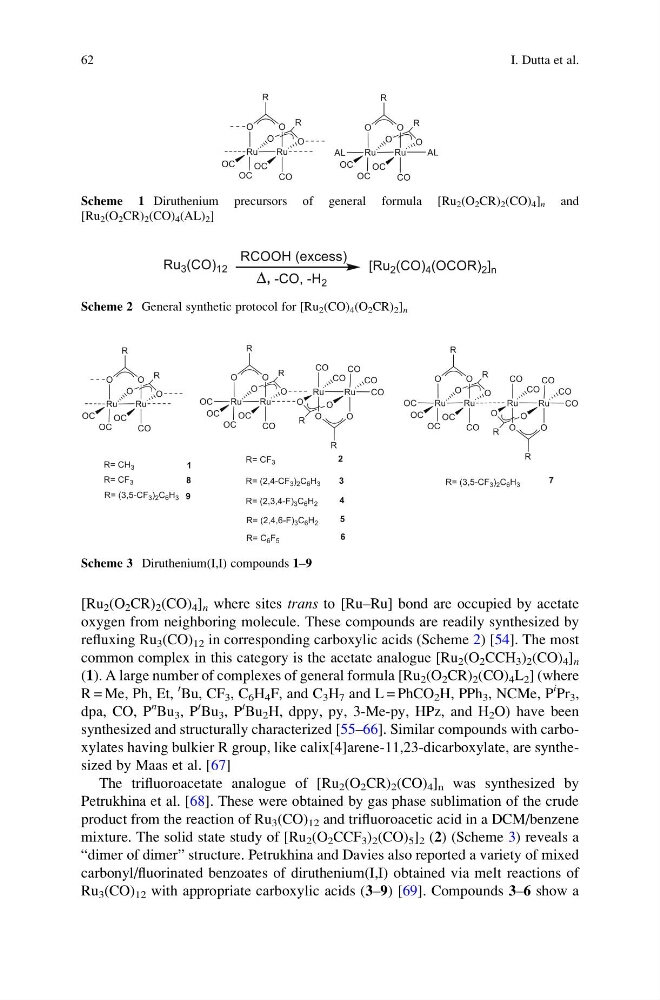
refluxing Ru 3 (CO) 12 in corresponding carboxylic acids (Scheme 2) [54]. The most
common complex in this category is the acetate analogue [Ru 2 (O 2 CCH 3 ) 2 (CO) 4 ] n
(1). A large number of complexes of general formula [Ru 2 (O 2 CR) 2 (CO) 4 L 2 ] (where
R = Me, Ph, Et,
t
Bu, CF 3 , C 6 H 4 F, and C 3 H 7 and L = PhCO 2 H, PPh 3 , NCMe, P
i
Pr 3 ,
dpa, CO, P
n Bu 3 , P
t Bu 3 , P
t
Bu 2 H, dppy, py, 3-Me-py, HPz, and H 2 O) have been
synthesized and structurally characterized [55–66]. Similar compounds with carboxylates having bulkier R group, like calix[4]arene-11,23-dicarboxylate, are synthesized by Maas et al. [67]
The trifluoroacetate analogue of [Ru 2 (O 2 CR) 2 (CO) 4 ] n was synthesized by
Petrukhina et al. [68]. These were obtained by gas phase sublimation of the crude
product from the reaction of Ru 3 (CO) 12 and trifluoroacetic acid in a DCM/benzene
mixture. The solid state study of [Ru 2 (O 2 CCF 3 ) 2 (CO) 5 ] 2 (2) (Scheme 3) reveals a
“dimer of dimer” structure. Petrukhina and Davies also reported a variety of mixed
carbonyl/fluorinated benzoates of diruthenium(I,I) obtained via melt reactions of
Ru 3 (CO) 12 with appropriate carboxylic acids (3–9) [69]. Compounds 3–6 show a
Scheme 2 General synthetic protocol for [Ru 2 (CO) 4 (O 2 CR) 2 ] n
Scheme 3 Diruthenium(I,I) compounds 1–9
Scheme 1 Diruthenium precursors of general formula [Ru 2 (O 2 CR) 2 (CO) 4 ] n and
[Ru 2 (O 2 CR) 2 (CO) 4 (AL) 2 ]
62
I. Dutta et al.
oxygen from neighboring molecule. These compounds are readily synthesized by
refluxing Ru 3 (CO) 12 in corresponding carboxylic acids (Scheme 2) [54]. The most
common complex in this category is the acetate analogue [Ru 2 (O 2 CCH 3 ) 2 (CO) 4 ] n
(1). A large number of complexes of general formula [Ru 2 (O 2 CR) 2 (CO) 4 L 2 ] (where
R = Me, Ph, Et,
t
Bu, CF 3 , C 6 H 4 F, and C 3 H 7 and L = PhCO 2 H, PPh 3 , NCMe, P
i
Pr 3 ,
dpa, CO, P
n Bu 3 , P
t Bu 3 , P
t
Bu 2 H, dppy, py, 3-Me-py, HPz, and H 2 O) have been
synthesized and structurally characterized [55–66]. Similar compounds with carboxylates having bulkier R group, like calix[4]arene-11,23-dicarboxylate, are synthesized by Maas et al. [67]
The trifluoroacetate analogue of [Ru 2 (O 2 CR) 2 (CO) 4 ] n was synthesized by
Petrukhina et al. [68]. These were obtained by gas phase sublimation of the crude
product from the reaction of Ru 3 (CO) 12 and trifluoroacetic acid in a DCM/benzene
mixture. The solid state study of [Ru 2 (O 2 CCF 3 ) 2 (CO) 5 ] 2 (2) (Scheme 3) reveals a
“dimer of dimer” structure. Petrukhina and Davies also reported a variety of mixed
carbonyl/fluorinated benzoates of diruthenium(I,I) obtained via melt reactions of
Ru 3 (CO) 12 with appropriate carboxylic acids (3–9) [69]. Compounds 3–6 show a
Scheme 2 General synthetic protocol for [Ru 2 (CO) 4 (O 2 CR) 2 ] n
Scheme 3 Diruthenium(I,I) compounds 1–9
Scheme 1 Diruthenium precursors of general formula [Ru 2 (O 2 CR) 2 (CO) 4 ] n and
[Ru 2 (O 2 CR) 2 (CO) 4 (AL) 2 ]
62
I. Dutta et al.