

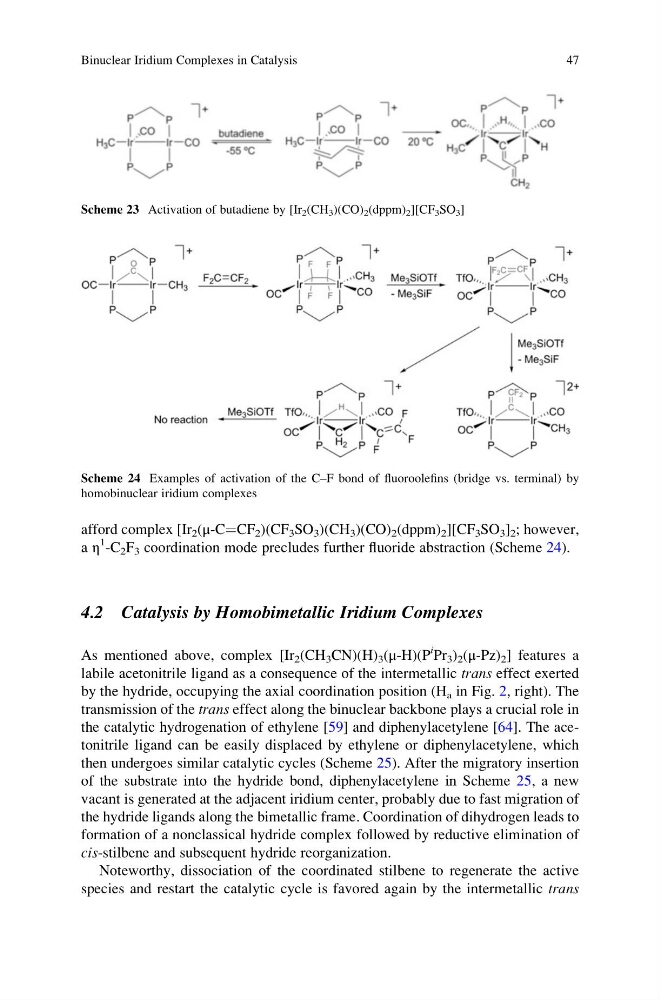
afford complex [Ir 2 (μ-C¼CF 2 )(CF 3 SO 3 )(CH 3 )(CO) 2 (dppm) 2 ][CF 3 SO 3 ] 2 ; however,
a η
1 -C 2 F 3 coordination mode precludes further fluoride abstraction (Scheme 24).
4.2 Catalysis by Homobimetallic Iridium Complexes
As mentioned above, complex [Ir 2 (CH 3 CN)(H) 3 (μ-H)(P
i
Pr 3 ) 2 (μ-Pz) 2 ] features a
labile acetonitrile ligand as a consequence of the intermetallic trans effect exerted
by the hydride, occupying the axial coordination position (H a in Fig. 2, right). The
transmission of the trans effect along the binuclear backbone plays a crucial role in
the catalytic hydrogenation of ethylene [59] and diphenylacetylene [64]. The acetonitrile ligand can be easily displaced by ethylene or diphenylacetylene, which
then undergoes similar catalytic cycles (Scheme 25). After the migratory insertion
of the substrate into the hydride bond, diphenylacetylene in Scheme 25, a new
vacant is generated at the adjacent iridium center, probably due to fast migration of
the hydride ligands along the bimetallic frame. Coordination of dihydrogen leads to
formation of a nonclassical hydride complex followed by reductive elimination of
cis-stilbene and subsequent hydride reorganization.
Noteworthy, dissociation of the coordinated stilbene to regenerate the active
species and restart the catalytic cycle is favored again by the intermetallic trans
Scheme 23 Activation of butadiene by [Ir 2 (CH 3 )(CO) 2 (dppm) 2 ][CF 3 SO 3 ]
Scheme 24 Examples of activation of the C–F bond of fluoroolefins (bridge vs. terminal) by
homobinuclear iridium complexes
Binuclear Iridium Complexes in Catalysis
47
a η
1 -C 2 F 3 coordination mode precludes further fluoride abstraction (Scheme 24).
4.2 Catalysis by Homobimetallic Iridium Complexes
As mentioned above, complex [Ir 2 (CH 3 CN)(H) 3 (μ-H)(P
i
Pr 3 ) 2 (μ-Pz) 2 ] features a
labile acetonitrile ligand as a consequence of the intermetallic trans effect exerted
by the hydride, occupying the axial coordination position (H a in Fig. 2, right). The
transmission of the trans effect along the binuclear backbone plays a crucial role in
the catalytic hydrogenation of ethylene [59] and diphenylacetylene [64]. The acetonitrile ligand can be easily displaced by ethylene or diphenylacetylene, which
then undergoes similar catalytic cycles (Scheme 25). After the migratory insertion
of the substrate into the hydride bond, diphenylacetylene in Scheme 25, a new
vacant is generated at the adjacent iridium center, probably due to fast migration of
the hydride ligands along the bimetallic frame. Coordination of dihydrogen leads to
formation of a nonclassical hydride complex followed by reductive elimination of
cis-stilbene and subsequent hydride reorganization.
Noteworthy, dissociation of the coordinated stilbene to regenerate the active
species and restart the catalytic cycle is favored again by the intermetallic trans
Scheme 23 Activation of butadiene by [Ir 2 (CH 3 )(CO) 2 (dppm) 2 ][CF 3 SO 3 ]
Scheme 24 Examples of activation of the C–F bond of fluoroolefins (bridge vs. terminal) by
homobinuclear iridium complexes
Binuclear Iridium Complexes in Catalysis
47