

Several C–H-activating systems seem to constitute an exception for the
pre-oxidation requisite, since they can work in the Ir 2
I,I form. The
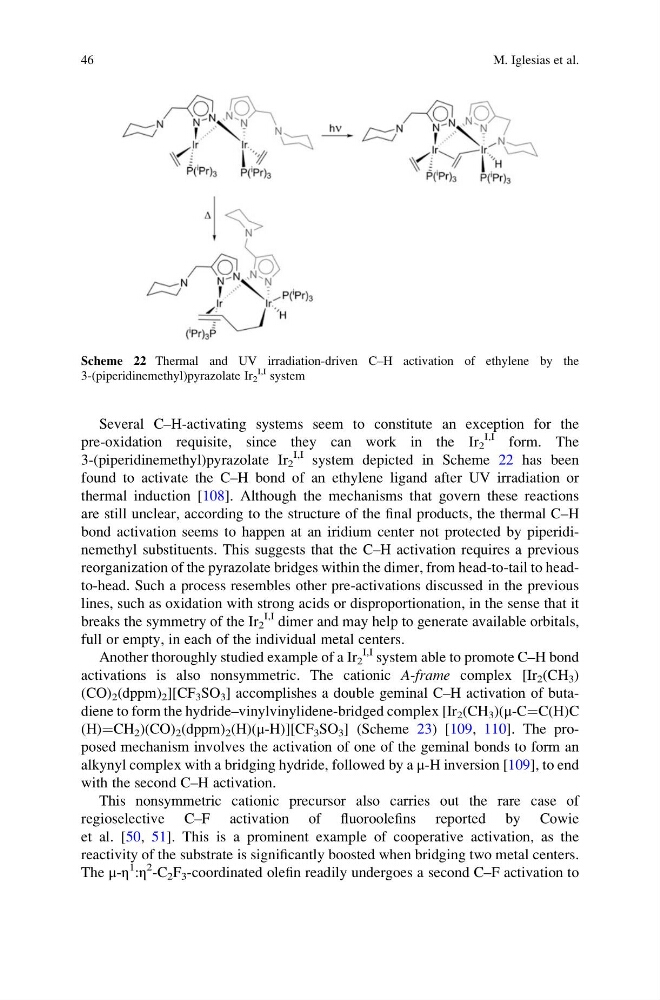
3-(piperidinemethyl)pyrazolate Ir 2
I,I system depicted in Scheme 22 has been
found to activate the C–H bond of an ethylene ligand after UV irradiation or
thermal induction [108]. Although the mechanisms that govern these reactions
are still unclear, according to the structure of the final products, the thermal C–H
bond activation seems to happen at an iridium center not protected by piperidinemethyl substituents. This suggests that the C–H activation requires a previous
reorganization of the pyrazolate bridges within the dimer, from head-to-tail to headto-head. Such a process resembles other pre-activations discussed in the previous
lines, such as oxidation with strong acids or disproportionation, in the sense that it
breaks the symmetry of the Ir 2
I,I dimer and may help to generate available orbitals,
full or empty, in each of the individual metal centers.
Another thoroughly studied example of a Ir 2
I,I system able to promote C–H bond
activations is also nonsymmetric. The cationic A-frame complex [Ir 2 (CH 3 )
(CO) 2 (dppm) 2 ][CF 3 SO 3 ] accomplishes a double geminal C–H activation of butadiene to form the hydride–vinylvinylidene-bridged complex [Ir 2 (CH 3 )(μ-C¼C(H)C
(H)¼CH 2 )(CO) 2 (dppm) 2 (H)(μ-H)][CF 3 SO 3 ] (Scheme 23) [109, 110]. The proposed mechanism involves the activation of one of the geminal bonds to form an
alkynyl complex with a bridging hydride, followed by a μ-H inversion [109], to end
with the second C–H activation.
This nonsymmetric cationic precursor also carries out the rare case of
regioselective C–F activation of fluoroolefins reported by Cowie
et al. [50, 51]. This is a prominent example of cooperative activation, as the
reactivity of the substrate is significantly boosted when bridging two metal centers.
The μ-η
1 :η
2 -C 2 F 3 -coordinated olefin readily undergoes a second C–F activation to
Scheme 22 Thermal and UV irradiation-driven C–H activation of ethylene by the
3-(piperidinemethyl)pyrazolate Ir 2
I,I system
46
M. Iglesias et al.
pre-oxidation requisite, since they can work in the Ir 2
I,I form. The
3-(piperidinemethyl)pyrazolate Ir 2
I,I system depicted in Scheme 22 has been
found to activate the C–H bond of an ethylene ligand after UV irradiation or
thermal induction [108]. Although the mechanisms that govern these reactions
are still unclear, according to the structure of the final products, the thermal C–H
bond activation seems to happen at an iridium center not protected by piperidinemethyl substituents. This suggests that the C–H activation requires a previous
reorganization of the pyrazolate bridges within the dimer, from head-to-tail to headto-head. Such a process resembles other pre-activations discussed in the previous
lines, such as oxidation with strong acids or disproportionation, in the sense that it
breaks the symmetry of the Ir 2
I,I dimer and may help to generate available orbitals,
full or empty, in each of the individual metal centers.
Another thoroughly studied example of a Ir 2
I,I system able to promote C–H bond
activations is also nonsymmetric. The cationic A-frame complex [Ir 2 (CH 3 )
(CO) 2 (dppm) 2 ][CF 3 SO 3 ] accomplishes a double geminal C–H activation of butadiene to form the hydride–vinylvinylidene-bridged complex [Ir 2 (CH 3 )(μ-C¼C(H)C
(H)¼CH 2 )(CO) 2 (dppm) 2 (H)(μ-H)][CF 3 SO 3 ] (Scheme 23) [109, 110]. The proposed mechanism involves the activation of one of the geminal bonds to form an
alkynyl complex with a bridging hydride, followed by a μ-H inversion [109], to end
with the second C–H activation.
This nonsymmetric cationic precursor also carries out the rare case of
regioselective C–F activation of fluoroolefins reported by Cowie
et al. [50, 51]. This is a prominent example of cooperative activation, as the
reactivity of the substrate is significantly boosted when bridging two metal centers.
The μ-η
1 :η
2 -C 2 F 3 -coordinated olefin readily undergoes a second C–F activation to
Scheme 22 Thermal and UV irradiation-driven C–H activation of ethylene by the
3-(piperidinemethyl)pyrazolate Ir 2
I,I system
46
M. Iglesias et al.