

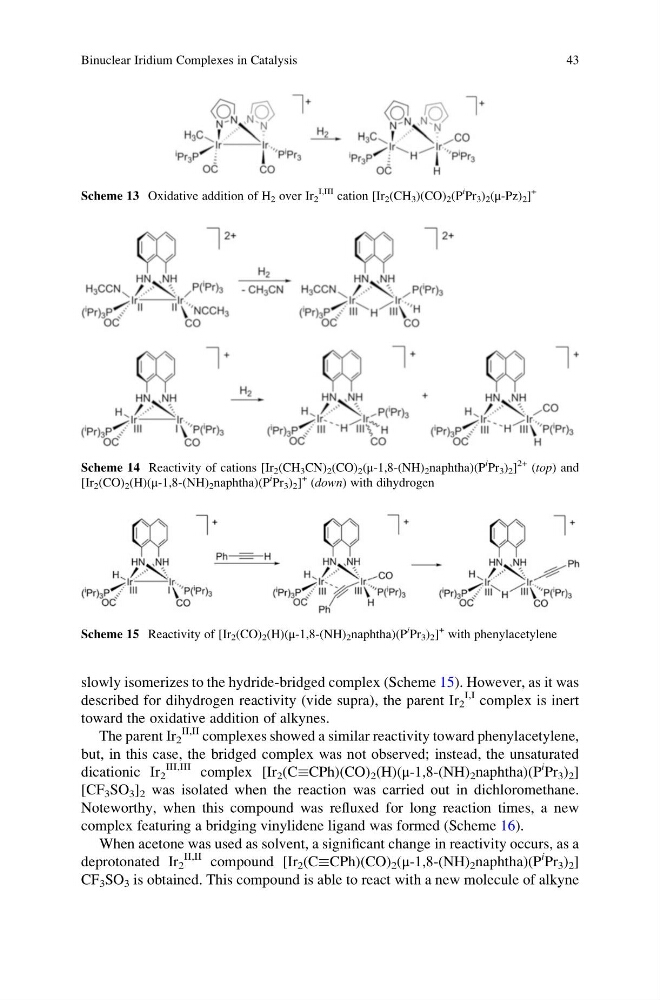
slowly isomerizes to the hydride-bridged complex (Scheme 15). However, as it was
described for dihydrogen reactivity (vide supra), the parent Ir 2
I,I complex is inert
toward the oxidative addition of alkynes.
The parent Ir 2
II,II complexes showed a similar reactivity toward phenylacetylene,
but, in this case, the bridged complex was not observed; instead, the unsaturated
dicationic Ir 2
III,III complex [Ir 2 (CCPh)(CO) 2 (H)(μ-1,8-(NH) 2 naphtha)(P
i Pr 3 ) 2 ]
[CF 3 SO 3 ] 2 was isolated when the reaction was carried out in dichloromethane.
Noteworthy, when this compound was refluxed for long reaction times, a new
complex featuring a bridging vinylidene ligand was formed (Scheme 16).
When acetone was used as solvent, a significant change in reactivity occurs, as a
deprotonated Ir 2
II,II compound [Ir 2 (CCPh)(CO) 2 (μ-1,8-(NH) 2 naphtha)(P
i Pr 3 ) 2 ]
CF 3 SO 3 is obtained. This compound is able to react with a new molecule of alkyne
Scheme 13 Oxidative addition of H 2 over Ir 2
I,III cation [Ir 2 (CH 3 )(CO) 2 (P
i
Pr 3 ) 2 (μ-Pz) 2 ]
+
Scheme 14 Reactivity of cations [Ir 2 (CH 3 CN) 2 (CO) 2 (μ-1,8-(NH) 2 naphtha)(P
i
Pr 3 ) 2 ]
2+ (top) and
[Ir 2 (CO) 2 (H)(μ-1,8-(NH) 2 naphtha)(P
i Pr 3 ) 2 ]
+ (down) with dihydrogen
Scheme 15 Reactivity of [Ir 2 (CO) 2 (H)(μ-1,8-(NH) 2 naphtha)(P
i
Pr 3 ) 2 ]
+ with phenylacetylene
Binuclear Iridium Complexes in Catalysis
43
described for dihydrogen reactivity (vide supra), the parent Ir 2
I,I complex is inert
toward the oxidative addition of alkynes.
The parent Ir 2
II,II complexes showed a similar reactivity toward phenylacetylene,
but, in this case, the bridged complex was not observed; instead, the unsaturated
dicationic Ir 2
III,III complex [Ir 2 (CCPh)(CO) 2 (H)(μ-1,8-(NH) 2 naphtha)(P
i Pr 3 ) 2 ]
[CF 3 SO 3 ] 2 was isolated when the reaction was carried out in dichloromethane.
Noteworthy, when this compound was refluxed for long reaction times, a new
complex featuring a bridging vinylidene ligand was formed (Scheme 16).
When acetone was used as solvent, a significant change in reactivity occurs, as a
deprotonated Ir 2
II,II compound [Ir 2 (CCPh)(CO) 2 (μ-1,8-(NH) 2 naphtha)(P
i Pr 3 ) 2 ]
CF 3 SO 3 is obtained. This compound is able to react with a new molecule of alkyne
Scheme 13 Oxidative addition of H 2 over Ir 2
I,III cation [Ir 2 (CH 3 )(CO) 2 (P
i
Pr 3 ) 2 (μ-Pz) 2 ]
+
Scheme 14 Reactivity of cations [Ir 2 (CH 3 CN) 2 (CO) 2 (μ-1,8-(NH) 2 naphtha)(P
i
Pr 3 ) 2 ]
2+ (top) and
[Ir 2 (CO) 2 (H)(μ-1,8-(NH) 2 naphtha)(P
i Pr 3 ) 2 ]
+ (down) with dihydrogen
Scheme 15 Reactivity of [Ir 2 (CO) 2 (H)(μ-1,8-(NH) 2 naphtha)(P
i
Pr 3 ) 2 ]
+ with phenylacetylene
Binuclear Iridium Complexes in Catalysis
43