

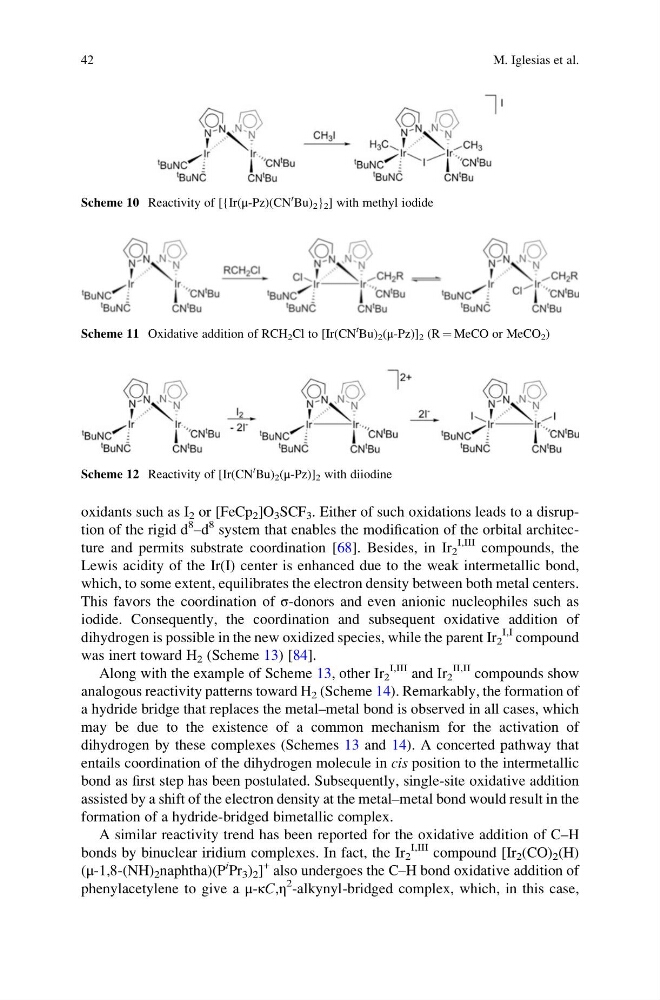
oxidants such as I 2 or [FeCp 2 ]O 3 SCF 3 . Either of such oxidations leads to a disruption of the rigid d
8 –d
8 system that enables the modification of the orbital architecture and permits substrate coordination [68]. Besides, in Ir 2
I,III compounds, the
Lewis acidity of the Ir(I) center is enhanced due to the weak intermetallic bond,
which, to some extent, equilibrates the electron density between both metal centers.
This favors the coordination of σ-donors and even anionic nucleophiles such as
iodide. Consequently, the coordination and subsequent oxidative addition of
dihydrogen is possible in the new oxidized species, while the parent Ir 2
I,I compound
was inert toward H 2 (Scheme 13) [84].
Along with the example of Scheme 13, other Ir 2
I,III and Ir 2
II,II compounds show
analogous reactivity patterns toward H 2 (Scheme 14). Remarkably, the formation of
a hydride bridge that replaces the metal–metal bond is observed in all cases, which
may be due to the existence of a common mechanism for the activation of
dihydrogen by these complexes (Schemes 13 and 14). A concerted pathway that
entails coordination of the dihydrogen molecule in cis position to the intermetallic
bond as first step has been postulated. Subsequently, single-site oxidative addition
assisted by a shift of the electron density at the metal–metal bond would result in the
formation of a hydride-bridged bimetallic complex.
A similar reactivity trend has been reported for the oxidative addition of C–H
bonds by binuclear iridium complexes. In fact, the Ir 2
I,III compound [Ir 2 (CO) 2 (H)
(μ-1,8-(NH) 2 naphtha)(P
i
Pr 3 ) 2 ]
+ also undergoes the C–H bond oxidative addition of
phenylacetylene to give a μ-κC,η
2 -alkynyl-bridged complex, which, in this case,
Scheme 10 Reactivity of [{Ir(μ-Pz)(CN
t Bu) 2 } 2 ] with methyl iodide
Scheme 11 Oxidative addition of RCH 2 Cl to [Ir(CN
t
Bu) 2 (μ-Pz)] 2 (R ¼ MeCO or MeCO 2 )
Scheme 12 Reactivity of [Ir(CN
t
Bu) 2 (μ-Pz)] 2 with diiodine
42
M. Iglesias et al.
8 –d
8 system that enables the modification of the orbital architecture and permits substrate coordination [68]. Besides, in Ir 2
I,III compounds, the
Lewis acidity of the Ir(I) center is enhanced due to the weak intermetallic bond,
which, to some extent, equilibrates the electron density between both metal centers.
This favors the coordination of σ-donors and even anionic nucleophiles such as
iodide. Consequently, the coordination and subsequent oxidative addition of
dihydrogen is possible in the new oxidized species, while the parent Ir 2
I,I compound
was inert toward H 2 (Scheme 13) [84].
Along with the example of Scheme 13, other Ir 2
I,III and Ir 2
II,II compounds show
analogous reactivity patterns toward H 2 (Scheme 14). Remarkably, the formation of
a hydride bridge that replaces the metal–metal bond is observed in all cases, which
may be due to the existence of a common mechanism for the activation of
dihydrogen by these complexes (Schemes 13 and 14). A concerted pathway that
entails coordination of the dihydrogen molecule in cis position to the intermetallic
bond as first step has been postulated. Subsequently, single-site oxidative addition
assisted by a shift of the electron density at the metal–metal bond would result in the
formation of a hydride-bridged bimetallic complex.
A similar reactivity trend has been reported for the oxidative addition of C–H
bonds by binuclear iridium complexes. In fact, the Ir 2
I,III compound [Ir 2 (CO) 2 (H)
(μ-1,8-(NH) 2 naphtha)(P
i
Pr 3 ) 2 ]
+ also undergoes the C–H bond oxidative addition of
phenylacetylene to give a μ-κC,η
2 -alkynyl-bridged complex, which, in this case,
Scheme 10 Reactivity of [{Ir(μ-Pz)(CN
t Bu) 2 } 2 ] with methyl iodide
Scheme 11 Oxidative addition of RCH 2 Cl to [Ir(CN
t
Bu) 2 (μ-Pz)] 2 (R ¼ MeCO or MeCO 2 )
Scheme 12 Reactivity of [Ir(CN
t
Bu) 2 (μ-Pz)] 2 with diiodine
42
M. Iglesias et al.