

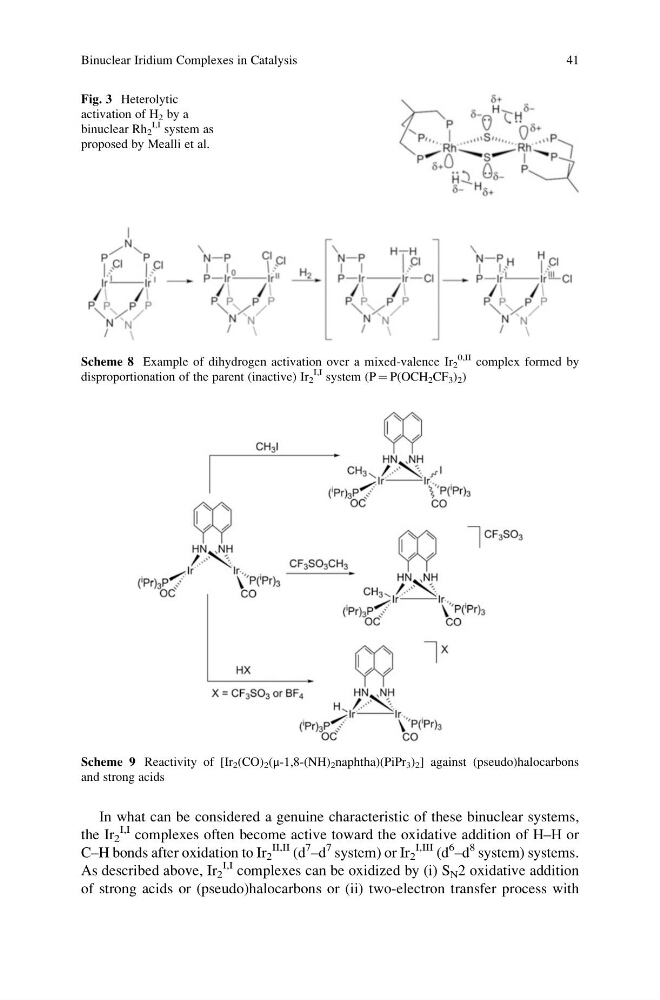
In what can be considered a genuine characteristic of these binuclear systems,
the Ir 2
I,I complexes often become active toward the oxidative addition of H–H or
C–H bonds after oxidation to Ir 2
II,II (d
7 –d
7 system) or Ir 2
I,III (d
6
–d
8 system) systems.
As described above, Ir 2
I,I complexes can be oxidized by (i) S N 2 oxidative addition
of strong acids or (pseudo)halocarbons or (ii) two-electron transfer process with
Fig. 3 Heterolytic
activation of H 2 by a
binuclear Rh 2
I,I system as
proposed by Mealli et al.
Scheme 8 Example of dihydrogen activation over a mixed-valence Ir 2
0,II complex formed by
disproportionation of the parent (inactive) Ir 2
I,I system (P ¼ P(OCH 2 CF 3 ) 2 )
Scheme 9 Reactivity of [Ir 2 (CO) 2 (μ-1,8-(NH) 2 naphtha)(PiPr 3 ) 2 ] against (pseudo)halocarbons
and strong acids
Binuclear Iridium Complexes in Catalysis
41
the Ir 2
I,I complexes often become active toward the oxidative addition of H–H or
C–H bonds after oxidation to Ir 2
II,II (d
7 –d
7 system) or Ir 2
I,III (d
6
–d
8 system) systems.
As described above, Ir 2
I,I complexes can be oxidized by (i) S N 2 oxidative addition
of strong acids or (pseudo)halocarbons or (ii) two-electron transfer process with
Fig. 3 Heterolytic
activation of H 2 by a
binuclear Rh 2
I,I system as
proposed by Mealli et al.
Scheme 8 Example of dihydrogen activation over a mixed-valence Ir 2
0,II complex formed by
disproportionation of the parent (inactive) Ir 2
I,I system (P ¼ P(OCH 2 CF 3 ) 2 )
Scheme 9 Reactivity of [Ir 2 (CO) 2 (μ-1,8-(NH) 2 naphtha)(PiPr 3 ) 2 ] against (pseudo)halocarbons
and strong acids
Binuclear Iridium Complexes in Catalysis
41