

that stabilizes the bent geometry [84], further hampering H 2 coordination. Against
this, however, the ability of bridging ligands to dissociate and adopt terminal
positions may generate the necessary vacant sites, thus accounting for dihydrogen
activation at certain complexes [40, 74–76]. Besides, the functional contributions of
ligands such as thiolates might account for the success of some of the previously
described systems. Actually, the thiolates present in the cysteine-rich active site of
hydrogenases have been proposed to assist the heterolytic activation of dihydrogen
[85–89]. Also, similar bifunctional heterolytic activations of dihydrogen have been
recognized for mononuclear Ir-thiolate complexes [90, 91] and, remarkably, also
for a binuclear (d
8 –d
8 ) Rh system (Fig. 3) [92].
Ir 2
I,I systems may also become active toward H 2 addition via disproportionation.
The reaction sequence depicted in Scheme 8 illustrates how the transformation of
an Ir 2
I,I symmetric structure (d
8 –d
8 system) into its related mixed-valence Ir 2
0,II
complex (d
7 –d
9 system) results in the generation of an empty orbital at the Ir(II) (d
7
metal center) that permits H 2 coordination and subsequent oxidative addition
[44, 46].
In spite of their relative inertness for H 2 activation, the Ir(I) dinuclear complexes
are still electron-rich entities and, therefore, capable of undergoing oxidative
additions via an S N 2 mechanism. This is the case of complex [Ir 2 (CO) 2 (μ-1,8-(NH) 2 naphtha)(PiPr 3 ) 2 ], which does not react with molecular hydrogen but
readily undergoes the binuclear oxidative addition of (pseudo)halocarbons and
strong acids to form products that display a metal–metal bond (Scheme 9) [70].
An analogous reaction between methyl iodide and complex [Ir(CN
t
Bu) 2 (μ-Pz)] 2
(Pz ¼ pyrazolate) consumes two equivalents of the reagent to give the Ir 2
III,III
complex [{Ir(CN
t
Bu) 2 (Me)(μ-Pz)} 2 (μ-I)]I (Scheme 10) [93].
The latter Ir 2
I,I complex is also capable of undergoing binuclear oxidative
addition of chloroalkanes such as MeCOCH 2 Cl and MeCO 2 CH 2 Cl to form the
Ir 2
II,II complexes [Ir (CH 3 COCH 2 )(Cl)(CN
t
Bu) 2 (μ-Pz)] 2 and [Ir(CH 3 CO 2 CH 2 )(Cl)
(CN
t
Bu) 2 (μ-Pz)] 2 , which are in equilibrium with their related Ir 2
I,III isomers
(Scheme 11) [94].
In contrast with haloalkanes, diiodine has been proposed to react with [Ir
(CN
t
Bu) 2 (μ-Pz)] 2 by a two-electron transfer process that affords cation [Ir(μ-Pz)
(CN
t
Bu) 2 ] 2
2+ and two iodide ions, which are subsequently incorporated into the
coordination sphere of the iridium centers to give the Ir 2
II,II complex [Ir
(CN
t
Bu) 2 (I) 2 (μ-Pz)] 2 (Scheme 12) [95]. Analogous oxidation processes have been
described for other similar Ir(I) d
8 –d
8 systems (e.g., see [80, 96–100])
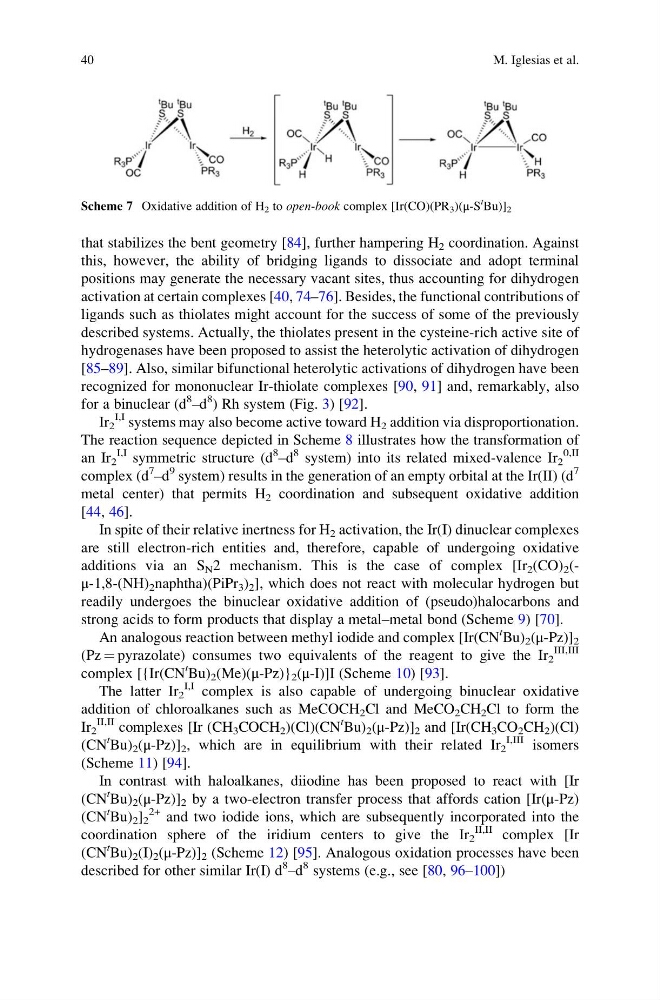
Scheme 7 Oxidative addition of H 2 to open-book complex [Ir(CO)(PR 3 )(μ-S
t
Bu)] 2
40
M. Iglesias et al.
this, however, the ability of bridging ligands to dissociate and adopt terminal
positions may generate the necessary vacant sites, thus accounting for dihydrogen
activation at certain complexes [40, 74–76]. Besides, the functional contributions of
ligands such as thiolates might account for the success of some of the previously
described systems. Actually, the thiolates present in the cysteine-rich active site of
hydrogenases have been proposed to assist the heterolytic activation of dihydrogen
[85–89]. Also, similar bifunctional heterolytic activations of dihydrogen have been
recognized for mononuclear Ir-thiolate complexes [90, 91] and, remarkably, also
for a binuclear (d
8 –d
8 ) Rh system (Fig. 3) [92].
Ir 2
I,I systems may also become active toward H 2 addition via disproportionation.
The reaction sequence depicted in Scheme 8 illustrates how the transformation of
an Ir 2
I,I symmetric structure (d
8 –d
8 system) into its related mixed-valence Ir 2
0,II
complex (d
7 –d
9 system) results in the generation of an empty orbital at the Ir(II) (d
7
metal center) that permits H 2 coordination and subsequent oxidative addition
[44, 46].
In spite of their relative inertness for H 2 activation, the Ir(I) dinuclear complexes
are still electron-rich entities and, therefore, capable of undergoing oxidative
additions via an S N 2 mechanism. This is the case of complex [Ir 2 (CO) 2 (μ-1,8-(NH) 2 naphtha)(PiPr 3 ) 2 ], which does not react with molecular hydrogen but
readily undergoes the binuclear oxidative addition of (pseudo)halocarbons and
strong acids to form products that display a metal–metal bond (Scheme 9) [70].
An analogous reaction between methyl iodide and complex [Ir(CN
t
Bu) 2 (μ-Pz)] 2
(Pz ¼ pyrazolate) consumes two equivalents of the reagent to give the Ir 2
III,III
complex [{Ir(CN
t
Bu) 2 (Me)(μ-Pz)} 2 (μ-I)]I (Scheme 10) [93].
The latter Ir 2
I,I complex is also capable of undergoing binuclear oxidative
addition of chloroalkanes such as MeCOCH 2 Cl and MeCO 2 CH 2 Cl to form the
Ir 2
II,II complexes [Ir (CH 3 COCH 2 )(Cl)(CN
t
Bu) 2 (μ-Pz)] 2 and [Ir(CH 3 CO 2 CH 2 )(Cl)
(CN
t
Bu) 2 (μ-Pz)] 2 , which are in equilibrium with their related Ir 2
I,III isomers
(Scheme 11) [94].
In contrast with haloalkanes, diiodine has been proposed to react with [Ir
(CN
t
Bu) 2 (μ-Pz)] 2 by a two-electron transfer process that affords cation [Ir(μ-Pz)
(CN
t
Bu) 2 ] 2
2+ and two iodide ions, which are subsequently incorporated into the
coordination sphere of the iridium centers to give the Ir 2
II,II complex [Ir
(CN
t
Bu) 2 (I) 2 (μ-Pz)] 2 (Scheme 12) [95]. Analogous oxidation processes have been
described for other similar Ir(I) d
8 –d
8 systems (e.g., see [80, 96–100])
Scheme 7 Oxidative addition of H 2 to open-book complex [Ir(CO)(PR 3 )(μ-S
t
Bu)] 2
40
M. Iglesias et al.