

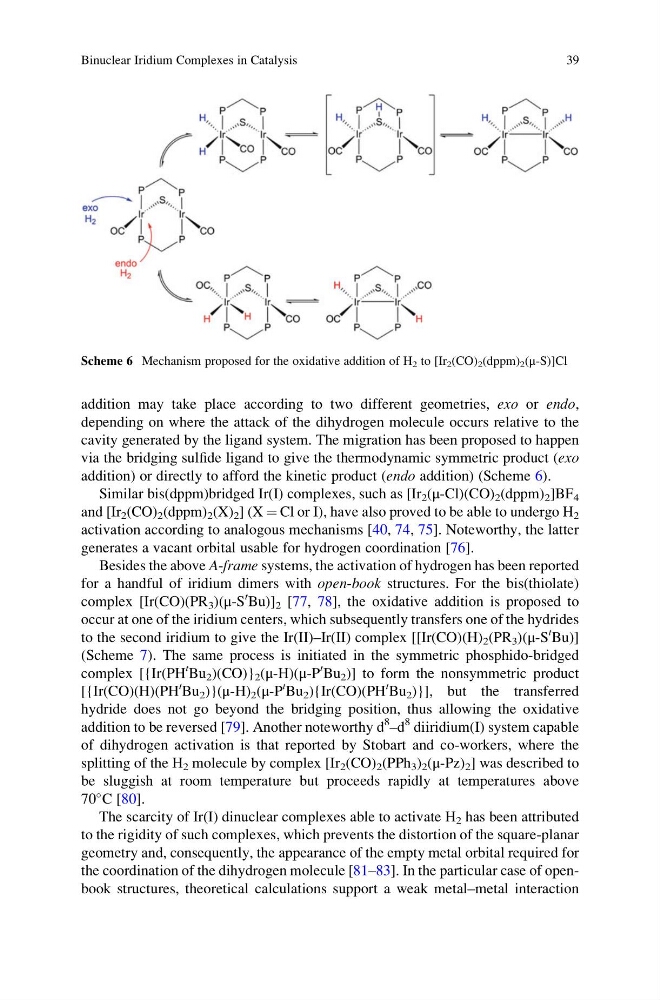
addition may take place according to two different geometries, exo or endo,
depending on where the attack of the dihydrogen molecule occurs relative to the
cavity generated by the ligand system. The migration has been proposed to happen
via the bridging sulfide ligand to give the thermodynamic symmetric product (exo
addition) or directly to afford the kinetic product (endo addition) (Scheme 6).
Similar bis(dppm)bridged Ir(I) complexes, such as [Ir 2 (μ-Cl)(CO) 2 (dppm) 2 ]BF 4
and [Ir 2 (CO) 2 (dppm) 2 (X) 2 ] (X ¼ Cl or I), have also proved to be able to undergo H 2
activation according to analogous mechanisms [40, 74, 75]. Noteworthy, the latter
generates a vacant orbital usable for hydrogen coordination [76].
Besides the above A-frame systems, the activation of hydrogen has been reported
for a handful of iridium dimers with open-book structures. For the bis(thiolate)
complex [Ir(CO)(PR 3 )(μ-S
t
Bu)] 2 [77, 78], the oxidative addition is proposed to
occur at one of the iridium centers, which subsequently transfers one of the hydrides
to the second iridium to give the Ir(II)–Ir(II) complex [[Ir(CO)(H) 2 (PR 3 )(μ-S
t
Bu)]
(Scheme 7). The same process is initiated in the symmetric phosphido-bridged
complex [{Ir(PH
t
Bu 2 )(CO)} 2 (μ-H)(μ-P
t
Bu 2 )] to form the nonsymmetric product
[{Ir(CO)(H)(PH
t
Bu 2 )}(μ-H) 2 (μ-P
t
Bu 2 ){Ir(CO)(PH
t
Bu 2 )}], but the transferred
hydride does not go beyond the bridging position, thus allowing the oxidative
addition to be reversed [79]. Another noteworthy d
8 –d
8 diiridium(I) system capable
of dihydrogen activation is that reported by Stobart and co-workers, where the
splitting of the H 2 molecule by complex [Ir 2 (CO) 2 (PPh 3 ) 2 (μ-Pz) 2 ] was described to
be sluggish at room temperature but proceeds rapidly at temperatures above
70
C [80].
The scarcity of Ir(I) dinuclear complexes able to activate H 2 has been attributed
to the rigidity of such complexes, which prevents the distortion of the square-planar
geometry and, consequently, the appearance of the empty metal orbital required for
the coordination of the dihydrogen molecule [81–83]. In the particular case of openbook structures, theoretical calculations support a weak metal–metal interaction
Scheme 6 Mechanism proposed for the oxidative addition of H 2 to [Ir 2 (CO) 2 (dppm) 2 (μ-S)]Cl
Binuclear Iridium Complexes in Catalysis
39
depending on where the attack of the dihydrogen molecule occurs relative to the
cavity generated by the ligand system. The migration has been proposed to happen
via the bridging sulfide ligand to give the thermodynamic symmetric product (exo
addition) or directly to afford the kinetic product (endo addition) (Scheme 6).
Similar bis(dppm)bridged Ir(I) complexes, such as [Ir 2 (μ-Cl)(CO) 2 (dppm) 2 ]BF 4
and [Ir 2 (CO) 2 (dppm) 2 (X) 2 ] (X ¼ Cl or I), have also proved to be able to undergo H 2
activation according to analogous mechanisms [40, 74, 75]. Noteworthy, the latter
generates a vacant orbital usable for hydrogen coordination [76].
Besides the above A-frame systems, the activation of hydrogen has been reported
for a handful of iridium dimers with open-book structures. For the bis(thiolate)
complex [Ir(CO)(PR 3 )(μ-S
t
Bu)] 2 [77, 78], the oxidative addition is proposed to
occur at one of the iridium centers, which subsequently transfers one of the hydrides
to the second iridium to give the Ir(II)–Ir(II) complex [[Ir(CO)(H) 2 (PR 3 )(μ-S
t
Bu)]
(Scheme 7). The same process is initiated in the symmetric phosphido-bridged
complex [{Ir(PH
t
Bu 2 )(CO)} 2 (μ-H)(μ-P
t
Bu 2 )] to form the nonsymmetric product
[{Ir(CO)(H)(PH
t
Bu 2 )}(μ-H) 2 (μ-P
t
Bu 2 ){Ir(CO)(PH
t
Bu 2 )}], but the transferred
hydride does not go beyond the bridging position, thus allowing the oxidative
addition to be reversed [79]. Another noteworthy d
8 –d
8 diiridium(I) system capable
of dihydrogen activation is that reported by Stobart and co-workers, where the
splitting of the H 2 molecule by complex [Ir 2 (CO) 2 (PPh 3 ) 2 (μ-Pz) 2 ] was described to
be sluggish at room temperature but proceeds rapidly at temperatures above
70
C [80].
The scarcity of Ir(I) dinuclear complexes able to activate H 2 has been attributed
to the rigidity of such complexes, which prevents the distortion of the square-planar
geometry and, consequently, the appearance of the empty metal orbital required for
the coordination of the dihydrogen molecule [81–83]. In the particular case of openbook structures, theoretical calculations support a weak metal–metal interaction
Scheme 6 Mechanism proposed for the oxidative addition of H 2 to [Ir 2 (CO) 2 (dppm) 2 (μ-S)]Cl
Binuclear Iridium Complexes in Catalysis
39