

4.1 Bond Activation by Homobimetallic Iridium Complexes
The stoichiometric chemistry of binuclear iridium complexes with reagents such as
molecular hydrogen, halocarbons, alkynes, and alkenes has provided a wealth of
interesting examples that have shed light on the reactivity trends and potential for
substrate activation of this type of species, which often diverge from those of their
mononuclear analogues [68]. As a typical example, there are precedents of Ir
(I) dimers inactive toward the oxidative addition of molecular hydrogen that need
to be oxidized in order to become active [63, 70]. This sharply contrasts with the
behavior expected for mononuclear iridium complexes, where the ability to
undergo oxidative addition increases when the metal centers are in low oxidation
states.
Theoretical calculations on the concerted binuclear addition of H 2 to Ir d
8 –d
8
complexes propose that the formation of a diradical that needs to reorganize
previous to metal–metal bond formation is required, which leads to high energy
barriers [71]. Besides, concerted symmetric mechanism are spin forbidden (vide
supra) [39]. These studies, together with experimental evidences, suggest that in the
rare cases where H 2 oxidative addition takes place at Ir 2
I,I systems, this is initiated
at one of the metal centers [72, 73]. Detailed NMR studies on the A-frame system
[Ir 2 (CO) 2 (dppm) 2 (μ-S)] (dppm ¼ Ph 2 PCH 2 CH 2 PPh 2 ) support a single-site oxidative addition followed by a hydride migration to the other Ir center. The oxidative
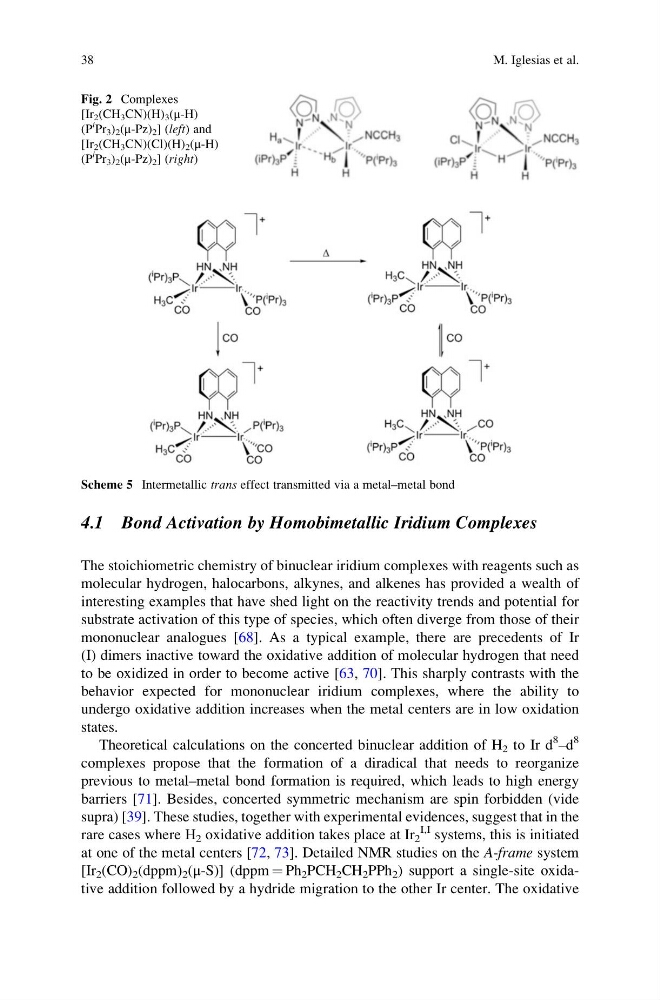
Fig. 2 Complexes
[Ir 2 (CH 3 CN)(H) 3 (μ-H)
(P
i Pr 3 ) 2 (μ-Pz) 2 ] (left) and
[Ir 2 (CH 3 CN)(Cl)(H) 2 (μ-H)
(P
i Pr 3 ) 2 (μ-Pz) 2 ] (right)
Scheme 5 Intermetallic trans effect transmitted via a metal–metal bond
38
M. Iglesias et al.
The stoichiometric chemistry of binuclear iridium complexes with reagents such as
molecular hydrogen, halocarbons, alkynes, and alkenes has provided a wealth of
interesting examples that have shed light on the reactivity trends and potential for
substrate activation of this type of species, which often diverge from those of their
mononuclear analogues [68]. As a typical example, there are precedents of Ir
(I) dimers inactive toward the oxidative addition of molecular hydrogen that need
to be oxidized in order to become active [63, 70]. This sharply contrasts with the
behavior expected for mononuclear iridium complexes, where the ability to
undergo oxidative addition increases when the metal centers are in low oxidation
states.
Theoretical calculations on the concerted binuclear addition of H 2 to Ir d
8 –d
8
complexes propose that the formation of a diradical that needs to reorganize
previous to metal–metal bond formation is required, which leads to high energy
barriers [71]. Besides, concerted symmetric mechanism are spin forbidden (vide
supra) [39]. These studies, together with experimental evidences, suggest that in the
rare cases where H 2 oxidative addition takes place at Ir 2
I,I systems, this is initiated
at one of the metal centers [72, 73]. Detailed NMR studies on the A-frame system
[Ir 2 (CO) 2 (dppm) 2 (μ-S)] (dppm ¼ Ph 2 PCH 2 CH 2 PPh 2 ) support a single-site oxidative addition followed by a hydride migration to the other Ir center. The oxidative
Fig. 2 Complexes
[Ir 2 (CH 3 CN)(H) 3 (μ-H)
(P
i Pr 3 ) 2 (μ-Pz) 2 ] (left) and
[Ir 2 (CH 3 CN)(Cl)(H) 2 (μ-H)
(P
i Pr 3 ) 2 (μ-Pz) 2 ] (right)
Scheme 5 Intermetallic trans effect transmitted via a metal–metal bond
38
M. Iglesias et al.