

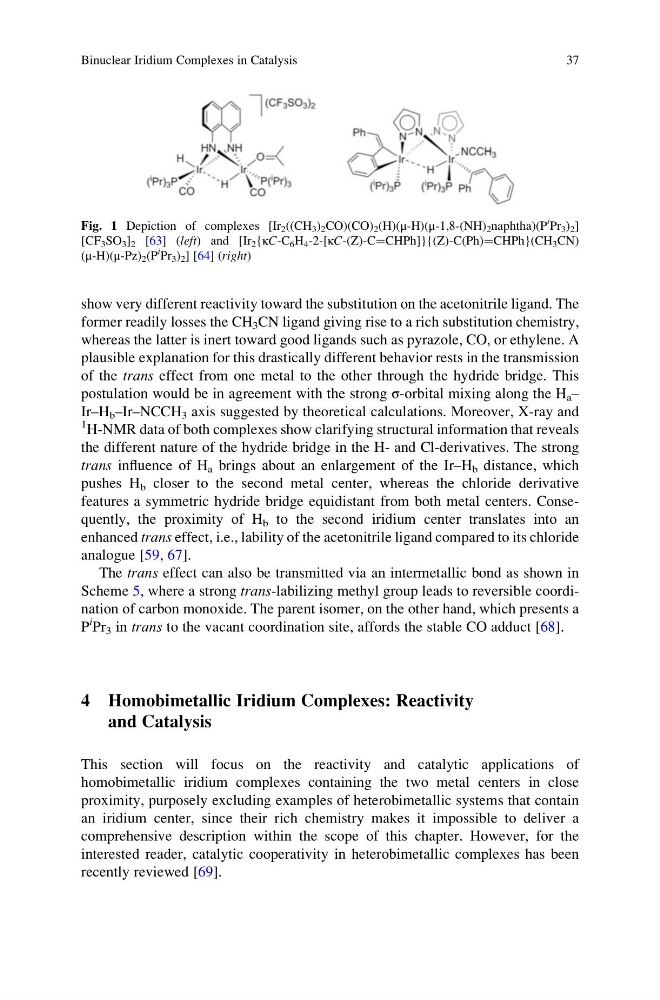
show very different reactivity toward the substitution on the acetonitrile ligand. The
former readily losses the CH 3 CN ligand giving rise to a rich substitution chemistry,
whereas the latter is inert toward good ligands such as pyrazole, CO, or ethylene. A
plausible explanation for this drastically different behavior rests in the transmission
of the trans effect from one metal to the other through the hydride bridge. This
postulation would be in agreement with the strong σ-orbital mixing along the H a –
Ir–H b –Ir–NCCH 3 axis suggested by theoretical calculations. Moreover, X-ray and
1 H-NMR data of both complexes show clarifying structural information that reveals
the different nature of the hydride bridge in the H- and Cl-derivatives. The strong
trans influence of H a brings about an enlargement of the Ir–H b distance, which
pushes H b closer to the second metal center, whereas the chloride derivative
features a symmetric hydride bridge equidistant from both metal centers. Consequently, the proximity of H b to the second iridium center translates into an
enhanced trans effect, i.e., lability of the acetonitrile ligand compared to its chloride
analogue [59, 67].
The trans effect can also be transmitted via an intermetallic bond as shown in
Scheme 5, where a strong trans-labilizing methyl group leads to reversible coordination of carbon monoxide. The parent isomer, on the other hand, which presents a
P
i
Pr 3 in trans to the vacant coordination site, affords the stable CO adduct [68].
4 Homobimetallic Iridium Complexes: Reactivity
and Catalysis
This section will focus on the reactivity and catalytic applications of
homobimetallic iridium complexes containing the two metal centers in close
proximity, purposely excluding examples of heterobimetallic systems that contain
an iridium center, since their rich chemistry makes it impossible to deliver a
comprehensive description within the scope of this chapter. However, for the
interested reader, catalytic cooperativity in heterobimetallic complexes has been
recently reviewed [69].
Fig. 1 Depiction of complexes [Ir 2 ((CH 3 ) 2 CO)(CO) 2 (H)(μ-H)(μ-1,8-(NH) 2 naphtha)(P
i Pr 3 ) 2 ]
[CF 3 SO 3 ] 2 [63] (left) and [Ir 2 {κC-C 6 H 4 -2-[κC-(Z)-C¼CHPh]}{(Z)-C(Ph)¼CHPh}(CH 3 CN)
(μ-H)(μ-Pz) 2 (P
i
Pr 3 ) 2 ] [64] (right)
Binuclear Iridium Complexes in Catalysis
37
former readily losses the CH 3 CN ligand giving rise to a rich substitution chemistry,
whereas the latter is inert toward good ligands such as pyrazole, CO, or ethylene. A
plausible explanation for this drastically different behavior rests in the transmission
of the trans effect from one metal to the other through the hydride bridge. This
postulation would be in agreement with the strong σ-orbital mixing along the H a –
Ir–H b –Ir–NCCH 3 axis suggested by theoretical calculations. Moreover, X-ray and
1 H-NMR data of both complexes show clarifying structural information that reveals
the different nature of the hydride bridge in the H- and Cl-derivatives. The strong
trans influence of H a brings about an enlargement of the Ir–H b distance, which
pushes H b closer to the second metal center, whereas the chloride derivative
features a symmetric hydride bridge equidistant from both metal centers. Consequently, the proximity of H b to the second iridium center translates into an
enhanced trans effect, i.e., lability of the acetonitrile ligand compared to its chloride
analogue [59, 67].
The trans effect can also be transmitted via an intermetallic bond as shown in
Scheme 5, where a strong trans-labilizing methyl group leads to reversible coordination of carbon monoxide. The parent isomer, on the other hand, which presents a
P
i
Pr 3 in trans to the vacant coordination site, affords the stable CO adduct [68].
4 Homobimetallic Iridium Complexes: Reactivity
and Catalysis
This section will focus on the reactivity and catalytic applications of
homobimetallic iridium complexes containing the two metal centers in close
proximity, purposely excluding examples of heterobimetallic systems that contain
an iridium center, since their rich chemistry makes it impossible to deliver a
comprehensive description within the scope of this chapter. However, for the
interested reader, catalytic cooperativity in heterobimetallic complexes has been
recently reviewed [69].
Fig. 1 Depiction of complexes [Ir 2 ((CH 3 ) 2 CO)(CO) 2 (H)(μ-H)(μ-1,8-(NH) 2 naphtha)(P
i Pr 3 ) 2 ]
[CF 3 SO 3 ] 2 [63] (left) and [Ir 2 {κC-C 6 H 4 -2-[κC-(Z)-C¼CHPh]}{(Z)-C(Ph)¼CHPh}(CH 3 CN)
(μ-H)(μ-Pz) 2 (P
i
Pr 3 ) 2 ] [64] (right)
Binuclear Iridium Complexes in Catalysis
37