

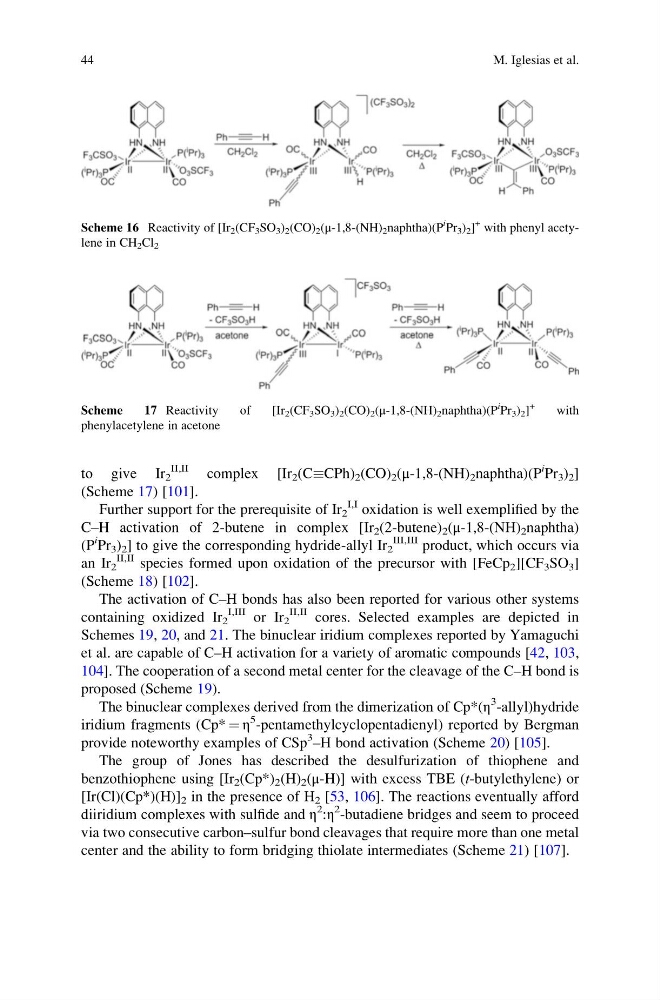
to give Ir 2
II,II
complex [Ir 2 (CCPh) 2 (CO) 2 (μ-1,8-(NH) 2 naphtha)(P
i
Pr 3 ) 2 ]
(Scheme 17) [101].
Further support for the prerequisite of Ir 2
I,I oxidation is well exemplified by the
C–H activation of 2-butene in complex [Ir 2 (2-butene) 2 (μ-1,8-(NH) 2 naphtha)
(P
i
Pr 3 ) 2 ] to give the corresponding hydride-allyl Ir 2
III,III product, which occurs via
an Ir 2
II,II species formed upon oxidation of the precursor with [FeCp 2 ][CF 3 SO 3 ]
(Scheme 18) [102].
The activation of C–H bonds has also been reported for various other systems
containing oxidized Ir 2
I,III or Ir 2
II,II cores. Selected examples are depicted in
Schemes 19, 20, and 21. The binuclear iridium complexes reported by Yamaguchi
et al. are capable of C–H activation for a variety of aromatic compounds [42, 103,
104]. The cooperation of a second metal center for the cleavage of the C–H bond is
proposed (Scheme 19).
The binuclear complexes derived from the dimerization of Cp*(η
3 -allyl)hydride
iridium fragments (Cp* ¼ η
5 -pentamethylcyclopentadienyl) reported by Bergman
provide noteworthy examples of CSp
3 –H bond activation (Scheme 20) [105].
The group of Jones has described the desulfurization of thiophene and
benzothiophene using [Ir 2 (Cp*) 2 (H) 2 (μ-H)] with excess TBE (t-butylethylene) or
[Ir(Cl)(Cp*)(H)] 2 in the presence of H 2 [53, 106]. The reactions eventually afford
diiridium complexes with sulfide and η
2 :η
2 -butadiene bridges and seem to proceed
via two consecutive carbon–sulfur bond cleavages that require more than one metal
center and the ability to form bridging thiolate intermediates (Scheme 21) [107].
Scheme 16 Reactivity of [Ir 2 (CF 3 SO 3 ) 2 (CO) 2 (μ-1,8-(NH) 2 naphtha)(P
i Pr 3 ) 2 ]
+ with phenyl acetylene in CH 2 Cl 2
Scheme
17 Reactivity
of
[Ir 2 (CF 3 SO 3 ) 2 (CO) 2 (μ-1,8-(NH) 2 naphtha)(P
i
Pr 3 ) 2 ]
+
with
phenylacetylene in acetone
44
M. Iglesias et al.
II,II
complex [Ir 2 (CCPh) 2 (CO) 2 (μ-1,8-(NH) 2 naphtha)(P
i
Pr 3 ) 2 ]
(Scheme 17) [101].
Further support for the prerequisite of Ir 2
I,I oxidation is well exemplified by the
C–H activation of 2-butene in complex [Ir 2 (2-butene) 2 (μ-1,8-(NH) 2 naphtha)
(P
i
Pr 3 ) 2 ] to give the corresponding hydride-allyl Ir 2
III,III product, which occurs via
an Ir 2
II,II species formed upon oxidation of the precursor with [FeCp 2 ][CF 3 SO 3 ]
(Scheme 18) [102].
The activation of C–H bonds has also been reported for various other systems
containing oxidized Ir 2
I,III or Ir 2
II,II cores. Selected examples are depicted in
Schemes 19, 20, and 21. The binuclear iridium complexes reported by Yamaguchi
et al. are capable of C–H activation for a variety of aromatic compounds [42, 103,
104]. The cooperation of a second metal center for the cleavage of the C–H bond is
proposed (Scheme 19).
The binuclear complexes derived from the dimerization of Cp*(η
3 -allyl)hydride
iridium fragments (Cp* ¼ η
5 -pentamethylcyclopentadienyl) reported by Bergman
provide noteworthy examples of CSp
3 –H bond activation (Scheme 20) [105].
The group of Jones has described the desulfurization of thiophene and
benzothiophene using [Ir 2 (Cp*) 2 (H) 2 (μ-H)] with excess TBE (t-butylethylene) or
[Ir(Cl)(Cp*)(H)] 2 in the presence of H 2 [53, 106]. The reactions eventually afford
diiridium complexes with sulfide and η
2 :η
2 -butadiene bridges and seem to proceed
via two consecutive carbon–sulfur bond cleavages that require more than one metal
center and the ability to form bridging thiolate intermediates (Scheme 21) [107].
Scheme 16 Reactivity of [Ir 2 (CF 3 SO 3 ) 2 (CO) 2 (μ-1,8-(NH) 2 naphtha)(P
i Pr 3 ) 2 ]
+ with phenyl acetylene in CH 2 Cl 2
Scheme
17 Reactivity
of
[Ir 2 (CF 3 SO 3 ) 2 (CO) 2 (μ-1,8-(NH) 2 naphtha)(P
i
Pr 3 ) 2 ]
+
with
phenylacetylene in acetone
44
M. Iglesias et al.