

When the rhodium and phosphorus atoms have partial positive charges, the electrostatic repulsion will work to weaken the Rh–P bonding. While this is probably not a
large effect, it does contribute to the Rh–P dissociation problem.
4 Hydroformylation in Water/Acetone: Formation
of a Monocationic Dirhodium Catalyst
The addition of 30% water by volume to the acetone solvent causes a dramatic
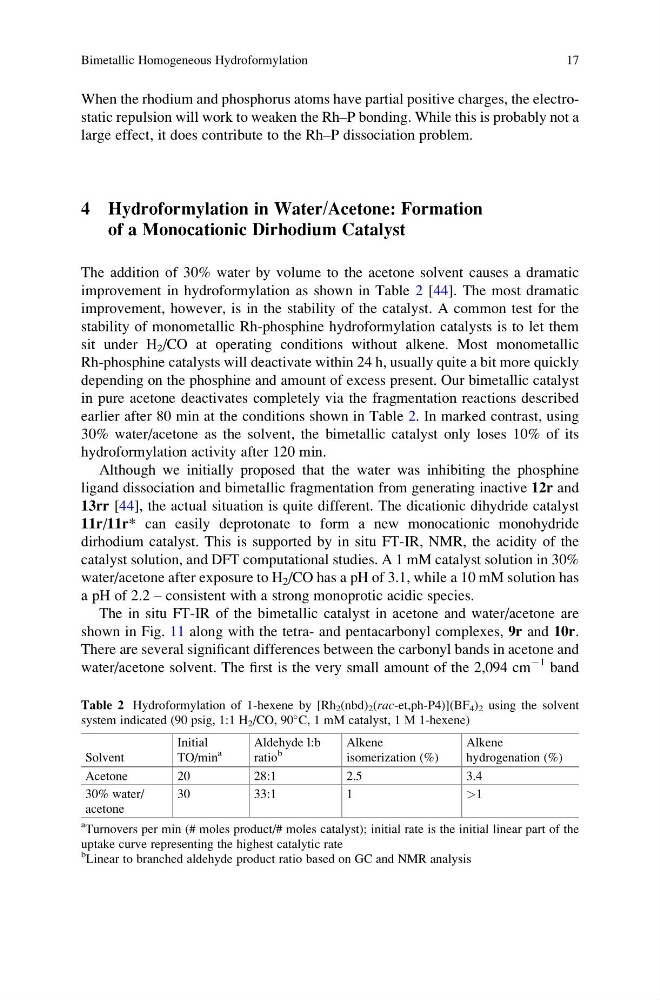
improvement in hydroformylation as shown in Table 2 [44]. The most dramatic
improvement, however, is in the stability of the catalyst. A common test for the
stability of monometallic Rh-phosphine hydroformylation catalysts is to let them
sit under H 2 /CO at operating conditions without alkene. Most monometallic
Rh-phosphine catalysts will deactivate within 24 h, usually quite a bit more quickly
depending on the phosphine and amount of excess present. Our bimetallic catalyst
in pure acetone deactivates completely via the fragmentation reactions described
earlier after 80 min at the conditions shown in Table 2. In marked contrast, using
30% water/acetone as the solvent, the bimetallic catalyst only loses 10% of its
hydroformylation activity after 120 min.
Although we initially proposed that the water was inhibiting the phosphine
ligand dissociation and bimetallic fragmentation from generating inactive 12r and
13rr [44], the actual situation is quite different. The dicationic dihydride catalyst
11r/11r* can easily deprotonate to form a new monocationic monohydride
dirhodium catalyst. This is supported by in situ FT-IR, NMR, the acidity of the
catalyst solution, and DFT computational studies. A 1 mM catalyst solution in 30%
water/acetone after exposure to H 2 /CO has a pH of 3.1, while a 10 mM solution has
a pH of 2.2 – consistent with a strong monoprotic acidic species.
The in situ FT-IR of the bimetallic catalyst in acetone and water/acetone are
shown in Fig. 11 along with the tetra- and pentacarbonyl complexes, 9r and 10r.
There are several significant differences between the carbonyl bands in acetone and
water/acetone solvent. The first is the very small amount of the 2,094 cm
À1 band
Table 2 Hydroformylation of 1-hexene by [Rh 2 (nbd) 2 (rac-et,ph-P4)](BF 4 ) 2 using the solvent
system indicated (90 psig, 1:1 H 2 /CO, 90
C, 1 mM catalyst, 1 M 1-hexene)
Solvent
Initial
TO/min
a
Aldehyde l:b
ratio
b
Alkene
isomerization (%)
Alkene
hydrogenation (%)
Acetone
20
28:1
2.5
3.4
30% water/
acetone
30
33:1
1
>1
a
Turnovers per min (# moles product/# moles catalyst); initial rate is the initial linear part of the
uptake curve representing the highest catalytic rate
b
Linear to branched aldehyde product ratio based on GC and NMR analysis
Bimetallic Homogeneous Hydroformylation
17
large effect, it does contribute to the Rh–P dissociation problem.
4 Hydroformylation in Water/Acetone: Formation
of a Monocationic Dirhodium Catalyst
The addition of 30% water by volume to the acetone solvent causes a dramatic
improvement in hydroformylation as shown in Table 2 [44]. The most dramatic
improvement, however, is in the stability of the catalyst. A common test for the
stability of monometallic Rh-phosphine hydroformylation catalysts is to let them
sit under H 2 /CO at operating conditions without alkene. Most monometallic
Rh-phosphine catalysts will deactivate within 24 h, usually quite a bit more quickly
depending on the phosphine and amount of excess present. Our bimetallic catalyst
in pure acetone deactivates completely via the fragmentation reactions described
earlier after 80 min at the conditions shown in Table 2. In marked contrast, using
30% water/acetone as the solvent, the bimetallic catalyst only loses 10% of its
hydroformylation activity after 120 min.
Although we initially proposed that the water was inhibiting the phosphine
ligand dissociation and bimetallic fragmentation from generating inactive 12r and
13rr [44], the actual situation is quite different. The dicationic dihydride catalyst
11r/11r* can easily deprotonate to form a new monocationic monohydride
dirhodium catalyst. This is supported by in situ FT-IR, NMR, the acidity of the
catalyst solution, and DFT computational studies. A 1 mM catalyst solution in 30%
water/acetone after exposure to H 2 /CO has a pH of 3.1, while a 10 mM solution has
a pH of 2.2 – consistent with a strong monoprotic acidic species.
The in situ FT-IR of the bimetallic catalyst in acetone and water/acetone are
shown in Fig. 11 along with the tetra- and pentacarbonyl complexes, 9r and 10r.
There are several significant differences between the carbonyl bands in acetone and
water/acetone solvent. The first is the very small amount of the 2,094 cm
À1 band
Table 2 Hydroformylation of 1-hexene by [Rh 2 (nbd) 2 (rac-et,ph-P4)](BF 4 ) 2 using the solvent
system indicated (90 psig, 1:1 H 2 /CO, 90
C, 1 mM catalyst, 1 M 1-hexene)
Solvent
Initial
TO/min
a
Aldehyde l:b
ratio
b
Alkene
isomerization (%)
Alkene
hydrogenation (%)
Acetone
20
28:1
2.5
3.4
30% water/
acetone
30
33:1
1
>1
a
Turnovers per min (# moles product/# moles catalyst); initial rate is the initial linear part of the
uptake curve representing the highest catalytic rate
b
Linear to branched aldehyde product ratio based on GC and NMR analysis
Bimetallic Homogeneous Hydroformylation
17