

the primary product is the inert 18e- monometallic product 12r. In our higherconcentration NMR tube studies (Figs. 4 and 5), G can also dimerize to form 13rr.
There are two electronic factors that favor phosphine dissociation. The first is
that while there are many examples of metal-metal-bonded dinuclear Rh(+2)
compounds ([34] and references therein), edge-sharing bioctahedral structures are
quite rare. The two most closely related dinuclear Rh(+2) oxidation state complexes
are Cotton’s [Rh 2 (μ-CO)(μ-Cl)Cl 2 (dppm) 2 (MeOH)]
+
, which has been structurally
characterized and needs one additional terminal ligand to reach full edge-sharing
bioctahedral coordination geometry[35–37], and Bianchini’s [Rh 2 H 2 (μ-H) 2 (tripod) 2 ] (tripod ¼ MeC(CH 2 PPh 2 ) 3 ) that has been proposed to have a full
edge-sharing bioctahedral structure, but for which there is scant spectroscopic or
structural data [38]. There are also several examples of Rh(+2) complexes with one
or three bridging hydrides [39–41]. [Rh 2 (μ-H) 3 (H)(PR 3 ) 4 ] (R ¼ O-iPr and iPr)
complexes have been characterized, but both have been assigned as mixed valent
Rh(+1)/Rh(+3) compounds [42, 43]. It is important to note that none of these other
Rh(+2), or mixed valent, hydride complexes have been demonstrated to be efficient
hydroformylation catalysts.
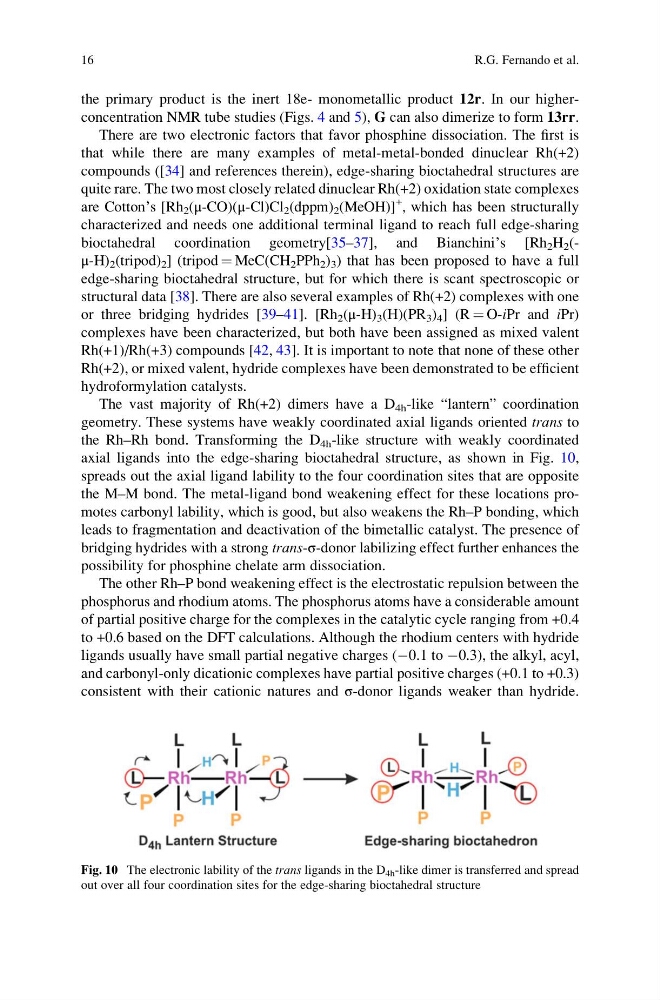
The vast majority of Rh(+2) dimers have a D 4h -like “lantern” coordination
geometry. These systems have weakly coordinated axial ligands oriented trans to
the Rh–Rh bond. Transforming the D 4h -like structure with weakly coordinated
axial ligands into the edge-sharing bioctahedral structure, as shown in Fig. 10,
spreads out the axial ligand lability to the four coordination sites that are opposite
the M–M bond. The metal-ligand bond weakening effect for these locations promotes carbonyl lability, which is good, but also weakens the Rh–P bonding, which
leads to fragmentation and deactivation of the bimetallic catalyst. The presence of
bridging hydrides with a strong trans-σ-donor labilizing effect further enhances the
possibility for phosphine chelate arm dissociation.
The other Rh–P bond weakening effect is the electrostatic repulsion between the
phosphorus and rhodium atoms. The phosphorus atoms have a considerable amount
of partial positive charge for the complexes in the catalytic cycle ranging from +0.4
to +0.6 based on the DFT calculations. Although the rhodium centers with hydride
ligands usually have small partial negative charges (À0.1 to À0.3), the alkyl, acyl,
and carbonyl-only dicationic complexes have partial positive charges (+0.1 to +0.3)
consistent with their cationic natures and σ-donor ligands weaker than hydride.
Fig. 10 The electronic lability of the trans ligands in the D 4h -like dimer is transferred and spread
out over all four coordination sites for the edge-sharing bioctahedral structure
16
R.G. Fernando et al.
There are two electronic factors that favor phosphine dissociation. The first is
that while there are many examples of metal-metal-bonded dinuclear Rh(+2)
compounds ([34] and references therein), edge-sharing bioctahedral structures are
quite rare. The two most closely related dinuclear Rh(+2) oxidation state complexes
are Cotton’s [Rh 2 (μ-CO)(μ-Cl)Cl 2 (dppm) 2 (MeOH)]
+
, which has been structurally
characterized and needs one additional terminal ligand to reach full edge-sharing
bioctahedral coordination geometry[35–37], and Bianchini’s [Rh 2 H 2 (μ-H) 2 (tripod) 2 ] (tripod ¼ MeC(CH 2 PPh 2 ) 3 ) that has been proposed to have a full
edge-sharing bioctahedral structure, but for which there is scant spectroscopic or
structural data [38]. There are also several examples of Rh(+2) complexes with one
or three bridging hydrides [39–41]. [Rh 2 (μ-H) 3 (H)(PR 3 ) 4 ] (R ¼ O-iPr and iPr)
complexes have been characterized, but both have been assigned as mixed valent
Rh(+1)/Rh(+3) compounds [42, 43]. It is important to note that none of these other
Rh(+2), or mixed valent, hydride complexes have been demonstrated to be efficient
hydroformylation catalysts.
The vast majority of Rh(+2) dimers have a D 4h -like “lantern” coordination
geometry. These systems have weakly coordinated axial ligands oriented trans to
the Rh–Rh bond. Transforming the D 4h -like structure with weakly coordinated
axial ligands into the edge-sharing bioctahedral structure, as shown in Fig. 10,
spreads out the axial ligand lability to the four coordination sites that are opposite
the M–M bond. The metal-ligand bond weakening effect for these locations promotes carbonyl lability, which is good, but also weakens the Rh–P bonding, which
leads to fragmentation and deactivation of the bimetallic catalyst. The presence of
bridging hydrides with a strong trans-σ-donor labilizing effect further enhances the
possibility for phosphine chelate arm dissociation.
The other Rh–P bond weakening effect is the electrostatic repulsion between the
phosphorus and rhodium atoms. The phosphorus atoms have a considerable amount
of partial positive charge for the complexes in the catalytic cycle ranging from +0.4
to +0.6 based on the DFT calculations. Although the rhodium centers with hydride
ligands usually have small partial negative charges (À0.1 to À0.3), the alkyl, acyl,
and carbonyl-only dicationic complexes have partial positive charges (+0.1 to +0.3)
consistent with their cationic natures and σ-donor ligands weaker than hydride.
Fig. 10 The electronic lability of the trans ligands in the D 4h -like dimer is transferred and spread
out over all four coordination sites for the edge-sharing bioctahedral structure
16
R.G. Fernando et al.